

Total Quality Management: 6 Essential Factors for Success
8 min read
Total Quality Management, commonly known as TQM, is a management approach designed to improve processes, product quality, operational efficiency, and customer satisfaction throughout an organisation. It helps businesses manage quality through quality management principles, quality management tools, quality assurance, quality control, and continuous improvement.
In a competitive business environment, companies must build quality into every process, department, supply chain activity, and customer interaction. Total quality management supports this by encouraging continuous quality improvement, employee involvement, leadership commitment, process improvement, risk management, and strong quality standards.
A quality management course can help professionals learn about quality management, understand quality management systems, explore quality assurance and quality control systems, and build skills applicable across industries. Whether learners are interested in manufacturing, software development, medical devices, service operations, or supply chain management, quality management training provides foundational knowledge and practical insights.
Successful TQM implementation requires planning, leadership, training, resources, and a clear understanding of quality management principles. When implemented correctly, total quality management can help an organisation improve processes, reduce costs, strengthen performance, meet regulatory compliance requirements, and succeed in the real world.
Key Takeaways
- Successful TQM implementation depends on management commitment, customer focus, employee involvement, training, communication, and organisational culture.
- A quality management course helps professionals gain knowledge of quality assurance, quality control, ISO standards, lean principles, six sigma methodologies, and risk management.
- Quality management systems help businesses improve processes, control performance, meet regulatory compliance, and increase operational efficiency.
- Continuous quality improvement supports better product quality, stronger service delivery, and long-term business performance.
- Quality management tools, statistical methods, Lean Six Sigma, and process improvement techniques help organisations identify problems and improve processes.
- Quality management training supports professional development, certification, career growth, and preparation for a quality assurance position.
What Is Total Quality Management?
Total Quality Management is a management approach that improves quality across all parts of an organisation. It is not limited to inspection or final product checks. Instead, TQM applies to leadership, employees, processes, customer service, suppliers, quality assurance, quality control, and company culture.
The primary goal of TQM is to improve customer satisfaction through ongoing improvement. Total Quality Management encourages everyone in the company to take responsibility for quality, including senior managers, supervisors, employees, suppliers, and service teams.
TQM also helps businesses improve process performance by identifying errors early, reducing waste, improving communication, and using quality management tools such as flowcharts, check sheets, root cause analysis, control charts, Pareto analysis, statistical methods, and risk assessment techniques.
Why Quality Management Matters
Quality management matters because poor quality can increase cost, reduce customer trust, create waste, weaken product quality, damage reputation, and affect regulatory compliance. A strong quality management system helps organisations prevent problems before they become serious.
Quality management is important in different industries, including manufacturing, healthcare, medical devices, construction, software development, logistics, education, hospitality, and professional services.
Successful quality management helps organisations improve customer satisfaction, reduce defects, optimise processes, enhance operational efficiency, support regulatory compliance, improve supply chain performance, build employee skills, reduce costs and waste, and support long-term success.
For professionals, learning quality management can support career development. A certificate or certification in quality management can help learners prepare for roles in quality assurance, quality control, process improvement, risk management, or operations management.
TQM Implementation at a Glance
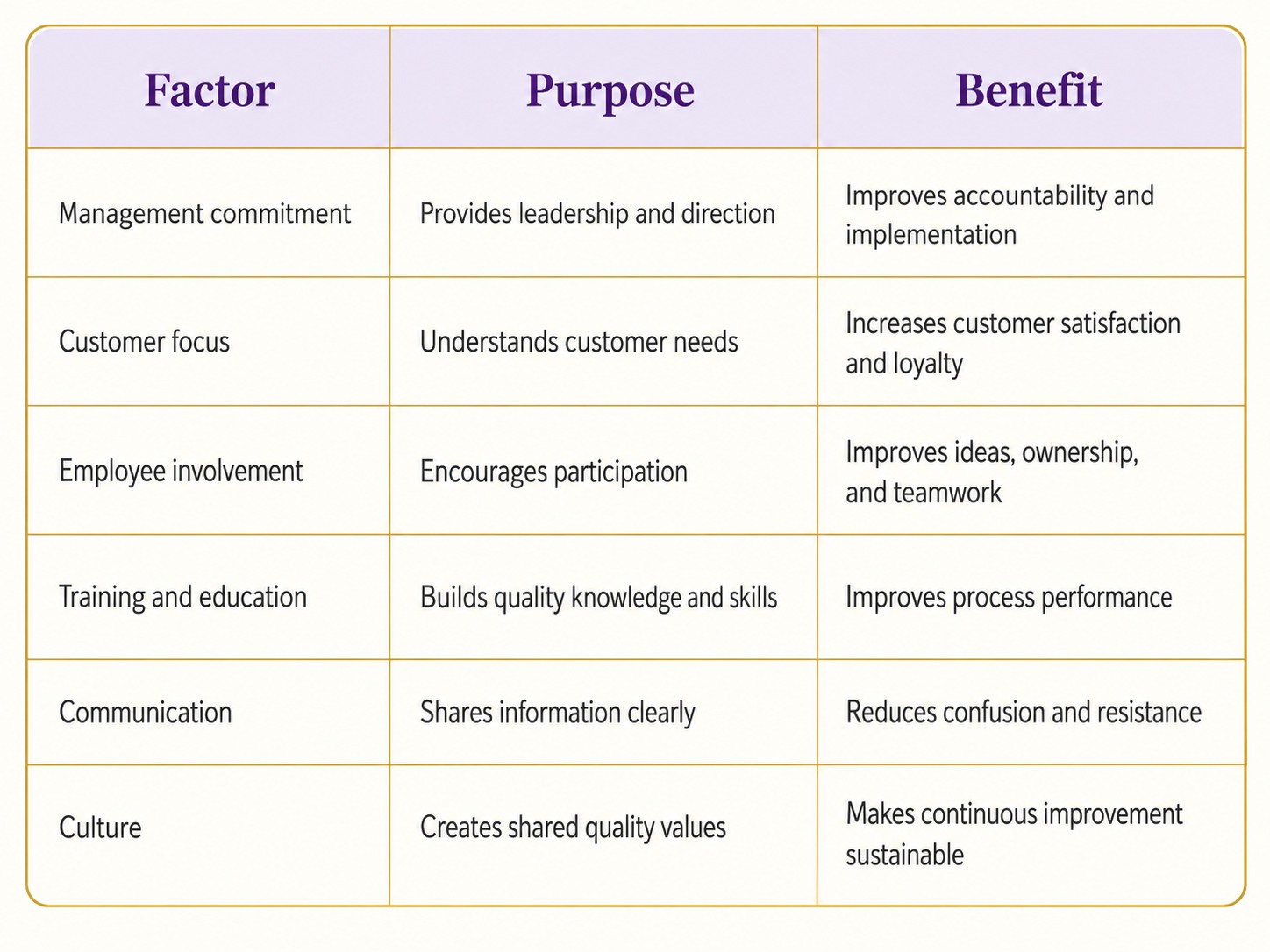
6 Essential Factors for Successful TQM Implementation
Successful Total Quality Management depends on more than systems and processes; it requires strong leadership, customer focus, employee participation, training, communication, and a supportive organisational culture.
These key factors help organisations build a quality-driven environment where continuous improvement becomes part of everyday business practice.
1. Management Commitment and Understanding
Management commitment is one of the most important factors in successful total quality management. Leaders must understand quality management principles and communicate them clearly across the organisation.
Employees need to know the company’s goals, quality standards, priorities, processes, expectations, and reasons behind quality improvement activities. When workers understand the company’s vision and align with management’s direction, quality improvement becomes easier.
If the vision is unclear, employees may not fully commit to TQM. Quality policies may also fail if management does not actively support them. Leaders must provide resources, training, direction, and accountability.
Strong management commitment includes clear quality policies, leadership support, employee guidance, quality planning, risk management, regulatory compliance, and continuous improvement.
2. Customer Focus
Customer focus is central to total quality management. A customer-focused organisation works continuously to understand and satisfy customer requirements.
Every decision should consider customer satisfaction, expectations, complaints, preferences, and service quality. This includes external customers who buy products or services, as well as internal customers, such as employees and departments that depend on one another.
Customer focus helps companies understand design preferences, service expectations, quality standards, and buying behaviour. Customer feedback can also support product, software, supply chain, and service development.
A strong customer focus includes listening to feedback, measuring satisfaction, responding to complaints, improving product quality, strengthening service quality, and building long-term relationships.
3. Employee Involvement and Participation
TQM requires committed, skilled employees who can fully participate in quality improvement activities. A company should encourage employees at all levels to take responsibility for managing quality.
Managers and supervisors should recognise that employees often have practical insights because they work closely with daily processes, customers, tools, equipment, and workplace problems. When employees share ideas, organisations can identify real opportunities for process improvement.
Employees can also be seen as internal customers. If they are respected, trained, and supported, they are more likely to satisfy external customers.
Employee involvement includes teamwork, suggestions, problem solving, responsibility, empowerment, recognition, communication, and trust.
4. Training and Education
Training and education are essential for successful TQM implementation. Employee empowerment is not effective if workers do not understand quality management systems, quality control systems, quality assurance, process improvement, or quality standards.
A formal quality management course can help learners gain foundational knowledge of quality management principles, lean principles, lean six sigma, six sigma methodologies, ISO standards, statistical methods, quality control, and risk management.
Training should not be limited to managers. Everyone in the organisation, from senior leadership to frontline employees, should receive relevant quality management training.
Course content may include quality assurance, quality control, continuous improvement, process performance, quality management tools, regulatory compliance, supply chain quality, and customer satisfaction.
An online course can be useful for busy professionals who want to learn quality management while balancing work and career goals.
5. Communication
Communication is another essential factor in TQM implementation. Good communication makes quality management more approachable and reduces fear, confusion, and resistance.
Without clear communication, employees may misunderstand quality goals, policies, responsibilities, or improvement plans. Effective communication includes direct communication between employees and supervisors, face-to-face interaction, feedback systems, regular updates, and clear explanations of quality management principles.
Good communication helps organisations share quality objectives, explain changes, collect employee feedback, improve teamwork, solve problems faster, and build trust.
TQM requires communication in every direction: top-down, bottom-up, and across departments.
6. Organisational Culture
In TQM, culture is important because continuous quality improvement depends on how people behave every day. A strong TQM culture is cooperative, open, responsible, and improvement-focused. Employees should feel respected and involved in the organisation’s vision, processes, quality standards, and improvement plans.
Culture affects how employees conduct business, interact with each other, solve workplace problems, and treat customers. If management ignores quality standards, employees are unlikely to take total quality management seriously.
A strong TQM culture includes openness, cooperation, trust, responsibility, respect, shared vision, employee involvement, quality assurance, quality control, and continuous improvement.
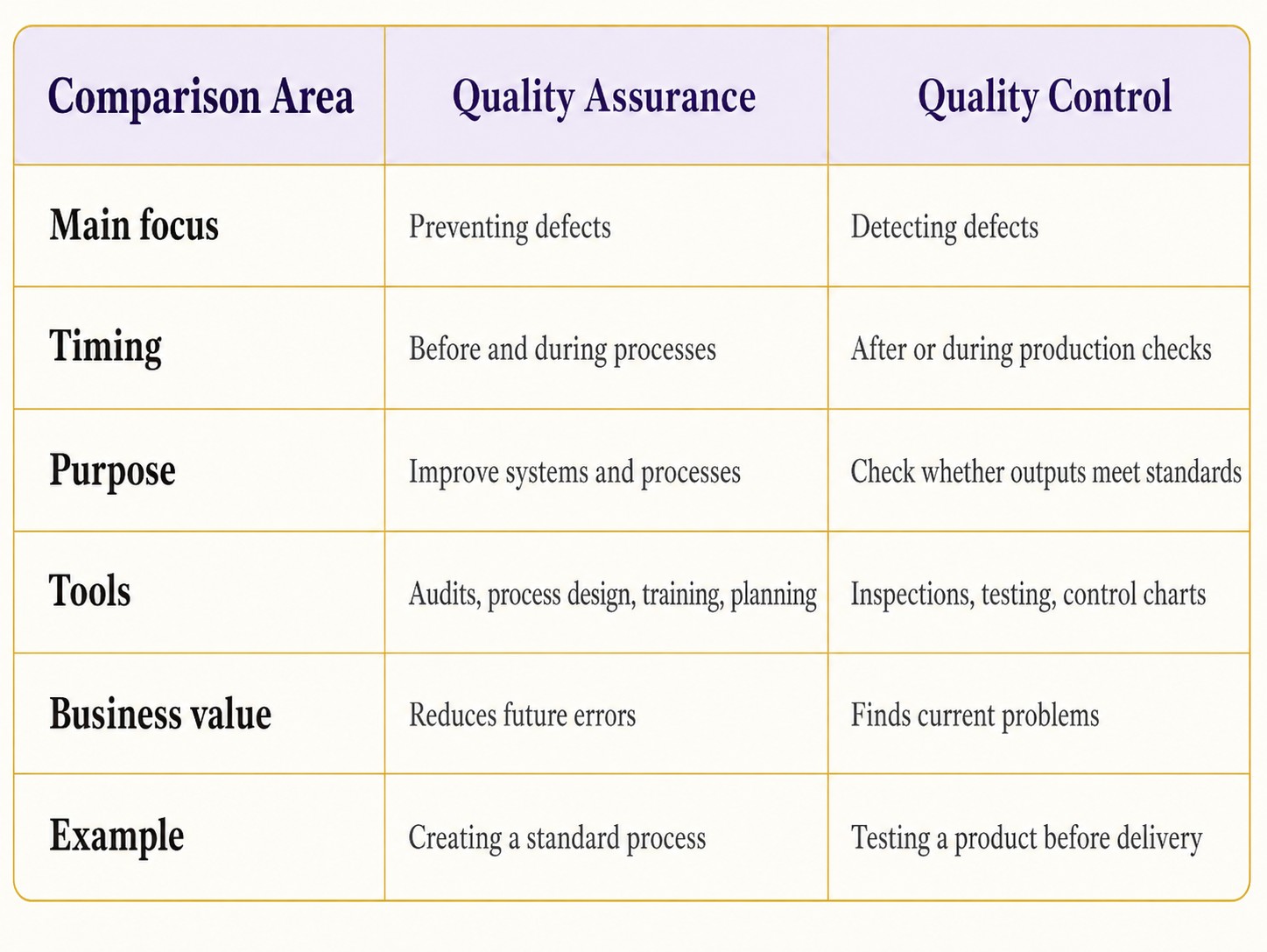
Comparison Table: Quality Assurance vs Quality Control
Key differences between quality assurance and quality control.
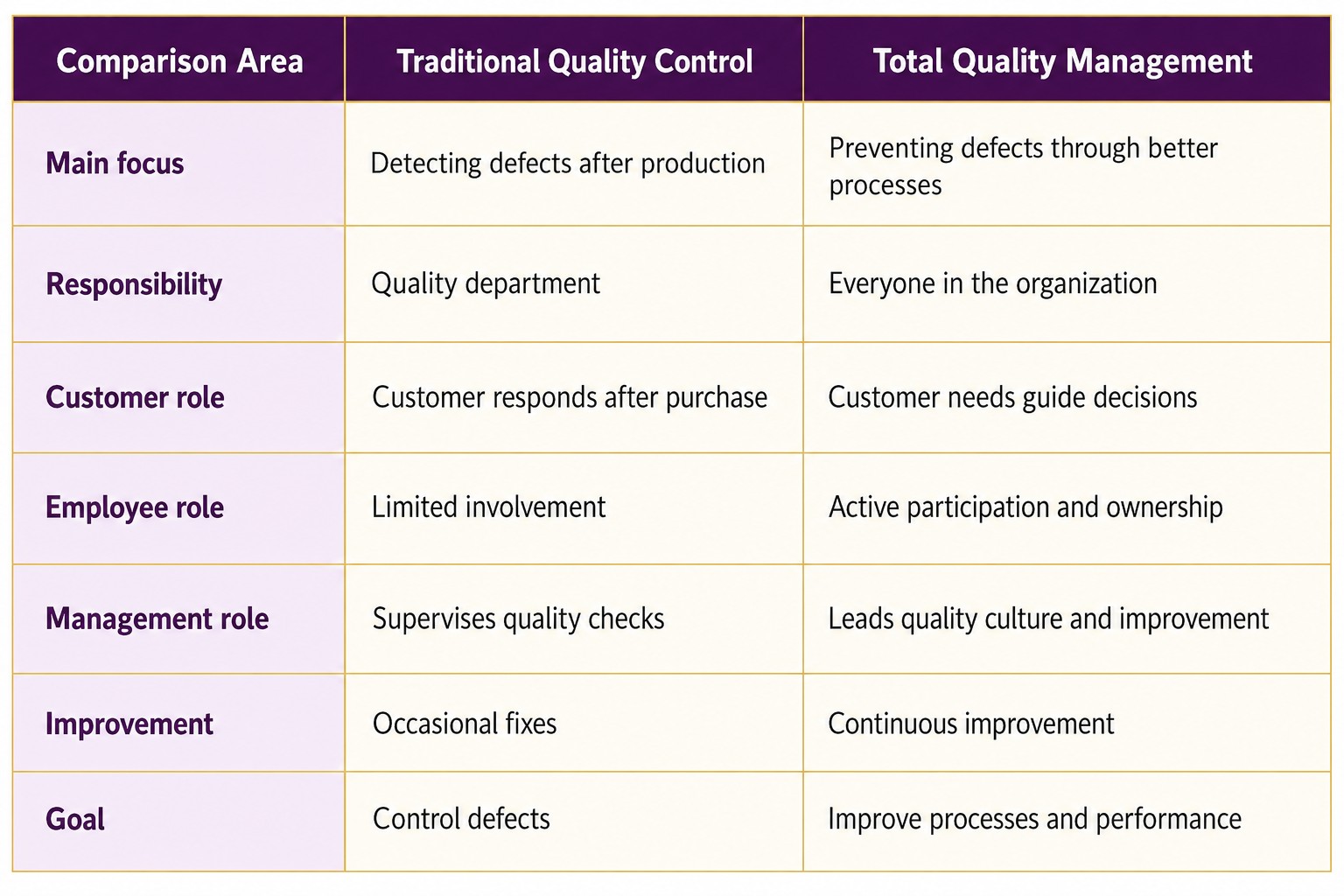
Comparison Table: Traditional Quality Control vs Total Quality Management
Quality Management Tools and Methods
Quality management tools help organisations understand problems, control processes, and improve performance. These tools give teams practical ways to measure quality, identify causes, and track improvement.
Common quality management tools and methods include flowcharts, check sheets, Pareto charts, root cause analysis, control charts, fishbone diagrams, statistical methods, risk assessment, lean principles, lean six sigma, six sigma methodologies, and process mapping.
These tools support continuous improvement by helping businesses make decisions based on data rather than assumptions.
How Quality Management Courses Support Professional Development
A quality management course can help professionals build skills and gain knowledge for different industries. These courses are useful for learners interested in quality assurance, quality control, process improvement, risk management, regulatory compliance, supply chain quality, software development, medical devices, and operations management.
A good learning experience should provide practical insights, real-world examples, useful course content, and tools that can be applied in the workplace.
Quality management courses may help professionals learn quality management principles, understand quality management systems, explore quality assurance and quality control, use quality management tools, apply lean principles and six sigma methodologies, improve processes, support regulatory compliance, prepare for certification or an exam, and gain confidence for a quality assurance position.
How Companies Can Improve TQM Implementation
1. Start With Clear Leadership
Senior management should explain the purpose of TQM and connect it to business goals. Employees need to see that quality is a serious priority.
2. Understand Customer Requirements
Organisations should collect feedback, study complaints, analyse customer expectations, and use customer data to improve products and services.
3. Involve Employees Early
Employees should be included in quality discussions, improvement plans, and problem-solving activities.
4. Provide Regular Training
Training should be continuous, practical, and relevant to each employee’s role. Quality management courses can help employees and managers develop the right skills.
5. Use Quality Management Tools
Companies should use tools and techniques such as root cause analysis, statistical methods, Lean Six Sigma, process mapping, and control charts.
6. Build Strong Feedback Systems
Feedback systems allow employees and customers to share problems, ideas, and opportunities for improvement.
7. Strengthen Quality Culture
TQM should become part of everyday behaviour. Organisations should reward teamwork, responsibility, ethical behaviour, and continuous improvement.
Conclusion
Successful TQM implementation depends on more than written policies. It requires strong leadership, customer focus, employee involvement, training, communication, quality management systems, and a supportive organisational culture.
Management must lead the process by clearly articulating quality goals, providing resources, supporting employees, and demonstrating a commitment to continuous improvement. Customers must remain central to every decision because customer satisfaction determines long-term business success.
Employees should also be involved at every level. When workers understand TQM, receive proper training, and feel respected, they are more likely to support process improvement.
Communication, culture, quality assurance, quality control, and quality management tools make TQM sustainable. Clear communication reduces confusion, while a strong quality culture helps employees work toward shared goals.
For professionals, a quality management course can support professional development, career growth, and preparation for a quality assurance position. It can also help learners gain practical knowledge, build skills, and understand real-world quality management examples.
In the end, Total Quality Management helps companies improve product quality, service quality, operational efficiency, customer satisfaction, and competitiveness.
Frequently Asked Questions (FAQs)
1. What is Total Quality Management?
Total Quality Management is a company-wide approach that promotes customer satisfaction, employee participation, process improvement, quality assurance, quality control, and continuous improvement.
2. Why is quality management important?
Quality management helps organisations improve product quality, reduce errors, control costs, meet quality standards, support regulatory compliance, and improve customer satisfaction.
3. What are the main factors for successful TQM implementation?
The main factors are management commitment, customer focus, employee involvement, training and education, communication, and organisational culture.
4. What does a quality management course cover?
A quality management course may cover quality management systems, quality management principles, quality assurance, quality control, ISO standards, lean principles, six sigma methodologies, risk management, process improvement, and customer satisfaction.
5. Who should take a quality management course?
A quality management course is useful for managers, quality professionals, operations staff, supply chain professionals, software development teams, medical device professionals, and learners interested in a quality assurance position.