

Employee Life Cycle: Attract, Recruit, Onboard, and Develop Top Talent
9 min read
Most organisations invest significant resources in attracting and hiring people. Far fewer apply the same discipline to what happens before a vacancy is advertised, after an offer is accepted, or throughout the full employee journey. That is where talent quietly slips away, performance begins to weaken, and the real costs of turnover start to rise.
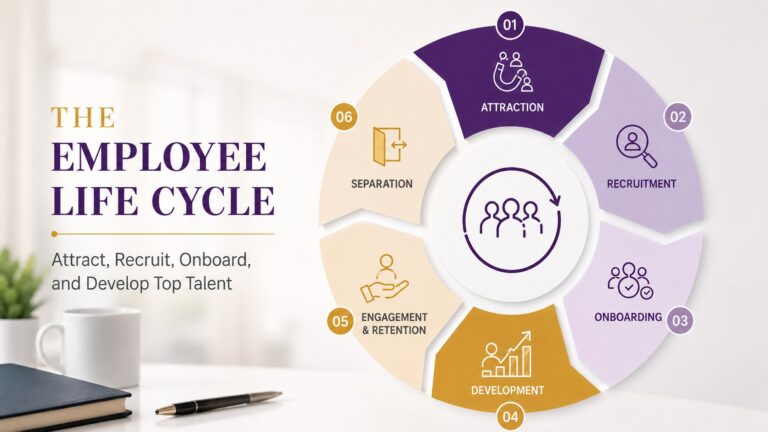
The employee life cycle offers a more complete way to think about people strategy. It maps the full path an employee takes within an organisation, from first contact with the employer brand to exit and whatever follows. Each stage shapes the next. Decisions made early in the employee lifecycle shape long-term outcomes in productivity, retention, employee engagement, and organisational capability.
Organisations that manage the employee life cycle intentionally tend to build stronger teams, create a better employee experience, and retain top talent more effectively. This article explains the six stages of the employee lifecycle, why it is important to long-term organisational performance, and how recruitment training, recruitment training courses, and sharper people practices can drive better results across every stage of the model.
Key Takeaways
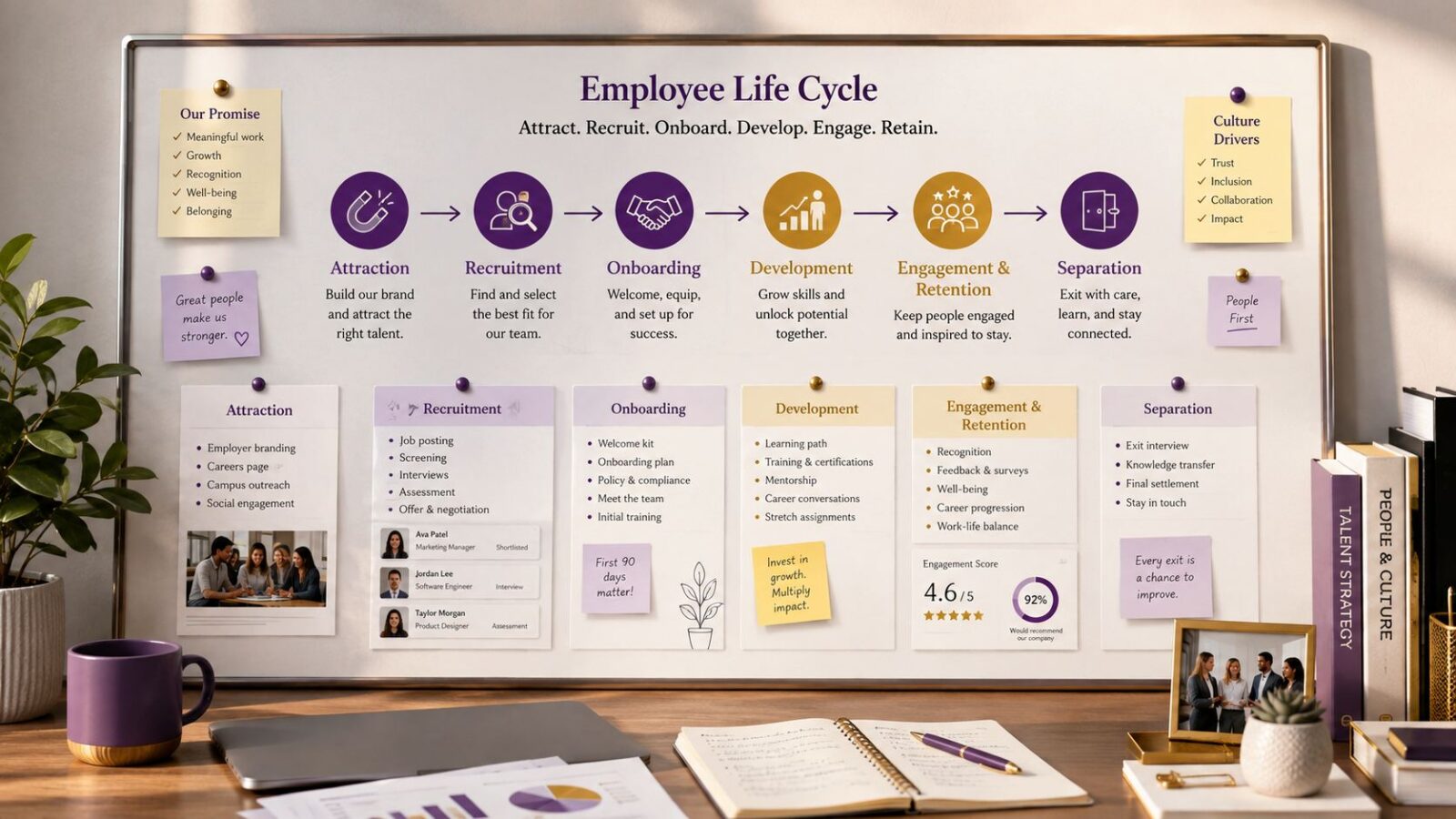
- The employee life cycle includes six stages: Attraction, Recruitment, Onboarding, Development, Engagement and Retention, and Separation.
- Better recruitment, onboarding, and performance management improve retention over time.
- Hiring managers, recruiters, and the HR team all influence the employee journey.
- Stronger recruitment training helps organisations improve selection quality, candidate experience, and long-term retention.
- A well-managed exit process can generate valuable insights that improve earlier stages of the lifecycle.
What the Employee Lifecycle Means in Practice
A strategic view of the employee journey
The employee lifecycle is more than an HR checklist. It is a strategic framework that helps companies understand how employees enter, experience, grow within, and eventually leave the business. It gives leaders, recruiters, and human resources professionals a shared way to assess how workforce decisions cumulatively affect the workforce over time.
Each stage has different goals, activities, and outcomes. Together, those stages shape the overall employee experience. When organisations manage them as a connected system rather than isolated events, they improve stability and performance and reduce turnover.
Why the employee life cycle is important
The employee life cycle is important because it connects people’s decisions to business outcomes. Who you attract, how you hire, how you onboard, and how you develop people all affect whether employees perform well and stay. The model helps companies move beyond reactive hiring and toward a more deliberate approach to talent management.
It also shows where capability gaps begin. For example, weak recruitment skills, inconsistent hiring managers, or a poor selection process can create problems that surface months later as disengagement, underperformance, or attrition.
Stage One: Attraction
Why attraction matters
Before potential candidates apply, they have already formed impressions of the organisation. Your employer brand, website, job descriptions, digital presence, and market reputation all influence the kind of talent you attract. Attraction is therefore not just a marketing exercise. It is part of talent acquisition.
A strong employer value proposition helps companies communicate why the role matters, what the culture feels like, and the career opportunities available. This matters because attracting the right talent improves the rest of the recruitment process.
What a good attraction looks like
Strong attraction depends on authenticity, clarity, and reach. That means describing the role honestly, clearly defining expectations, and using the right channels for candidate sourcing. The goal is not simply to generate more applicants. It is to attract stronger candidates with the right skills, motivation, and cultural fit.
For many organisations, this is also where recruitment training starts to matter. Recruiters and hiring managers need the necessary skills to write better job descriptions, position the role properly, and create a positive early candidate experience. Well-designed recruitment courses can help recruitment professionals strengthen these practices.
Stage Two: Recruitment
Recruitment is about selecting quality.
The purpose of recruitment is not simply to fill vacancies. It is to identify candidates who are most likely to perform well, contribute to the team, and remain with the organisation over time. That requires a structured hiring process, not just instinct.
Effective recruitment supports talent acquisition, strengthens workforce quality, and improves long-term results across the employee life cycle. Poor hiring decisions, by contrast, affect onboarding, performance, team confidence, and costs.
What does effective recruitment look like?
Effective recruitment starts with a clear role definition and a strong selection process. It then moves through structured interviews, fair assessment methods, and consistent decision-making. The stronger the structure, the more reliable the result.
This is where hiring managers, recruiters, and the wider HR team need to be aligned. When they use agreed criteria and focus on job-relevant evidence, they make better decisions and improve candidate experience at the same time.
Strong recruitment training helps organisations build this capability. It gives recruiters and managers better recruitment skills, sharper interviewing approaches, and more consistent decision-making.
Why does recruitment training matter?
Many managers are expected to interview and assess candidates without formal preparation. That often leads to inconsistency, bias, and weak hiring decisions. Recruitment training courses can improve structured interviewing, decision quality, and communication with candidates.
For organisations investing in recruiting, this matters greatly. Better recruitment training supports stronger talent acquisition, more confident hiring managers, and better alignment between recruiters and the business. Whether delivered through workshops, internal training, or selected online courses, the aim is the same: improve the quality of every hire.
LBTC recruitment courses combine practical exercises, structured learning paths, and scenario-based activities to help recruiters build skills faster and apply them more effectively. The real value of this approach lies in its ability to strengthen judgment in real hiring situations, where sound decisions directly impact recruitment quality.
Stage Three: Onboarding
Why does onboarding have a long-term effect?
Onboarding is the bridge between recruitment and performance. It shapes how quickly new employees become productive, how well they understand the culture, and whether they feel confident about joining the organisation. A strong hire can still turn out poorly if onboarding is poor.
This stage is especially important because it transforms expectation into lived experience. Attraction and recruitment may create interest, but onboarding determines whether employees feel supported, welcomed, and equipped to succeed.
What does strong onboarding include?
Good onboarding goes beyond orientation. It includes role clarity, manager support, practical guidance, and team integration. New employees need to understand what success looks like, who they rely on, and how work gets done.
Organisations that do this well usually see better early progress, stronger employee engagement, and a more positive employee experience. They also reduce the risk of early exits caused by confusion, weak support, or poor fit.
In hybrid and remote settings, this stage needs even more structure. Scheduled check-ins, clear communication, and social connection all matter. If the organisation wants employees to engage, it must make those early connections intentional.
Stage Four: Development
Why does development matter?
Development is one of the strongest drivers of retention and capability. People want to know they are growing, building knowledge, and making progress in their careers. When that sense of growth is missing, motivation declines.
This is why development should not be treated as an occasional event. It is an ongoing part of the employee journey. Organisations that invest in learning, coaching, and role-based growth create stronger capability over time and improve their chances of retaining top talent.
What does effective development look like?
Effective development combines formal training, applied learning, coaching, and feedback. It should help people build relevant skills, gain practical confidence, and connect learning to real work. That is where good learning design matters.
Managers play a central role here. They help people identify the right learning paths, build new skills, and connect development to future opportunities. Without that support, even strong performers can lose momentum.
Role-specific learning can make a meaningful difference at this stage. Leadership courses, recruitment courses, and management training can all improve how people lead, select, coach, and develop others. When organisations build those capabilities well, they improve performance across multiple stages of the employee lifecycle.
Stage Five: Engagement and Retention
Why does retention begin earlier than it seems?
Retention is often treated as a problem to solve once people start leaving. In reality, it is built across the full employee life cycle. Expectations formed in attraction, fit established during recruitment, support provided during onboarding, and opportunities created through development all shape whether people remain committed.
Employee engagement is not separate from the earlier stages. It reflects the cumulative quality of the employee’s experience. Gallup’s latest data shows that global employee engagement has fallen to 21%, down two percentage points from the previous reading, suggesting that many organisations are still falling short in creating workplaces where people feel fully involved and connected.
What strengthens engagement?
Employees are more likely to stay when they understand expectations, receive useful feedback, feel genuinely supported by their managers, and believe their work matters. Strong company culture, visible growth opportunities, and credible engagement initiatives all contribute to this.
This makes managers extraordinarily influential. They shape the day-to-day reality of work. They create clarity, coach performance, recognise effort, and help people feel connected to the team. If organisations want to improve employee engagement, they need better people management, not just better slogans.
Supporting high-performing and low-performing employees
A strong retention strategy does not treat all employees the same. Different people need different forms of support.
High performers often drive innovation, delivery, and momentum. To retain this talent, organisations need to provide stretch opportunities, meaningful recognition, and room to grow. High performers are more likely to stay when they can see a future, take on critical roles, and continue to develop.
Low-performing employees should not automatically be written off. Underperformance often reflects skill gaps, unclear expectations, weak support, or poor role fit. A constructive response includes clearer goals, targeted training, coaching, and better performance management. When handled well, this creates fairness, accountability, and genuine process improvement.
Steady contributors matter too. They need consistency, recognition, and a sense of progress. Organisations that use a single blanket approach across the workforce often fail to retain top talent while doing too little to improve weaker performers.
Why does performance management matter?
Good performance management should be continuous, not limited to annual reviews. It should help strong people grow, help struggling people improve, and support fair standards across the workplace. Done well, it strengthens trust, builds capability, and supports long-term retention.
For companies serious about the employee lifecycle, engagement and retention should be measured through meaningful indicators such as development progress, internal mobility, employee feedback, and retention in key roles. These indicators help organisations understand what is working, where gaps are emerging, and which actions will strengthen retention over time.
Stage Six: Separation
Why is separation part of the lifecycle?
Separation is not outside the employee lifecycle. It is a natural stage within it. Employees leave for many reasons, including new opportunities, personal change, or organisational shifts. What matters is how the organisation handles the departure and what it learns from it.
What does good separation look like?
Well-managed separation includes respectful communication, structured offboarding, and honest exit conversations. It treats the departing employee professionally and uses the moment to gather valuable insights. Those insights can reveal recurring issues in management, development, hiring quality, or company culture. In that way, separation helps organisations improve earlier stages of the employee life cycle.
Handled well, this final stage can even strengthen the reputation. Former employees may refer future candidates, speak positively about the organisation, or return later with stronger experience.
Making the Employee Lifecycle Work as One Strategy
A common failure in the employee lifecycle is fragmentation. Attraction, recruitment, onboarding, development, and retention are often managed separately, with different priorities and different success measures. The result is a disconnected experience for employees.
A carefully selected hire who is poorly onboarded may quickly lose confidence. A capable employee with no clear growth path may disengage. A manager expected to build engagement without training or support will struggle to deliver.
That is why alignment matters. Leaders, recruiters, and managers need to understand their roles at every stage. The HR team supports this by creating clear systems, practical frameworks, and useful learning opportunities. Better recruitment training, stronger onboarding, and clearer management practices all contribute to a more effective system.
Organisations should also measure what matters. Metrics around hiring quality, onboarding effectiveness, engagement, retention, and internal development provide valuable insights that support better decisions over time.
Conclusion
The employee life cycle sits at the heart of how organisations perform. It is a practical framework for building stronger organisations. It helps companies think more clearly about how they attract, select, support, develop, and retain employees across every stage of the relationship.
It also shows where capability matters most. Better recruitment training, stronger recruitment skills, improved performance management, and more intentional support from hiring managers all influence workforce quality over time.
Organisations that manage the employee lifecycle with structure and intention are more likely to build capable, committed, and resilient teams. Those who leave it to chance usually pay the price in turnover, weaker performance, and the recurring cost of hiring again.
Frequently Asked Questions
1. What is the employee life cycle?
The employee life cycle describes the full path an employee takes with an organisation, from attraction and recruitment to onboarding, development, engagement, retention, and separation.
2. Why is the employee life cycle important?
The employee life cycle is important because it connects people’s decisions to business outcomes. Better hiring, stronger onboarding, and more effective management all improve long-term performance and retention.
3. How does recruitment training improve outcomes?
Recruitment training improves interviewing, assessment, and decision-making. It helps hiring managers, recruiters, and recruitment professionals make better choices, improve candidate experience, and support stronger talent acquisition.
4. Are recruitment training courses useful for managers?
Yes. Good recruitment training courses help managers build practical recruitment skills, improve the selection process, and make more consistent hiring decisions. Many online courses also offer flexible training formats.
5. What supports employee engagement most?
Strong employee engagement depends on clarity, manager support, growth opportunities, and a healthy company culture. Employees are more likely to stay when they feel supported, valued, and able to develop.
6. How should companies handle separation?
Separation should be treated as a structured stage of the employee lifecycle. Good offboarding, honest conversations, and careful analysis of exit themes help companies improve future recruitment, retention, and workforce planning.