

How AI Is Transforming Procurement: Applications, Benefits and Skills
8 min read
AI in procurement uses artificial intelligence technologies to improve how businesses source, purchase, manage, and evaluate goods and services. Procurement is a key business function that supports purchasing, supplier management, contract management, inventory control, logistics, supply chain management, cost control, compliance, and long-term business success.
A strong procurement process helps an organisation choose reliable suppliers, manage contracts, improve quality, reduce risk, and support long-term business success. As supply chains become more complex, AI tools are helping procurement professionals make faster, more accurate, and more strategic decisions.
Procurement courses can help learners and professionals build skills in strategic sourcing, supplier relationship management, contract negotiation, sourcing strategies, inventory control, ethics, negotiation strategies, and supply chain management. These courses are useful for anyone who wants to develop procurement skills, gain practical knowledge, and succeed in procurement, purchasing, logistics, or supply chain roles.
Key Takeaways
- AI in procurement helps businesses automate tasks, reduce errors, improve demand forecasting, manage suppliers, and support better decision-making.
- The main types of procurement are direct, indirect, goods, and services.
- AI supports strategic sourcing, spend analysis, supplier management, contract management, inventory control, contract negotiation, risk management, and supply chain management.
- Procurement courses help participants build skills in procurement fundamentals, sourcing strategies, negotiation, contracts, logistics, supplier relationship management, and business analysis.
- Procurement training and certificate completion can support career development and help professionals qualify for procurement, purchasing, logistics, and supply chain jobs.
What Is Procurement?
Procurement is the process of identifying business needs and sourcing, purchasing, and managing the goods and services required for everyday operations. It covers activities such as supplier selection, contract negotiation, purchase requests, inventory control, contract management, supplier relationship management, risk assessment, and supplier performance evaluation.
The importance of procurement lies in its ability to help organisations control costs, maintain quality, manage supply, reduce risk, and improve business efficiency. Procurement also plays a major role in supply chain management because it affects the availability and price,and ensures the quality of the products and services an organisation depends on.
What Is AI in Procurement?
AI in procurement refers to the use of intelligent tools that analyse data, automate repetitive tasks, identify patterns, support supplier evaluation, and improve decisions. These tools help professionals move from manual administration to more strategic work.
AI can support spend analysis, demand forecasting, supplier management, contract review, invoice processing, risk detection, and strategic sourcing. It does not replace professionals. Instead, it gives them better access to data, stronger analysis, and more time to focus on negotiation, supplier relationships, ethics, and business success.
Types of Procurement
Direct Procurement
Direct procurement involves purchasing goods, raw materials, or services used directly in the production of a final product. Examples include steel, fabric, packaging components, electronic parts, and production materials.
This affects product quality, inventory levels, costs, and supply chain performance. Strong supplier management is important because delays, poor communication, or low-quality materials can affect production and customer satisfaction.
Indirect Procurement
Indirect procurement involves purchasing goods and services that support daily business operations but are not part of the final product. Examples include office supplies, CRM platforms, electricity, internet, IT equipment, marketing services, and facilities support.
This helps an organisation operate smoothly by supporting departments such as HR, IT, finance, marketing, administration, and facilities management.
Goods Procurement
Goods procurement focuses on buying physical items needed for business use or production. Examples include office equipment, raw materials, machinery, spare parts, tools, and technology hardware.
Effective inventory control, supplier communication, quality checks, cost analysis, and logistics planning are essential for successful procurement of goods.
Services Procurement
Services procurement involves sourcing and managing external services. Examples include contractors, freelancers, consultants, logistics providers, facilities management, and IT support.
Services and performance evaluation procurement often require careful contract management, supplier relationship management, service-level agreements, and communication.
Key AI Technologies Used in Procurement
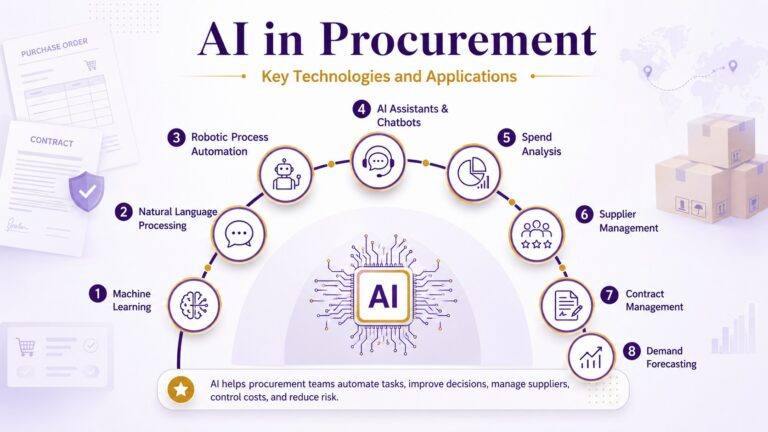
Machine Learning
Machine learning helps teams analyse historical data and predict future outcomes. It can support demand forecasting, supplier risk analysis, fraud detection, inventory control, price prediction, and supply chain monitoring.
Natural Language Processing
Natural language processing, or NLP, helps AI tools read and understand text. In procurement, NLP can review contracts, supplier emails, payment terms, renewal clauses, compliance documents, and risk language. This improves the contracting process and reduces manual review time.
Robotic Process Automation
Robotic process automation, or RPA, automates repetitive procurement tasks. These tasks include creating purchase orders, processing invoices, entering supplier data, tracking orders, reporting, and managing approval workflows. RPA reduces errors and improves completion speed.
AI Assistants and Chatbots
AI assistants and chatbots can answer questions, process internal requests, provide order updates, explain purchasing policies, and help employees access supplier information. These tools improve support and reduce pressure on teams.
Main Applications of AI in Procurement
Strategic Sourcing
AI supports strategic sourcing by comparing suppliers, analysing prices, evaluating supply chain risk, and identifying sourcing strategies. This helps businesses choose suppliers based on cost, quality, reliability, ethics, performance, and long-term value.
Spend Analysis
AI tools collect, clean, and analyse purchasing data. Spend analysis helps professionals understand where money is spent, identify duplicate purchases, detect inefficient spending, and find cost-saving opportunities.
Supplier Management
AI improves supplier management by tracking supplier performance, delivery reliability, quality, compliance, financial risk, and communication patterns. This supports stronger supplier relationship management and better business decisions.
Contract Management
AI supports contract management by reviewing contracts, identifying missing terms, tracking renewal dates, and highlighting risk clauses. It can also support contract negotiation by providing procurement professionals with supplier history, pricing trends, and contract data.
Demand Forecasting and Inventory Control
AI can predict future demand by analysing purchasing history, sales data, seasonal patterns, market changes, and supply chain factors. This helps businesses improve inventory control, reduce waste, and avoid stock shortages.
Invoice Processing
AI can automatically match invoices to purchase orders and delivery records, improving accuracy and reducing manual work. This improves accuracy, reduces manual work, detects duplicate charges, and speeds up invoice completion.
Risk Management
AI helps identify supplier risk, supply chain disruption, compliance issues, logistics problems, and quality concerns. Early risk detection allows businesses to respond before problems affect operations.
Traditional Procurement vs AI-Driven Procurement
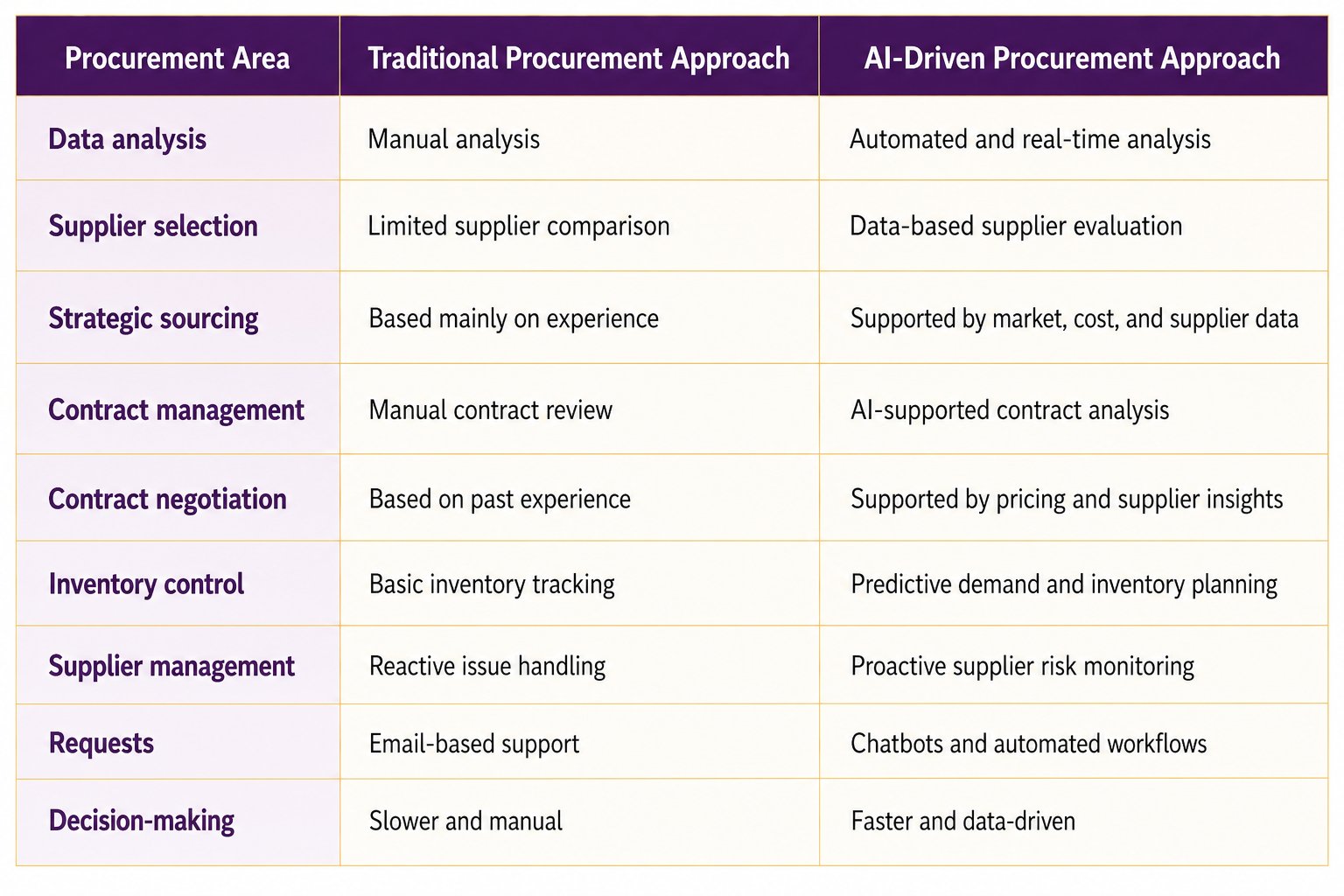
Comparison of traditional procurement and AI-driven procurement approaches.
Benefits of AI in Procurement
1. Cost Savings
Helps reduce costs by identifying duplicate charges, overbilling, inefficient purchasing, and better supplier options, and by creating stronger negotiation opportunities.
2. Time Efficiency
AI automates routine tasks, including order tracking, invoice matching, reporting, supplier data updates, and internal purchase requests.
3. Better Compliance
AI can check activities against company policies, contracts, ethics guidelines, and regulatory requirements. This helps reduce compliance risk.
4. Improved Negotiation
AI gives professionals access to supplier history, pricing trends, market data, and contract terms. This supports effective negotiation and stronger negotiation strategies.
5. Stronger Supply Chain Management
AI improves supply chain management by helping businesses manage demand, inventory, suppliers, logistics, quality, and risk.
6. Better Supplier Relationship Management
AI supports supplier relationship management by improving visibility, communication, supplier evaluation, contract tracking, and performance monitoring.
7. Better Business Decisions
AI gives procurement teams better tools, faster analysis, and more reliable information. This helps organisations make informed decisions and improve long-term success.
Challenges of AI in Procurement
Although AI can improve efficiency, supplier management, cost control, and decision-making, successful implementation requires careful planning. Businesses must address challenges such as poor data quality, system integration, employee adoption, training requirements, change management, and ethical concerns.
Data quality is one of the most important challenges. AI systems rely on accurate, complete, consistent, and up-to-date data. Missing supplier information, duplicated records, incorrect pricing details, or inconsistent product descriptions can lead to unreliable recommendations and poor purchasing decisions.
System integration can also be difficult, as AI tools need to connect with existing procurement, finance, inventory, contract management, and supply chain systems. Professionals may also require training to use AI tools effectively, interpret results, and apply human judgment when making important decisions.
Other concerns include implementation costs, cybersecurity risks, data privacy, algorithmic bias, and regulatory compliance. To manage these challenges, organisations should introduce AI gradually, strengthen data governance, provide employee training, maintain human oversight, and regularly review the performance of AI systems.
Procurement Courses and Professional Development
An overview of procurement courses shows how they help learners build practical knowledge for roles in procurement, purchasing, logistics, and supply chain management. Good course content may include procurement fundamentals, strategic sourcing, sourcing strategies, supplier relationship management, contract management, the contracting process, contract negotiation, supplier evaluation, inventory control, ethics, risk analysis, and practical application.
Employees need skills in contract negotiation and management. Procurement courses teach negotiation strategies and supplier management. Many procurement courses include case studies, discussions, templates, tools, resources, and real business examples. These help participants explore procurement practices and develop confidence in applying their knowledge.
For employers, procurement training can improve team skills, supplier management, cost control, communication, compliance, and supply chain performance.
Who Should Take Procurement Courses?
Procurement courses are useful for beginners, purchasing assistants, procurement professionals, supply chain professionals, logistics staff, contract managers, business managers, and anyone involved in managing suppliers, contracts, inventory, or purchasing requests. These courses are also useful for professionals seeking to expand their career options, develop stronger negotiation skills, and succeed in modern AI-supported procurement environments.s.
Procurement Skills Developed Through Training
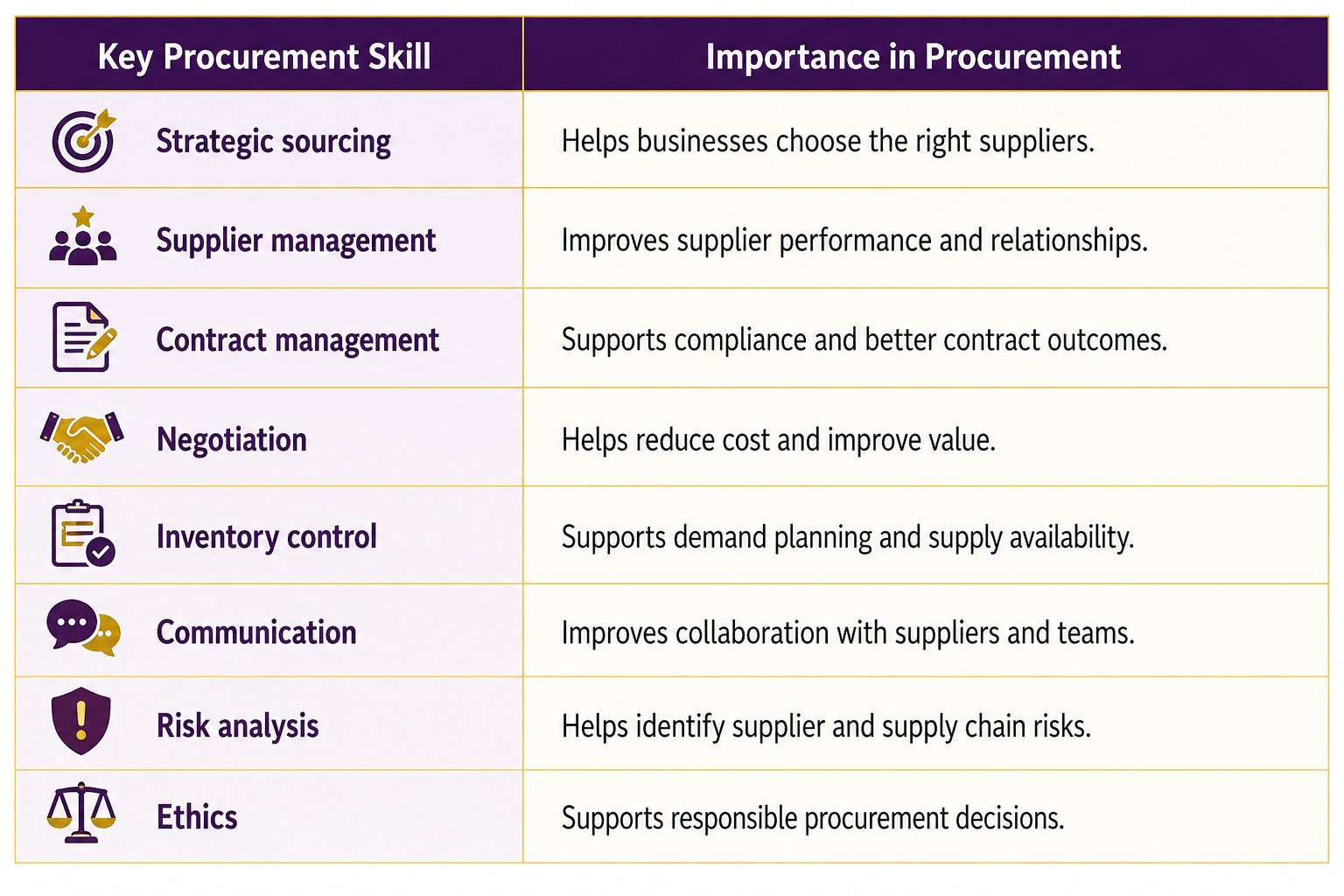
Key procurement skills and their importance in procurement.
Conclusion
AI is transforming procurement into a more strategic, efficient, and data-driven business function. It supports strategic sourcing, supplier management, supplier relationship management, contract management, contract negotiation, inventory control, spend analysis, supply chain management, risk monitoring, and business decision-making.
However, AI adoption depends on data quality, system integration, communication, ethics, user adoption, and proper training. Procurement professionals need the right knowledge, tools, and procurement skills to use AI effectively.
Procurement courses can help learners understand procurement fundamentals, strengthen practical skills, increase professional confidence, and prepare for long-term career development roles in purchasing, logistics, supplier management, and supply chain management. By combining AI with skilled professionals, organisations can improve cost control, supplier performance, quality, and long-term success.
Frequently Asked Questions (FAQ’s)
1. What is AI in procurement?
AI in procurement is the use of artificial intelligence tools to automate, analyse, and improve procurement tasks, including supplier management, contract management, spend analysis, demand forecasting, inventory control, and risk monitoring.
2. Why is procurement important?
Procurement is important because it helps a business control costs, manage suppliers, maintain quality, reduce risk, improve purchasing decisions, and support the supply chain.
3. What are the main types of procurement?
The main types of procurement are direct, indirect, goods, and services.
4. How does AI help procurement professionals?
AI helps review contracts and makes business professionals more efficient by automating routine tasks, analysing data, improving negotiation, managing supplier risk, and forecasting demand, enabling better decision-making.
5. What skills are needed in procurement?
Important procurement skills include communication, negotiation, analysis, supplier management, contract management, strategic sourcing, ethics, inventory control, logistics, and supply chain understanding.
6. What do procurement courses cover?
Procurement courses usually cover procurement fundamentals, sourcing strategies, supplier relationship management, contract negotiation, inventory control, negotiation strategies, ethics, risk management, case studies, and practical applications.
7. Can procurement training help my career?
Yes. Procurement training can help professionals build skills, gain confidence, and qualify for jobs in procurement, purchasing, logistics, and supply chain management.
8. What should I check before choosing a procurement course?
Check the course content, eligibility, certificate, practical application, resources, case studies, website information, course completion requirements, and career support.