


Marketing Skills and Career Guide 2027: From Expertise to Leadership
18 min read
A senior marketing career develops through the quality of decisions you can make, explain and implement. Campaign knowledge matters, but wider responsibility requires commercial judgement, customer insight and the ability to coordinate people with different priorities. Marketing training courses can support that development when learning addresses a clear professional need.
For a head of marketing, the challenge may be allocating investment across competing opportunities. A digital strategy manager might need to challenge performance assumptions. Meanwhile, a founder may need to assess agency recommendations without becoming a specialist in every channel.
This guide is for experienced marketing, digital, brand, communications and growth professionals preparing toward broader influence. It also addresses product marketing and customer experience leaders, consultants and business owners. LBTC’s approach is practical: identify the decisions your next role requires, assess the evidence of your current capability and build a development plan around the gaps.
Key takeaways
- Senior marketing development should connect customer understanding, commercial decisions and organisational execution.
- Technical knowledge needs support from measurement skills, concise communication and responsible judgement.
- Demonstrate career readiness through decisions, working methods and evidence, rather than activity lists alone.
- Select training around a specific capability gap and create opportunities to apply it.
Why marketing skills need a wider business focus
A common career challenge is moving from owning a specialist activity to overseeing several connected disciplines. Expertise in SEO, content or paid media gives a foundation. However, leadership requires evaluating trade-offs across those activities and knowing their place in the business model.
For example, an illustrative software company might generate many trial registrations but have difficulty with customer retention. Increasing acquisition spend could worsen the economics if customers leave before generating sufficient value. The marketing leader needs to investigate targeting, expectations, onboarding and product experience alongside campaign performance.
This needs collaboration with finance, product and customer service. It also requires the confidence to question whether the stated marketing problem is actually a marketing problem. Stronger briefs and better advertising cannot resolve every weakness in the offer.
Career development should therefore include commercial understanding. Learn how your organisation earns revenue, incurs costs and serves customers. Then explain recommendations in terms of those realities. This makes specialist knowledge more useful when you take on wider responsibility.
Digital adoption makes judgement more important
Eurostat reports that 63.6% of EU enterprises used social media in 2025. Adoption varied by size: 60.6% among small enterprises, 76.2% among medium enterprises and 89.1% among large enterprises. The survey covers specified business sectors and enterprises with at least ten employed persons.
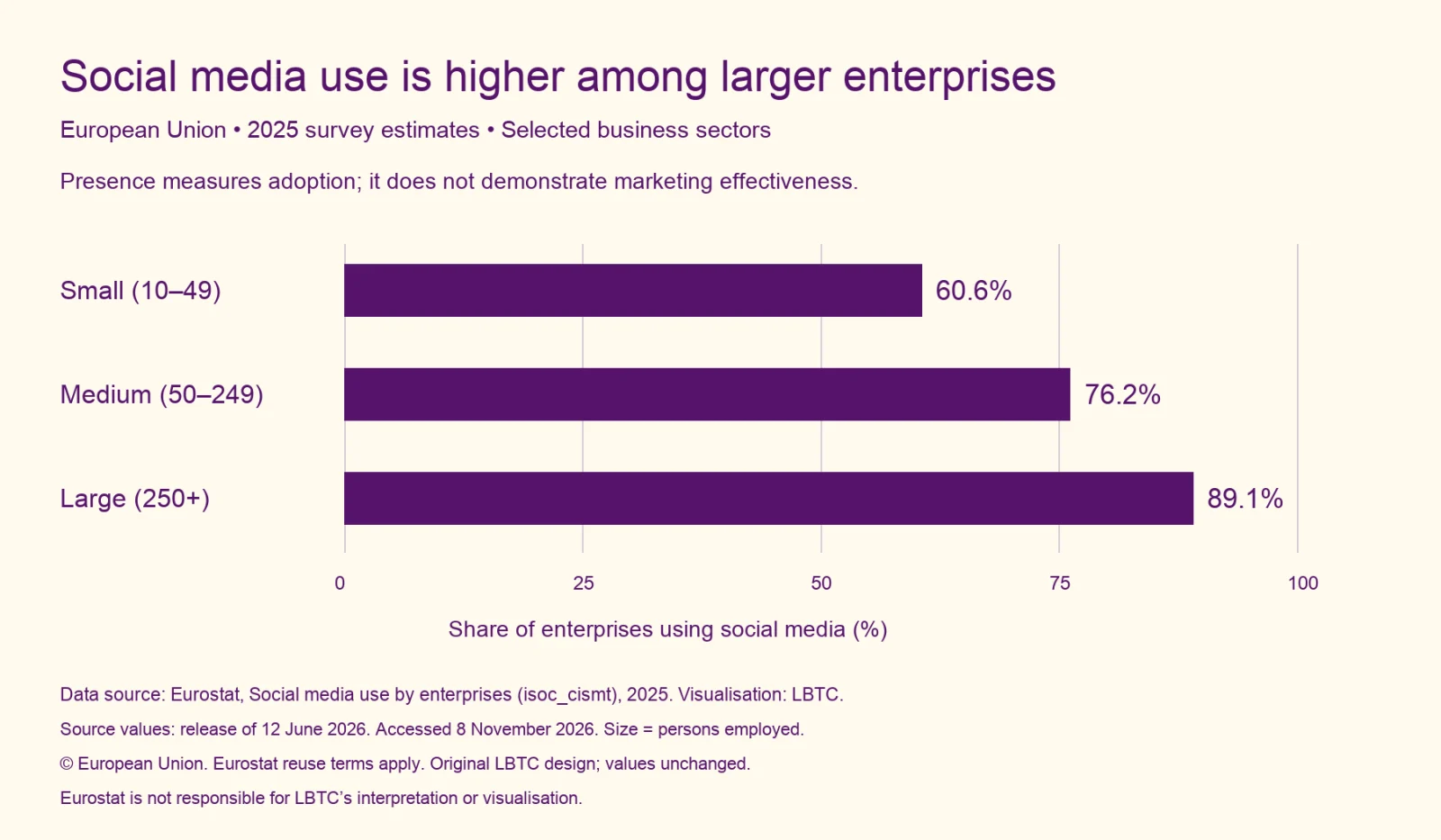
These figures describe adoption, not marketing effectiveness. They do not measure career prospects, training outcomes or UK business behaviour. Nevertheless, they show why a digital presence alone offers limited evidence of professional capability.
For career development, move beyond statements such as “managed social channels”. Explain the audience problem, the choices you made and the evidence you reviewed. Also show how you coordinated work and responded when results questioned your assumptions.
A senior professional should be able to distinguish a popular activity from a justified investment. That distinction matters whether you oversee a small growth team or a large marketing function. Training is most useful when it improves this judgement and practical execution.
Strategic thinking: make choices others can act on
Strategic marketing begins with priorities. Which customers should the organisation serve, what value can it offer and why should buyers choose it? These decisions should guide channel selection, investment and messaging.
First, examine segmentation, targeting and positioning. Useful segments change how you approach the market. A list of demographic characteristics is less useful if it doesn’t change the offer, message, or buying journey.
Next, identify the assumptions behind the proposed strategy. A team may believe that a particular segment values speed above price. Before committing substantial resources, establish what customer evidence supports that belief and how you will test it.
Finally, make the trade-offs explicit. Choosing one priority means delaying or declining something else. Senior leaders need to explain those choices without presenting uncertain forecasts as facts.
LBTC’s Advanced Strategic Marketing course covers strategic planning, segmentation, positioning, customer experience and campaign development. It is relevant when a professional needs to connect individual marketing activities with a wider commercial direction.
Customer insight and product marketing: understand the buying decision
Customer insight should influence decisions rather than sit unused in presentations. Combine interviews, sales feedback, service interactions plus behavioural evidence to understand what customers are trying to achieve. However, recognise that each source provides only part of the picture.
For instance, website behaviour can reveal where visitors leave without explaining why. Interviews can explore motivations, but a small group may not represent the wider market. Stronger interpretation compares sources and makes uncertainty visible.
Product marketing adds another discipline: translating an offer into a credible reason to buy. This entails understanding alternatives, clarifying positioning and preparing evidence for different stakeholders. In a complex purchase, users and budget holders may have different concerns.
Customer journey mapping helps connect these requirements. Identify the questions customers face, the information they need and the handovers that create friction. Then agree who can improve each stage.
For brand and customer experience leaders, this work also tests whether the organisation delivers its promise. A persuasive campaign should not create expectations that the product or service cannot fulfil. Career credibility depends partly on recognising that boundary.
Digital marketing strategy: connect channels with purpose
A digital marketing strategy should explain how digital activity supports customer and business objectives. It is not simply a list of platforms. Each channel needs a role, an appropriate audience and a reason to receive resources.
Consider an illustrative professional services launch. Search content might address questions from buyers researching a problem. Email could help interested prospects evaluate the offer, while a specialist event provides discussion with decision-makers. These activities need coherent messages and suitable measures.
However, senior oversight does not require equal expertise in every platform. It requires enough understanding to test assumptions, recognise dependencies and judge recommendations. Where technical depth is missing, involve specialists rather than disguise uncertainty.
LBTC’s Digital Marketing Strategy course addresses brand identity, customer personas, journey mapping, content, AI and SEO. It fits experts seeking a more connected approach to digital planning.
Content, SEO and storytelling: turn expertise into useful communication
A content marketing strategy should connect what the organisation knows with what customers need to understand. Senior content and SEO leaders must judge relevance, accuracy and purpose alongside visibility.
Start with the decision the reader faces. A buying guide may need to explain trade-offs, while a product page needs clear suitability information. Content for an executive sponsor may require a succinct business case rather than detailed implementation instructions.
SEO can help identify relevant language and search intent. However, repeating keywords does not resolve weak reasoning or missing evidence. Review whether the page answers the question clearly and provides a useful next step.
Storytelling also requires discipline. Employ examples to make a problem understandable but distinguish illustrative scenarios from verified customer results. Avoid turning a limited success into a universal promise.
Analytics and commercial awareness: explain what the numbers mean
Marketing leaders need to connect performance measures with decisions. A dashboard becomes useful when it helps a team decide what to continue, investigate or change. More reporting does not automatically produce better understanding.
Begin by agreeing on definitions. Marketing and sales should mean the same thing when they discuss qualified opportunities. Similarly, finance and marketing should understand which costs appear in an acquisition-cost calculation and which remain outside it.
Then distinguish attributed results from incremental effects. An attribution model allocates credit according to its rules. It does not establish that every recorded conversion occurred because of the credited activity.
Conversion rate optimisation requires similar care. Develop a hypothesis, select a relevant outcome and consider whether the available traffic supports a useful comparison. Seasonal demand, simultaneous website changes and differences between audiences can complicate interpretation.
For example, cheaper enquiries may produce fewer suitable opportunities. A commercially useful analysis follows quality and progression, rather than celebrating a lower headline cost. It also identifies gaps in the evidence.
LBTC’s Digital Marketing Management course covers social media, paid advertising, email automation, analytics and conversion rate optimisation. It is relevant for professionals strengthening the connection between campaign execution and performance review.
AI literacy: improve the workflow and retain accountability
Eurostat estimated that 20.0% of EU enterprises used AI technologies in 2025. This measures business-wide adoption in covered sectors, not a marketing-specific figure or evidence of successful implementation.
For senior marketers, AI literacy includes deciding when assistance is appropriate and how to check output. Draft generation, content variation and organising material may offer useful applications. However, generated statements still need verification against reliable evidence.
Establish responsibilities before expanding use. Clarify who checks facts, approves claims and reviews brand consistency. Also specify which tools and information teams may use, with specialist input where needed.
Evaluate the complete workflow. Faster drafting may create little benefit if correction and approval take longer. Therefore, review turnaround time alongside quality, rework and the ability to explain the finished output.
LBTC’s Mastering Digital Marketing programme combines AI and content with SEO, social media, paid advertising and analytics. It provides a broader option when development needs span several connected disciplines.
For career discussions, explain what you improved, how you checked the work and what limitations remained. Avoid treating tool familiarity as proof of strategic capability.
Communication and influence: make recommendations usable
Senior marketing communication must help other people make decisions. A recommendation must explain the issue, options, evidence, proposed action and implications. Include detail only when it clarifies the choice rather than obscures it.
Adapt the discussion to the stakeholder’s responsibility. Finance may need visibility of costs and assumptions. Sales may need clarity about qualification and handovers. Product teams may need customer evidence that informs priorities.
Listening is equally important. If colleagues challenge a proposal, determine whether they disagree with the objective, evidence or implementation. Those are different problems and require different responses.
For leaders with reputation responsibilities, communication also involves steadiness under pressure. Campaign claims, spokesperson messages and customer responses should reflect what the organisation can substantiate.
LBTC’s Advanced Strategic Public Relations Management programme covers stakeholder interaction, reputation and crisis communication. It is relevant to marketing and communications directors whose remit goes beyond campaign delivery.
To build influence and get feedback on the usefulness of your recommendations. The goal is not simply a more confident presentation. It is a clearer decision and a common understanding of what happens next.
Planning, collaboration and sustainable delivery
A marketing plan should connect objectives with resources, responsibilities and review points. Without these connections, even a strong strategy can become a collection of competing requests.
Identify dependencies early. A campaign may require product information, sales capacity, technical changes or legal review. Assign owners and feasible deadlines before promising delivery. When a new priority arrives, make its consequences for existing commitments visible.
LBTC’s The Marketing Plan course focuses on customer journeys, campaign alignment and quantifiable impacts. It offers a focused development route for professionals looking to improve planning and execution.
Team leadership also entails creating workable conditions. Persistent overload calls for a review of priorities, resources and approval processes. It should not become a test of individual resilience alone.
Build regular opportunities to review completed work. Discuss what the team expected, what happened and what should change. This creates practical learning while reducing the temptation to repeat familiar activity without reviewing its value.
Apply skills effectively across diverse business environments
Professionals working across the UK, GCC, Indonesia, Nigeria and other markets need a disciplined approach to local evidence. Do not assume that geography alone explains customer priorities or buying behaviour.
Instead, examine the actual segment, purchasing process, language requirements and competitive alternatives. Consult local colleagues and customers, then test important assumptions. Where rules affect advertising or data use, obtain current advice for the relevant jurisdiction.
Maintain dependability in the brand promise while changing how you communicate and deliver it. A global framework should guide decisions without preventing justified local changes. For regional leaders, explaining those choices is part of the role.
Match marketing training to your career responsibilities
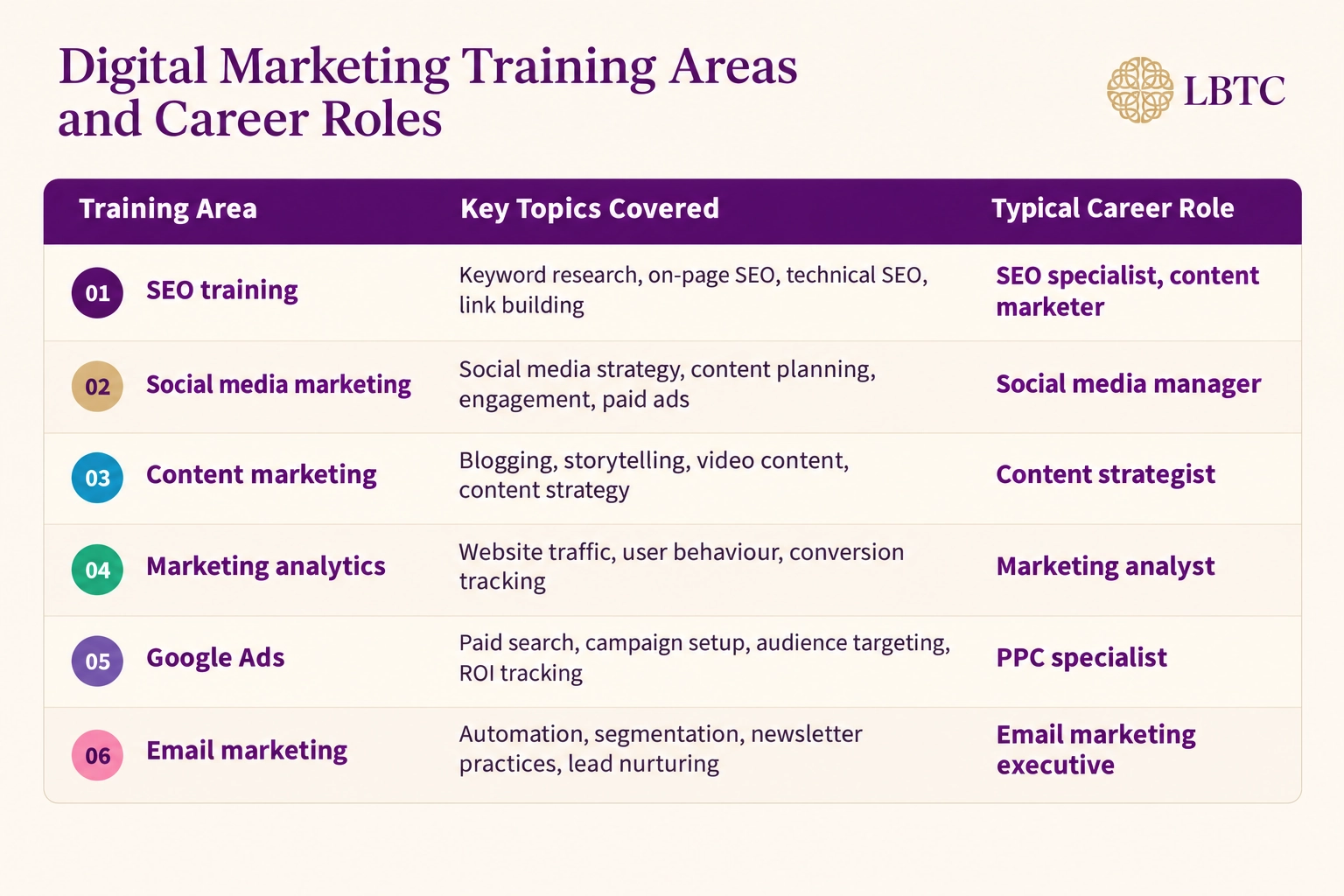
Different marketing roles require different combinations of expertise. The training areas below provide a useful starting point for identifying where to deepen your knowledge. However, senior professionals should also consider how these disciplines work together.
For example, an SEO strategy lead needs to connect search visibility with content quality and customer intent. A head of digital marketing needs enough understanding of paid media, analytics and email automation to challenge recommendations and coordinate investment. Meanwhile, a marketing director must assess how these activities support positioning, customer experience and commercial priorities.
Use the overview to identify a capability gap, not a fixed career pathway. Then choose development that supports your current responsibilities or the scope of your next role. LBTC’s Mastering Digital Marketing programme brings several of these disciplines together for professionals seeking broader digital understanding.
Build a career-development plan with evidence
Begin with the responsibilities you want to take on. Moving into marketing leadership may require budget allocation, team development, and executive communication. A senior specialist path may instead demand deeper expertise and stronger influence across functions.
Assess yourself against real work. Review recent recommendations, campaign briefs and performance discussions. Ask trusted colleagues where your contribution is strong and where they need greater clarity or depth.
Next, select one development priority and a live application. Marketing training courses must address that priority through relevant content and practice. Agree with your manager how you will apply the learning and what support is available.
During the following three months, create and review a practical output. This might be a revised measurement framework, customer journey or campaign plan. Record what changed and distinguish your contribution from wider business influences.
Finally, build a portfolio that observes confidentiality. Explain the problem, choices, collaboration and lessons using authorised or anonymised material. Strong evidence of judgement is more useful than unsupported claims about transformation or guaranteed results.
Conclusion
Building a successful marketing career in 2027 requires more than keeping pace with platforms and tools. Senior professionals need to connect customer insight, strategic thinking, commercial awareness and clear communication. These capabilities help leaders assess opportunities, challenge assumptions and guide teams towards meaningful business objectives.
The next step is to identify where stronger skills would improve your contribution. You may need to sharpen positioning, interpret campaign results more confidently or strengthen stakeholder influence. Choose a focused development priority, apply it to a real business challenge and review your progress through feedback and evidence.
For professionals seeking structured development, LBTC’s Digital Marketing Strategy course covers brand identity, customer personas, customer journeys, content, AI and SEO. It offers a relevant learning pathway for those connecting digital activity with wider marketing priorities.
Training can support career progression, but its value depends on how you apply it. Combine learning with practical experience, thoughtful reflection and opportunities to take responsibility. Over time, this approach can strengthen both your professional judgement and your contribution to your organisation.
Frequently asked questions
Which marketing skills should senior managers prioritise?
Prioritise the skills required by your actual remit: strategic choices, commercial interpretation, customer insight, stakeholder influence and team management. Maintain enough digital understanding to evaluate specialist recommendations and recognise when you need additional expertise.
Can marketing training courses help an experienced professional?
They can support focused development when the syllabus matches a genuine gap. Evaluate practical relevance, opportunities for feedback and how you will apply the learning. Attendance does not guarantee promotion or improved commercial results.
Should I specialise or move into more extensive marketing leadership?
Both are valid paths. Consider whether you prefer deeper technical responsibility or coordinating markets, teams and investment. Seek assignments that let you test the next level of responsibility before making a larger career change.
How can I demonstrate marketing skills without sharing confidential results?
Use authorised examples, anonymised descriptions or clearly labelled illustrative projects. Explain your reasoning, methods and learning without revealing customer information or restricted commercial data. Obtain permission before including employer-owned material in a public portfolio.


