


Financial Market Course: Functions of Financial Markets Explained
14 min read
Financial markets are essential to modern economies, linking organisations seeking capital with investors and institutions that supply it.
They enable companies and governments to raise funds, trade financial assets, support price discovery, and provide tools for managing financial exposures.
For managers and finance professionals, understanding these relationships supports more informed decisions on funding, investment, liquidity, and financial risk.
A financial market course helps professionals understand how debt, equity, foreign exchange, and derivatives markets operate, and how interest rates, valuation, and financial information influence market activity.
LBTC’s Financial Markets and Risk Management course covers global market institutions, debt and equity instruments, credit risk, valuation, currency markets, investment risk, and derivatives.
This guide outlines the main functions of financial markets, how market mechanisms interact, and why market knowledge is important for professional decision-making.
Key Takeaways
- Financial markets connect organisations seeking capital with investors and financial institutions.
- Core functions include capital formation, price discovery, liquidity, capital allocation and risk transfer.
- Markets support economic activity but may also experience volatility, illiquidity, and periods of instability.
- Financial instruments help manage specific exposures but cannot eliminate uncertainty.
- Financial statements, economic information and market data all contribute to professional analysis.
- Relevant training can enhance professional knowledge but does not guarantee employment, promotion, or investment results.
What Are Financial Markets?
Financial markets are systems where participants issue, buy, and sell financial assets and contracts.
The Bank of England explains that markets bring buyers and sellers together to establish prices for financial assets and provide mechanisms through which companies and governments can obtain finance.
Common types of markets include:
- Equity markets, where company shares are issued and traded.
- Bond markets, where governments, businesses and other organisations raise debt finance.
- Money markets, which mainly involve shorter-term borrowing and lending.
- Foreign exchange markets, where currencies are traded.
- Derivatives markets, where contracts derive value from an underlying asset, rate or other variable.
- Commodity markets, where commodities and related contracts are traded.
These markets serve different functions but are interconnected. For example, a change in interest rates can simultaneously affect bond prices, company financing costs, currency movements, and investor decisions.
Why Do Financial Markets Matter?
Financial markets move capital between investors and organisations seeking funding.
Companies may issue shares to raise equity, while businesses or governments may issue bonds to borrow funds. Investors purchase securities based on their objectives, expected returns, and risk tolerance.
Markets facilitate financing, investment, and capital allocation. However, disruptions can impact banking, credit availability, and the broader economy, so markets do not automatically ensure stability or wealth.
Core Functions of Financial Markets
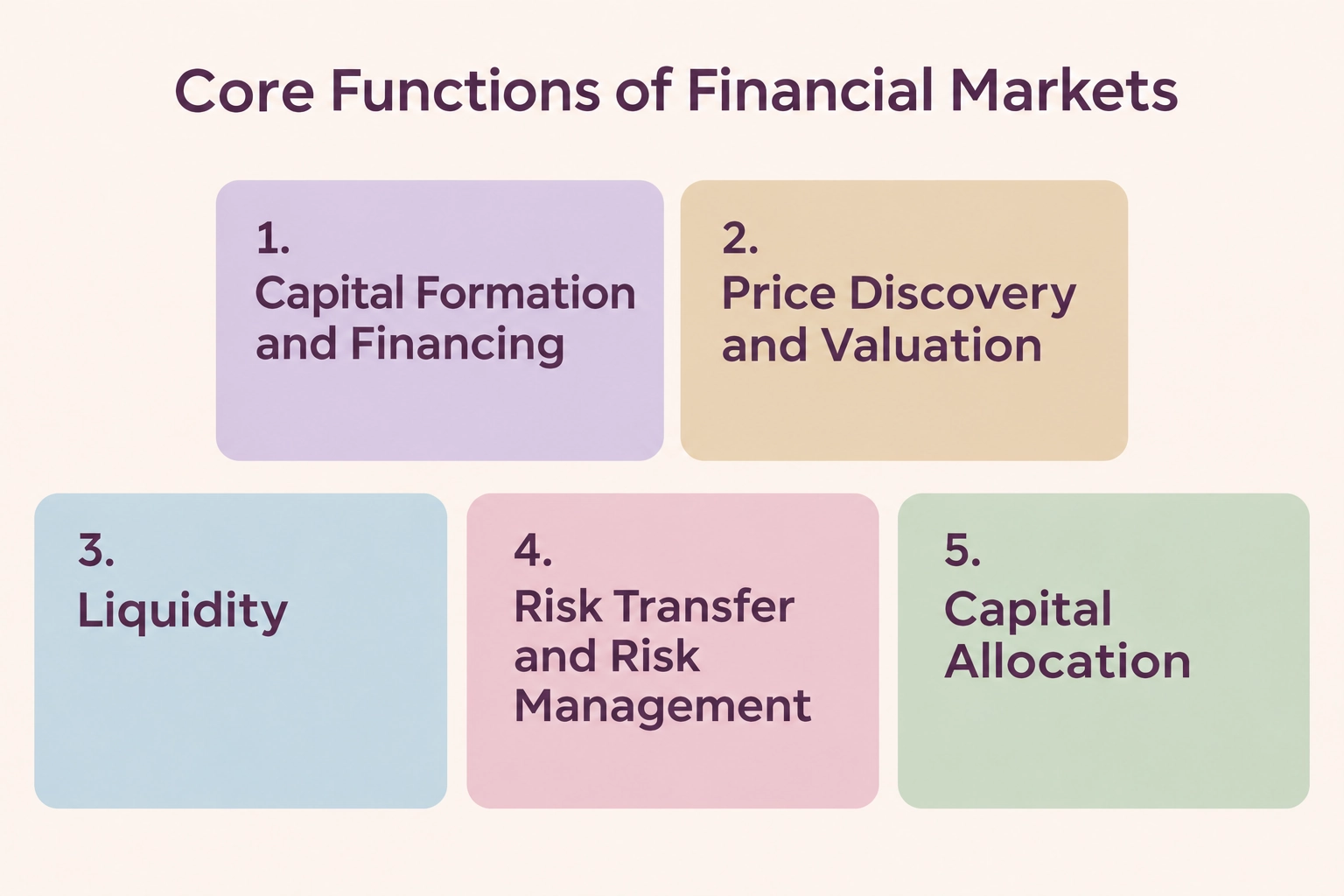
1. Capital Formation and Financing
A primary function of financial markets is to provide organisations with access to capital.
Companies raise equity by issuing shares or debt by issuing bonds. Governments also issue debt securities to fund expenditures.
Two key concepts are the primary market, where issuers offer new securities to raise funds, and the secondary market, where investors trade existing securities.
A functioning secondary market makes new issues more attractive, as investors can later sell their holdings. Access to finance still depends on creditworthiness, investor demand, and market conditions.
2. Price Discovery and Valuation
Financial markets facilitate price discovery, where interactions between buyers and sellers establish market prices.
Prices respond to company earnings, interest rate decisions, economic data, industry developments, geopolitical events, and changes in investor expectations.
Price discovery does not guarantee that market prices equal an asset’s intrinsic value. Prices reflect available information, expectations, liquidity, and participants’ willingness to trade at a given time.
This is why professional investors and analysts continue to use valuation methods alongside observed market prices.
3. Liquidity
Liquidity is the ability to buy or sell an asset without significantly changing its price.
A highly liquid market has active trading and enough participants willing to transact. Liquidity helps organisations and investors adjust positions, raise cash, reallocate assets, or meet financial obligations.
However, liquidity is not constant. A security that is easy to sell under normal conditions may become difficult to trade during market stress.
Liquidity should be seen as both a valuable market characteristic and a financial risk that requires monitoring.
4. Risk Transfer and Risk Management
Financial markets offer instruments that organisations and investors use to manage or adjust specific exposures.
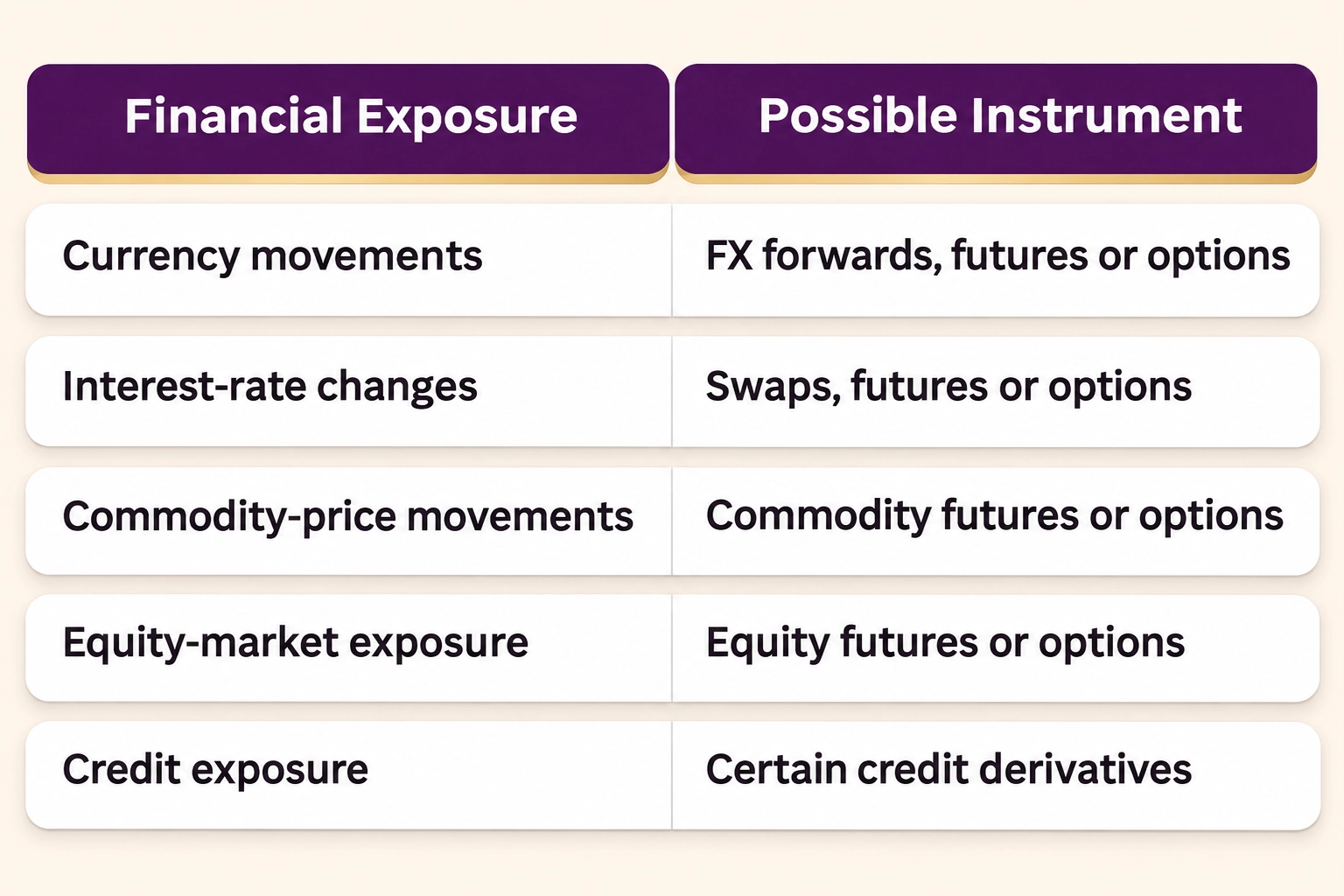
Derivatives can support hedging, but hedging does not eliminate risk. A hedge can introduce counterparty risk, basis risk, liquidity risk, model risk or transaction costs.
Diversification can reduce company-specific risks but cannot eliminate all market-wide risks. Effective risk control requires professionals to understand which exposures can be managed, transferred, or reduced, and which uncertainties remain.
5. Capital Allocation
Financial markets influence capital allocation among businesses, industries, and investment opportunities.
Investors consider expected return, financial risk, liquidity, credit quality, business prospects, and valuation when allocating funds.
Organisations seen as financially strong or offering attractive opportunities may find it easier to obtain funding than those considered higher risk.
However, markets do not allocate resources perfectly. Information gaps, behavioural biases, market concentration, incentives, and changing expectations all influence investment decisions.
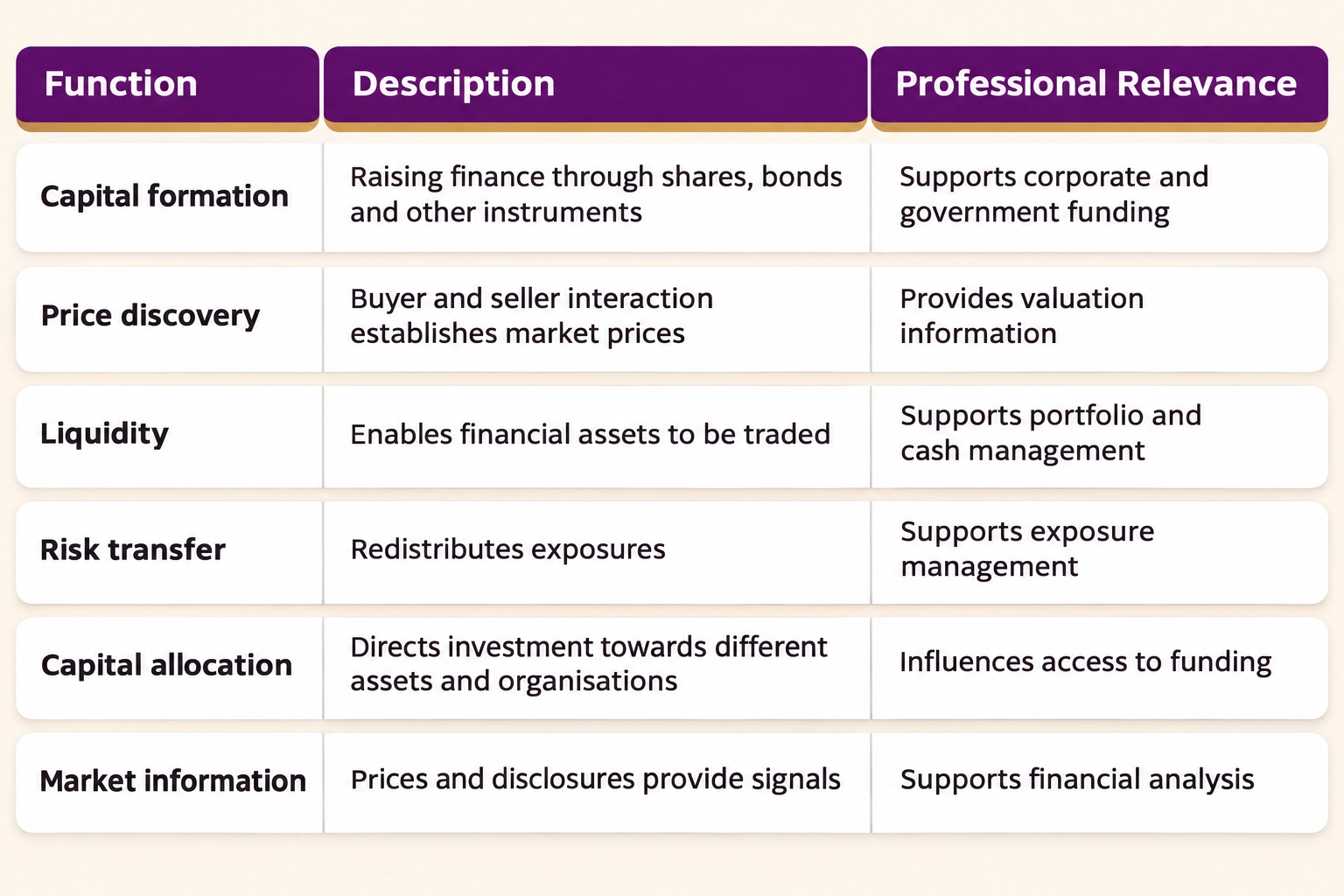
Main Functions at a Glance
These functions interact, and their effectiveness depends on market structure and economic conditions.
Financial Markets and Risk Management
Financial decisions involve uncertainty. Conditions may change due to interest rates, inflation, business performance, regulation, economic developments, and investor behaviour.
Common categories include market risk, credit risk, liquidity risk, interest-rate risk, currency risk and operational risk.
Professionals use hedging, diversification, scenario analysis, stress testing, and quantitative measures in risk management. The appropriate techniques depend on the organisation, instrument, and objective.
For those seeking deeper knowledge, structured training explores how market exposures, instruments, and analytical methods interact.
Financial Statements and Market Decision-Making
Financial statements provide structured information about a company’s financial position and performance.
The income statement reports income, expenses, and profit or loss over a period. The balance sheet presents assets, liabilities, and equity at a specific date. The statement of cash flows details cash generated and used through operating, investing, and financing activities.
Investors and analysts use this information to assess profitability, debt, financial structure, liquidity, and cash generation.
Financial statements are not the only evidence relevant to market decisions. Professional analysis also considers economic conditions, industry trends, interest rates, competitive position, company strategy, and valuation.
Financial reporting supports investment analysis but does not automatically determine whether to buy or sell an investment.
Behavioural Finance and Market Behaviour
Behavioural finance examines how psychological factors can influence financial decisions.
Traditional models assume investors process information rationally. In practice, people may also be influenced by overconfidence, loss aversion, anchoring, framing, limited attention, or herd behaviour.
These tendencies affect individual decisions and broader market behaviour, though not every market movement is irrational. For professionals, behavioural finance provides another way to challenge assumptions under uncertainty.
Banks, Interest Rates and Market Activity
Banks accept deposits, provide credit, facilitate payments, and perform financial intermediation. Investment banks and other institutions also participate directly in securities, foreign exchange, and other markets.
Banks do not simply “manage interest rates”; they price products in an environment shaped by monetary policy, funding costs, credit risk, competition, and market conditions.
Interest rates influence borrowing costs, lending activity, bond prices, company financing decisions, savings, investment behaviour, and currencies.
Bond prices and yields generally move in opposite directions. If market rates rise, an existing fixed-rate bond may become less attractive than new securities offering higher yields, which can put downward pressure on its price.
The effect depends on factors including maturity, coupon, duration, credit quality, and expectations. These relationships are especially relevant for professionals in treasury, banking, investment, and risk management.
Role of Financial Analysis
Financial analysis integrates accounting information, market data, and analytical techniques.
Professionals may use ratio analysis, financial modelling, valuation models, forecasts, scenario analysis, and risk metrics, depending on their responsibilities.
A credit analyst may focus on leverage, cash generation, and a borrower’s ability to meet obligations. An equity analyst may examine profitability, growth assumptions, and valuation. A treasury professional may concentrate on liquidity, funding, currencies, and interest-rate exposures.
The objective is to understand both the calculations and the underlying assumptions.
Financial Markets and Career Opportunities
Market knowledge supports roles in banking, investment, treasury, corporate finance, analysis, and risk functions. However, studying the subject does not guarantee a specific career path, as individual roles may require different qualifications, technical skills, and experience.
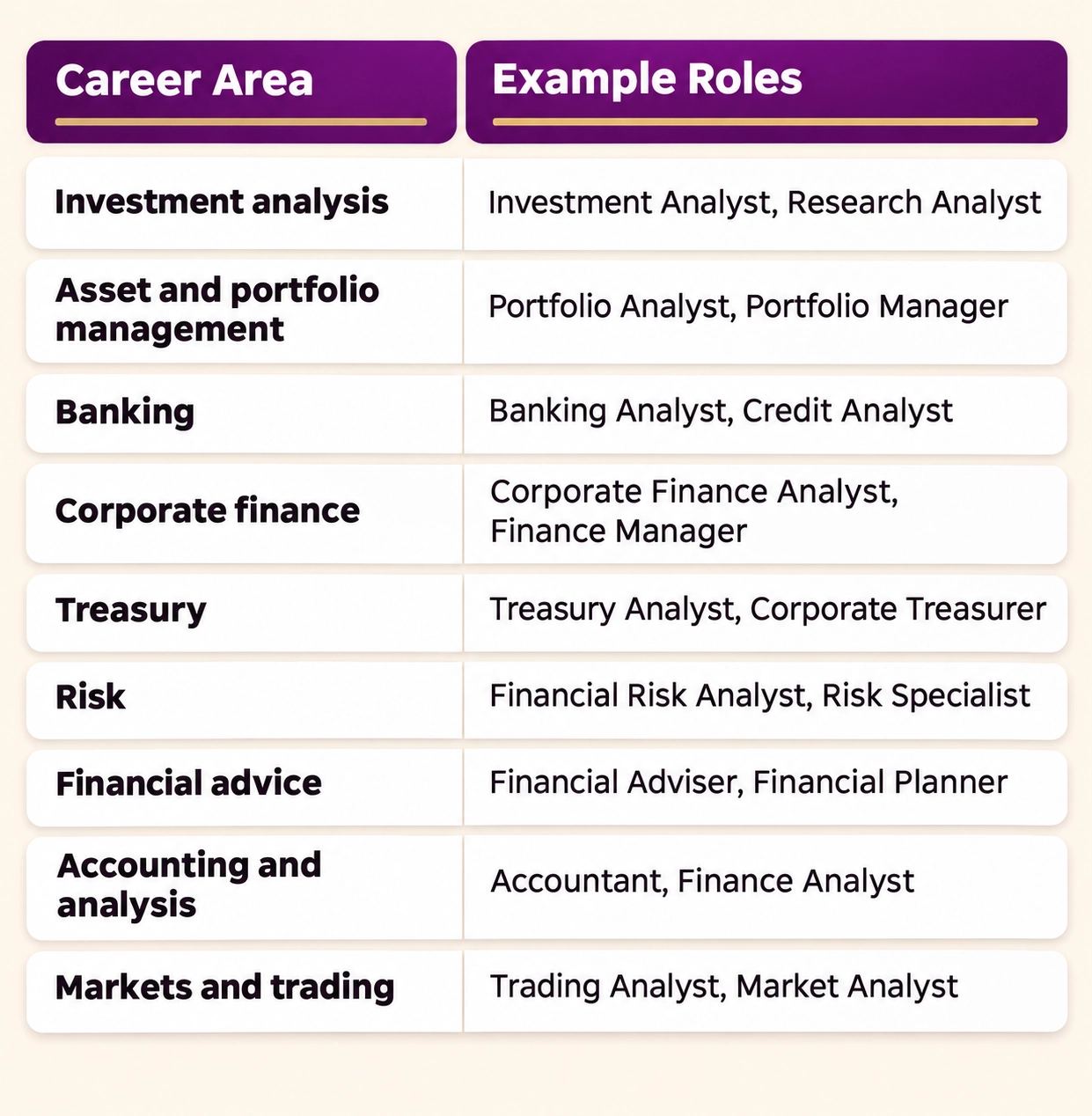
These are examples, not a progression ladder. Advancement to specialist or senior roles depends on experience, qualifications, technical capability, and employer requirements. A financial market course should be seen as professional development rather than a direct path to a specific job title.
Professionals seeking broader development may also consider LBTC’s Accounting, Finance, and Banking courses.
What Does a Financial Market Course Cover?
The content of a financial market course varies by programme and level of study.
For working professionals, relevant subject areas may include:
- Global financial institutions
- Market structure
- Debt and money markets
- Bond valuation
- Interest-rate risk
- Credit analysis
- Equity markets
- Company valuation
- Foreign exchange
- Hedging
- Investment risk
- Derivatives
- Fintech
LBTC’s Financial Markets and Risk Management programme covers market structure, fixed income, equity valuation, FX, investment risk, and derivatives.
The curriculum includes yield to maturity, duration, credit spreads, valuation, FX forwards and options, volatility, Value at Risk, futures, and swaps.
A financial market course can provide structured development for professionals seeking a broader understanding of how different instruments and market risks interact. Course selection should align with the participant’s existing knowledge and responsibilities.
Tools and Methods Used in Financial Markets
Finance professionals use different tools based on their role and organisation. The industry has no universal technology stack.
Common categories include:
- Spreadsheets and financial models for calculations, forecasts and valuation.
- Market-data and trading platforms for monitoring prices and transactions.
- Business-intelligence tools for analysing and presenting financial data.
- Database and query tools for working with larger datasets.
- Portfolio systems for monitoring holdings, performance and exposures.
- Accounting and enterprise systems for records and reporting.
- Statistical software for quantitative analysis.
Technology can improve speed and efficiency, but does not replace financial understanding. Systems may calculate valuations or execute transactions quickly, but professionals must still assess the underlying assumptions, data quality, and risks.
Training should connect market concepts with practical analysis, rather than treat technology as a substitute for professional judgement.
Skills Relevant to Financial-Market Responsibilities
Relevant capabilities include financial analysis, data interpretation, risk assessment, valuation, financial modelling, market research, communication, and critical thinking.
Different roles require different skill combinations, so training should reflect actual responsibilities rather than serve as universal preparation for all finance roles.
Why Professional Training Matters
Financial markets combine technical concepts with evolving economic and market conditions. Professionals must understand relationships between interest rates and bond prices, risk and return, liquidity and market conditions, financial reporting and valuation, currencies and corporate exposures, and derivatives and hedging.
Structured training can provide a framework for examining these relationships systematically.
A financial market course should not be viewed as a guarantee of career advancement or superior investment performance. Its value depends on how effectively participants apply the knowledge in their roles.
Conclusion
Financial markets serve several important functions in modern economies. They help companies and governments raise finance, support trading and price discovery, and enable certain exposures to be transferred or managed.
They can also experience volatility, liquidity shortages, mispricing, and periods of instability. Risk management techniques can modify or reduce specific exposures, but cannot eliminate uncertainty.
For managers and finance professionals, understanding markets requires more than knowing the definitions of shares, bonds, and derivatives. It involves understanding how capital, prices, liquidity, interest rates, financial information, investor behaviour, and risk considerations interact.
LBTC’s Financial Markets and Risk Management course provides structured professional development across these areas, including debt and equity markets, valuation, FX, investment risk, and derivatives.
The most effective financial market course aligns with the participant’s responsibilities and helps them apply market concepts in their professional context.
Frequently Asked Questions
What Is a Financial Market Course?
A financial market course provides structured learning about financial institutions, securities, debt and equity markets, interest rates, foreign exchange, valuation, and financial risk. The exact content depends on the programme and intended audience.
Why Are Financial Markets Important?
Financial markets help companies and governments obtain finance, allow assets to be traded, contribute to price discovery, and provide mechanisms for transferring or managing certain exposures.
What Are the Main Functions of Financial Markets?
The main functions include capital formation, price discovery, liquidity, risk transfer, capital allocation, and the provision of market information.
How Do Financial Markets Support Risk Management?
Financial instruments such as forwards, futures, options, and swaps can help organisations manage specific exposures. They do not eliminate all risks and may create additional costs or exposures.
What Skills Are Useful When Working With Financial Markets?
Useful skills include financial analysis, risk assessment, valuation, financial modelling, data interpretation, market research, and critical thinking. The required combination varies by role.
Can a Financial Market Course Support Professional Development?
Yes. A financial market course can strengthen market knowledge and analytical capability. However, completing a course does not guarantee employment, promotion, professional status, investment returns, or a particular salary.


