
6 Ways AI Can Strengthen Your Content Marketing Strategy
8 min read
Content marketing depends on judgment. Organisations must understand their audience, define a relevant message, present evidence clearly and measure whether each activity supports wider business goals. Artificial intelligence can improve this process by helping marketing professionals analyse information, organise ideas, personalise communication and learn from performance data.
However, AI does not replace digital marketing expertise. It cannot determine commercial priorities, understand organisational culture or protect brand trust without human direction. Its value depends on the quality of the digital marketing strategy, the data provided, and the standards used to review each output.
This distinction matters for professionals considering marketing training courses, a professional certificate or a digital marketing certification. Learning how to use marketing tools is useful, but long-term success depends on strategy, consumer behaviour, analytical judgment and responsible decision-making.
Google advises organisations to produce helpful, reliable and people-first material rather than pages created primarily for search engines. Therefore, AI should support content marketers rather than encourage uncontrolled production or keyword stuffing.
Key Takeaways
- AI can improve audience research, planning, content creation, personalisation, SEO and performance measurement.
- Human review remains essential for accuracy, brand consistency, customer relevance and governance.
- A clear content strategy should connect every asset with audience needs and measurable business goals.
- Google Analytics, CRM evidence and customer feedback should guide marketing efforts.
- Marketing courses can help learners develop the knowledge needed to use AI responsibly across marketing disciplines.
Build the Right Foundations Before Using AI
AI performs best when organisations define clear operating standards. Without governance, even advanced tools can create weak claims, inconsistent copywriting, privacy risks and repetitive material.
A practical foundation should include approved uses, prohibited uses, source-verification rules, data-protection controls, brand guidance and named reviewers. Teams also need a prompt library, a measurement plan and a process for escalating sensitive content.
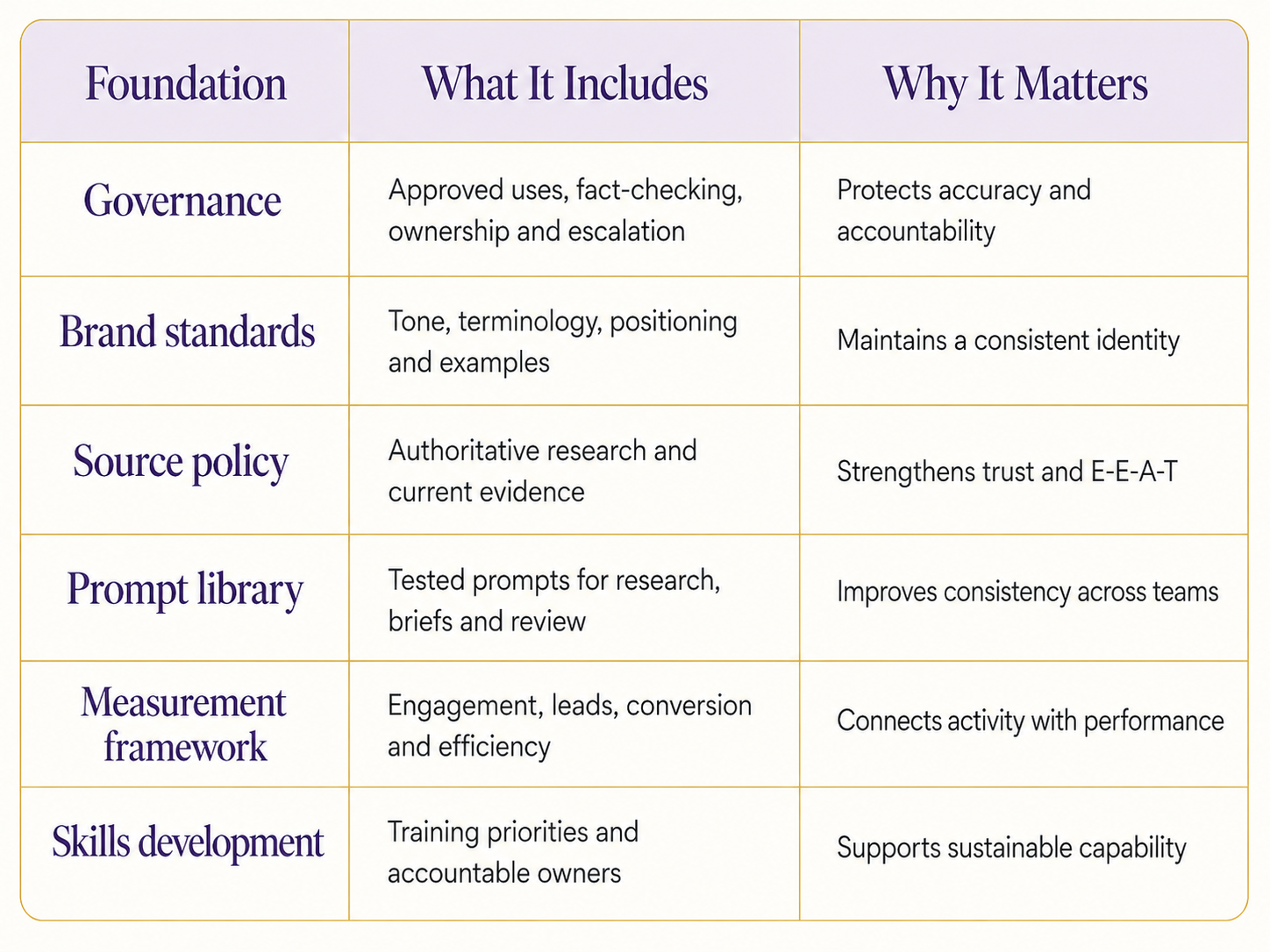
The Information Commissioner’s Office states that data protection law applies when AI systems process personal information. The EU AI Act also reinforces the need for responsible development and use. For marketing managers, governance is therefore a management responsibility rather than an optional control (ICO, 2023; European Commission, 2024).
1. Improve Audience Research and Consumer Insight
Effective content starts with evidence about what people need. AI can organise search terms, customer enquiries, reviews, survey comments, sales notes and service records. It can identify recurring questions, objections and gaps across the customer journey.
Someone searching for marketing training courses may have several intentions. One person may want a basic understanding of digital marketing. Another may be exploring a marketing career, comparing certifications or looking for a digital marketing certification. A senior manager may need practical insights for a team, while a marketing specialist may want advanced knowledge of analytics or marketing automation.
AI can group these needs by intent and decision stage. However, digital marketers must validate the findings through CRM data, Google Analytics and direct customer conversations. Consumer behaviour cannot be understood through generated assumptions alone.
Useful applications include:
- Grouping audience questions by search intent
- Comparing regional interests and industry trends
- Identifying topics that support demand generation
- Mapping content to awareness, consideration and decision stages
- Developing research briefs for content marketers and marketing specialists
Audience analysis should follow this principle by increasing relevance rather than simply increasing volume.
2. Use AI as a Structured Research and Planning Assistant
AI can accelerate early-stage research. It can summarise long documents, compare arguments, suggest questions and organise evidence. This helps marketing professionals move from a broad subject to a focused brief.
The process should begin with a human-defined objective. The brief should state the audience, business goals, main keyphrase, regional context, preferred sources, tone and desired action. AI can then propose side headings, FAQs, examples and content gaps.
This approach works across several marketing disciplines. A campaign may combine content marketing, social media marketing, email marketing, advertising, public relations and sales support. AI can show how these activities connect, while experienced marketers decide which channels deserve investment.
It can also support project management by converting an approved plan into tasks, deadlines and owners. Yet it must never treat a plausible statement as verified knowledge.
Strong research practices require teams to:
- Use approved and authoritative sources.
- Record publication dates.
- Separate facts from interpretation.
- Verify statistics and claims.
- Avoid copying competitor structures.
- Review all recommendations before publication.
These practices help content creators, copywriting teams, and subject-matter experts work more quickly without compromising quality.
3. Strengthen SEO and Search-Led Planning
AI can support search engine optimisation by grouping keywords, reviewing headings, comparing search intent and identifying missing FAQ’s. It can also suggest internal links and help teams plan topic clusters.
However, SEO success does not come from repeating the same words. Search engines reward useful, relevant and accessible information. Keywords should guide structure and coverage while preserving readability.
A strong website may use a single central guide, supported by related resources. For example, a pillar page on digital marketing may link to articles about Google Ads, Google Analytics, email marketing, social media strategy, content strategy and marketing automation. This structure helps readers explore a subject and supports clearer site architecture.
AI can also identify content overlap, recommend page updates and compare depth against search intent. It can monitor the latest trends without encouraging teams to chase every new development.
A disciplined SEO workflow should combine AI-assisted analysis with:
- Search Console data
- Keyword research
- Competitor analysis
- Customer questions
- Editorial review
- Internal linking
- Performance monitoring
The result should be a clearer website, better navigation and stronger alignment between search demand and business goals.
4. Create More Relevant Email and Social Communication
Personalisation works when it improves relevance. AI can segment audiences by role, sector, region, previous engagement and stage of interest. It can then help create message variations for different needs.
A senior executive may need a concise strategic case. Marketing managers may require implementation guidance. Learners beginning a professional certificate may need an introduction to core concepts. Digital marketers may want advanced examples, while people interested in a job may value career guidance, practical skills and recognised certifications.
AI can support email subject lines, nurturing sequences, campaign variations and social media posts. However, every message must remain accurate and purposeful.
A successful social media strategy requires defined audiences, channel roles, themes, response standards and measurement. On LinkedIn, a post may guide readers to a report, strengthen a LinkedIn profile or invite professionals to join a webinar. Facebook may support awareness or community communication. Adobe Express can assist with branded content creation, but design templates do not replace a strong message.
AI can also help content marketers repurpose one core idea into:
- LinkedIn posts
- Facebook updates
- Email summaries
- Short video scripts
- Website FAQs
- Webinar follow-ups
This supports consistency across channels and helps organisations build brand awareness without producing disconnected content.
5. Improve Production Efficiency Across Formats
AI can reduce the time spent on routine preparation. It can help create an outline, summarise an interview, turn a webinar transcript into a briefing note or adapt a long article into shorter formats.
One expert-led session can become a long-form article, an executive summary, an email newsletter, social posts, a video script, an FAQ page, and an internal learning resource. This gives skilled professionals more time for interviews, analysis, editing and original thinking.
Research from the CMI found that many B2B marketers expected to increase investment in AI for content optimisation, performance, and creation. This reflects growing demand for efficient workflows, but efficiency must not reduce quality.
Content creation should therefore include clear review stages:
- Confirm the purpose and audience.
- Develop a structured brief.
- Create the first version.
- Verify facts and sources.
- Review tone and originality.
- Approve the final asset.
- Measure its performance.
Marketing tools such as Adobe Express, scheduling platforms and marketing automation systems can support production and distribution. However, named professionals should remain accountable for what the organisation publishes.
6. Improve Measurement, Learning and Orchestration
Content marketing should not end at publication. Teams must understand which pages attract qualified visitors, which messages drive engagement, and where users drop off in the journey.
Google Analytics can show how users move across a website and which actions they complete. This helps organisations assess the journey from an article to a course page, an enquiry form, a booking page, or a purchase.
AI can summarise campaign data, compare performance by audience and identify weak points. It can highlight declining engagement, recommend refresh priorities and connect qualitative feedback with numerical evidence.
Useful measures include:
- Engaged sessions
- Qualified enquiries
- Conversion rate
- Assisted revenue
- Returning visitors
- Search visibility
- Email engagement
- Lead quality
- Customer retention
Teams should also connect Google Ads, organic search, social media, email, and referral traffic into a single measurement framework. This gives marketing managers a clearer view of how each channel supports wider strategies.
The goal is not to create more reports. It is to improve decisions.
Skills Required for Responsible AI Use
AI tools change quickly, but core capability remains stable. Digital marketers need strategy, research, analytics, editorial judgement, governance and communication.
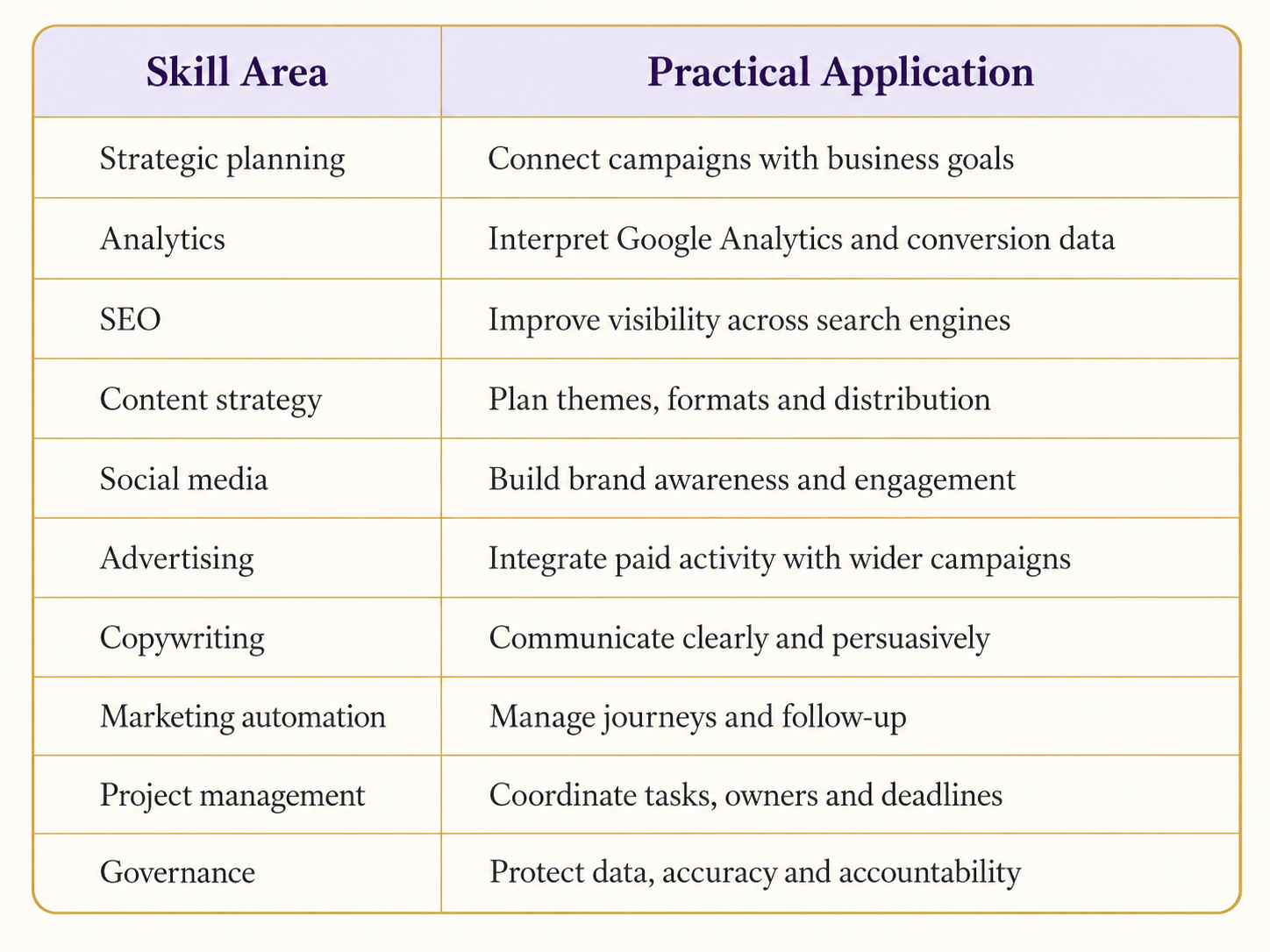
Marketing courses should cover practical application, not only theory. Strong programmes help learners develop expertise, explore current marketing tools and apply knowledge to real business challenges.
Effective professional development should also help learners set goals, access expert guidance, launch a campaign, improve services, and achieve measurable outcomes.
Professionals comparing courses should review whether the programme covers topics such as digital marketing strategy, content marketing, consumer behaviour, analytics, Google Ads, SEO, email marketing and social media marketing. They should also consider facilitator experience, case-based learning and opportunities to develop practical skills.
Conclusion
AI can strengthen content marketing in six clear ways. It can improve audience research, support structured planning, strengthen SEO, personalise communication, increase production efficiency and deepen performance analysis.
However, technology creates value only when organisations set clear standards. Governance, source verification, data protection, brand control and human review must remain part of the process.
For professionals seeking marketing training courses, the priority is capability rather than tool familiarity. Strong marketers understand customers, assess evidence, connect activity with business goals and measure results.
AI can accelerate the work. Expertise determines whether that acceleration leads to stronger communication, better decisions and sustainable success.
Frequently Asked Questions (FAQ’s)
1. How can AI support content marketing?
AI can support audience research, content planning, SEO, personalisation, content creation, repurposing, distribution and performance analysis. Human review remains essential.
2. Can AI replace content marketers?
No. AI can complete defined tasks, but content marketers still provide strategy, creativity, customer insight, editorial judgement and accountability.
3. Is AI-generated content harmful to SEO?
Not automatically. Google focuses on helpful, reliable and people-first content. Low-value pages created at scale can damage performance, regardless of the technology used.
4. Which marketing tools support an AI-assisted workflow?
Common tools include Google Analytics, Google Ads, CRM platforms, automation software, social scheduling tools, content systems and Adobe Express.
5. Can marketing courses improve AI capability?
Yes. Structured marketing courses help professionals connect AI with digital marketing strategy, consumer insight, analytics, governance and measurable outcomes.
6. What should an organisation do before using AI for content?
It should define approved uses, data rules, source standards, brand guidance, review responsibilities, measurement criteria and escalation procedures.