
Understanding the Role of Technicians in Facilities Management Success
13 min read
Building compliance records, energy use, and occupant experience are shaped each day by people with tools in their hands. Facilities Management can set priorities and budgets, yet the result depends on whether a maintenance technician finds the failing pump, records the fire door defect, and closes the job with accurate data.
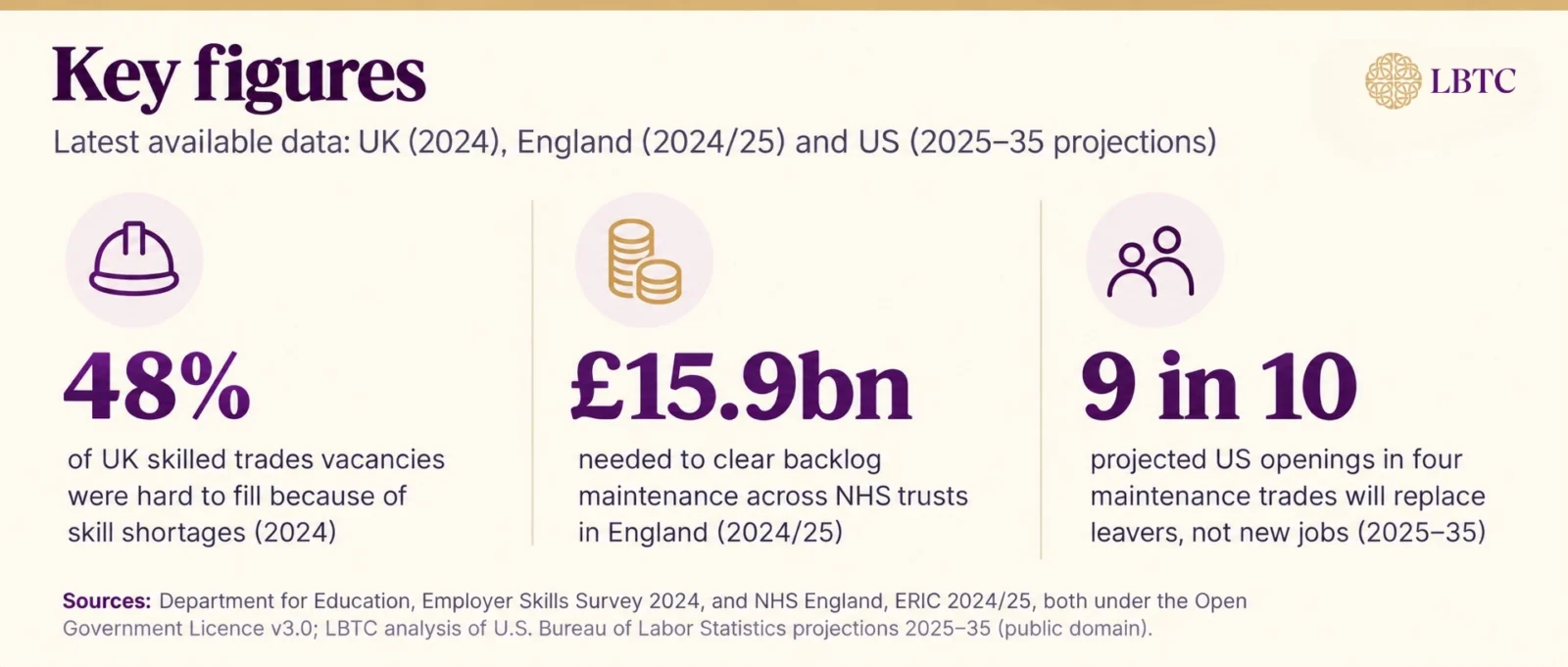
That workforce is getting harder to recruit. In the Employer Skills Survey, 48% of UK skilled trades vacancies in 2024 were hard to fill because applicants lacked the required skills, the highest rate of any occupation group (DfE, 2025a). Across NHS trusts in England, the cost of clearing backlog maintenance reached £15.9 billion in 2024/25 (NHS England, 2025).
For experienced Facilities Management and Workplace Management leaders, the management question is broader than “How quickly are work orders closed?” It is how technical services are organised so that people, assets, data, and risk controls work together.
This article sets out what technicians contribute that managers and systems cannot, and what labour market data say about supply. It explains how maintenance planning, asset management, and performance measurement can protect technical capability. It is written for leaders who answer for building operations, budgets or compliance, and who rely on technicians to turn plans into working, safe and legally compliant buildings.
Key Takeaways
- Technicians are the execution layer of hard Facilities Management, turning maintenance plans, compliance requirements, and asset strategies into physical results.
- Preventive Maintenance works best when technicians understand asset criticality, failure consequences, and escalation rules.
- Technician-generated CAFM and CMMS data is management information; poor records weaken Maintenance Planning and lifecycle decisions.
- UK employers report their sharpest skill shortages in skilled trades: 48% of vacancies were skill-shortage vacancies in 2024, compared with 27% across all occupations.
- Technician jobs are projected to grow despite AI. Around nine in ten US openings in four maintenance trades to 2035 will replace leavers.
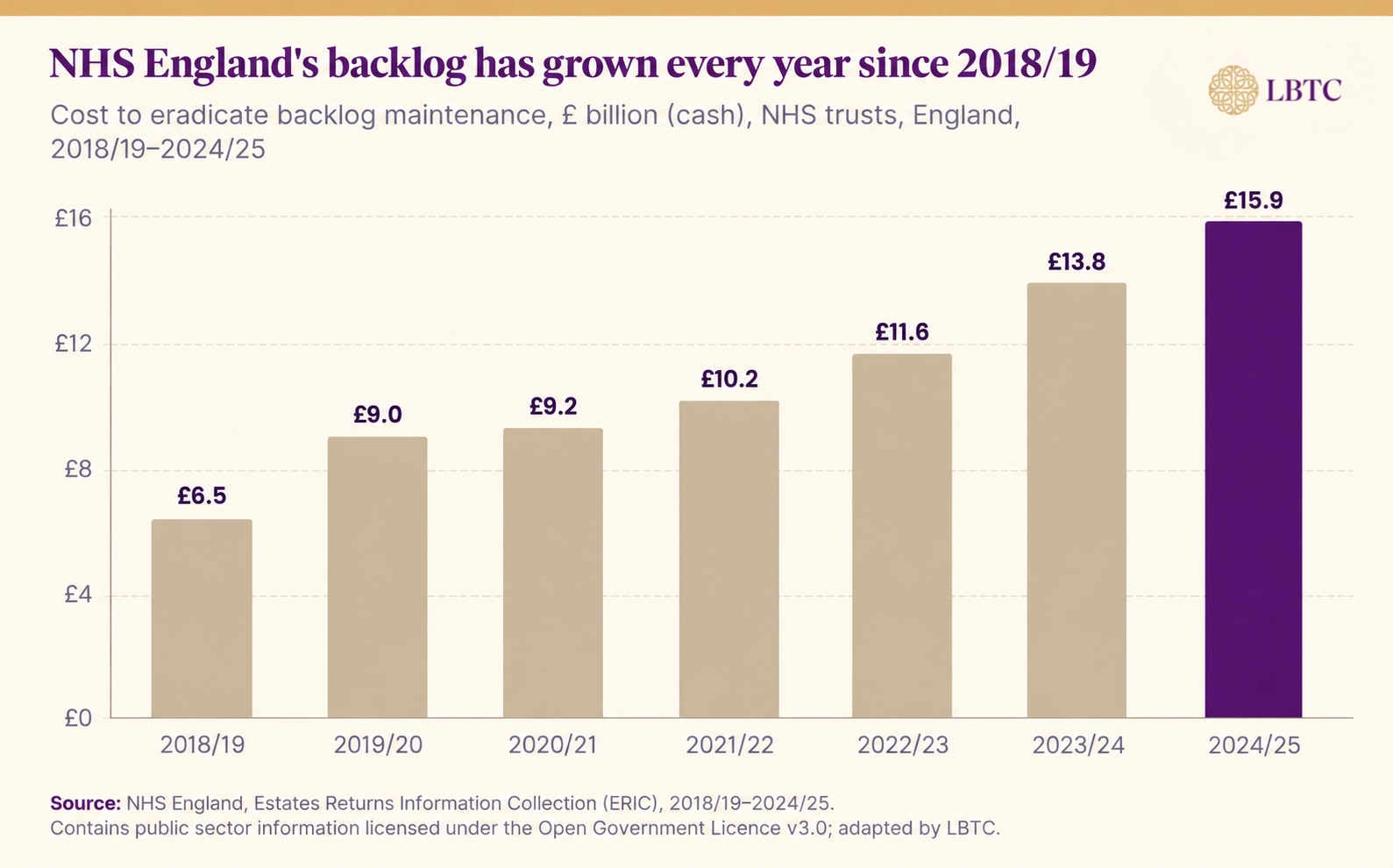
- Deferred maintenance of compounds. NHS trusts in England reported a £15.9 billion backlog in 2024/25, up from £9.0 billion in 2019/20 in cash terms.
- Assess performance through reliability, risk, quality, backlog, asset condition, and service outcomes, not work-order volume alone.
Why technicians matter to Facilities Management
Facilities Management brings together Building Operations, maintenance, compliance, workplace services and asset stewardship. Within that system, technicians are closest to the estate’s physical condition. They see recurring defects, unusual equipment behaviour, access problems, and operational workarounds before those issues appear in monthly reports.
That proximity creates value only when the organisation uses it. A technician who repeatedly resets a failing pump without recording the pattern may restore service temporarily. A technician who records the symptom, identifies the probable cause, checks maintenance history and escalates the asset for engineering review turns the same intervention into useful maintenance intelligence.
The UK Government’s Facilities Management Standard links hard FM to operational availability, statutory compliance, preventing asset deterioration, and sustainability. It also expects maintenance regimes to consider risk, asset criticality, and whole-life asset management. The implication is clear: Technical Maintenance should connect with risk, Asset Management, finance, and service delivery.
O*NET, the US Department of Labor’s occupational database, rates the importance of each work activity to an occupation on a 0 – 100 scale. A comparison of general maintenance and repair workers with facilities managers shows a clear division of labour (O*NET, 2026).

Technicians rate inspecting equipment at 87 and mechanical repair at 83, against 77 and 58 for facilities managers. The pattern reverses for coordinating the work of others: 76 for managers, 53 for technicians. Both groups place decision-making and problem-solving near the top of their work.
The ratings describe US occupations and average importance, not individual performance. Managers allocate money, people, and time. Technicians decide what the asset needs, and those judgements determine where facility maintenance budgets go.
Core Responsibilities of a Facilities Maintenance Technician
The exact role varies by building type, Facility Services model and technical specialism, but several responsibilities are common across Facility Operations.
Preventive Maintenance and Inspection
Typical Preventive Maintenance includes inspections, filter and belt changes, lubrication, testing, emergency lighting, adjustments and actions intended to identify deterioration before failure. A technician who records that a pump is running hot gives the planner time to act; a ticked “complete” box does not.
For Facilities Management leaders, completion alone is not enough. Work should match the asset, be proportionate to its criticality, and be supported by evidence. A completed task with no inspection result, measurement or defect note may satisfy a schedule but provide little control.
Fault Diagnosis and Reactive Maintenance
Reactive work will always exist. The difference is how it is handled. Technicians need to make equipment safe, restore service where appropriate, distinguish symptoms from underlying causes, and know when specialist escalation is necessary.
Diagnosis decides the cost of a breakdown. A technician must judge whether a reading points to a sensor’s fault or a failing compressor, and whether a defect can safely wait for the next planned visit. Emergency response belongs here too: isolating a leak quickly limits damage and downtime.
Building Systems and Competence Boundaries
Facilities technicians may work across HVAC, electrical distribution, lighting, plumbing, pumps, motors, controls, fire-system interfaces and building fabric. The law sets limits. Anyone working on gas fitting must be competent, and employers must belong to a class of persons approved by the Health and Safety Executive. Electrical work that needs technical knowledge to prevent danger requires that knowledge or suitable supervision. Multi-skilled roles can improve flexibility, but competence boundaries must remain clear. General technicians should not replace licensed, authorised, or specialist trades where risk or legal requirements demand specific competence.
Facilities managers need an explicit competence matrix showing what each technician may inspect, operate, isolate, adjust, or repair; what requires supervision; and what must be referred to a specialist contractor.
Record Keeping and Asset Information
Every completed inspection, defect, repair, and replacement becomes a valuable data point that improves knowledge of an asset condition. Technicians create much of the data behind Maintenance Planning: failure codes, condition observations, meter readings, parts used, labour time, test results and follow-on recommendations.
This is why the CMMS or CAFM discipline matters. The UK Government FM standard describes CAFM as supporting the tracking, planning, management and reporting of facilities information. If work orders are closed with unclear comments such as “done”, the system records activity without creating useful evidence.
How Technicians Contribute to Operational Efficiency
In maintenance management, operational efficiency comes from productive time on site. Good maintenance planning gives each job a realistic duration, the right parts, access arrangements, and any permits in advance. Maintenance scheduling groups work by location and skill to cut travelling and waiting time. In addition, maintenance activities identify problems that are invisible at the design or procurement stage, such as poor equipment access or recurring control faults.
First-time fixes avoid repeat visits and repeat disruption for occupants. Managers should avoid measuring efficiency through ticket closure alone. A stronger view examines repeat faults, overdue preventive work, emergency work, backlog age, critical-asset downtime and work quality alongside customer and safety outcomes.
Preventive Maintenance Should Be Risk-Based, Not Calendar-Driven
A maintenance schedule is not a strategy. A planned task that adds no value consumes scarce technician hours and teaches teams to treat the schedule as box-ticking. Statutory tasks are fixed by law and guidance and are not open to negotiation. For the rest, frequency should follow the consequence of failure, the asset’s condition and its fault history.
Technicians’ condition notes show which assets deteriorate faster than the plan assumes, and which tasks find nothing year after year. When they report condition, recurring defects and task relevance, Maintenance Planning can improve over time. If they are expected only to follow a static checklist, the organisation loses that learning loop.
The Technician’s Role in Asset Management and Lifecycle Planning
Asset Management depends on knowing what an organisation owns, its condition, how it performs, and when intervention is required. Technicians contribute to all four questions through inspection results, repair history, condition notes, and first-hand knowledge of asset behaviour.
The scale of deferred work shows why this matters. NHS England reported an estimated £15.9 billion cost to eradicate backlog maintenance across NHS trusts in England in 2024/25. However, the figure should not be attributed to maintenance practice alone, as estate age, funding levels and wider investment decisions can also contribute to maintenance backlog. It nevertheless illustrates the scale of the asset-management challenge that can develop when building condition and required works accumulate over time.
Facilities leaders should therefore connect technician observations with lifecycle planning. Recurring faults, obsolete components, long lead times for spares, poor access and increasing maintenance hours can all strengthen the business case for replacement or redesign. Relevant Facilities Management courses can help managers strengthen their understanding of asset management, lifecycle planning and maintenance decision-making.
Technical Work is also Communication Work
Technical competence is only part of the job. O*NET gives communication with supervisors, peers or subordinates an importance score of 84 for general maintenance and repair workers. That matters because many building faults cross organisational boundaries.
A leaking valve may require access coordination, isolation approval, occupant communication and specialist attendance. A power issue may involve electrical staff, IT, security and business-continuity teams. Technicians therefore need to explain risks clearly, provide useful handovers and describe defects in a way that supports sound management decisions.
Technical teams should be developed not only in trade skills but also in concise reporting, evidence-based escalation, contractor briefing and professional communication with building users.
Safety, Compliance and the Limits of Technical Autonomy
Maintenance work can involve electrical hazards, work at height, moving machinery, hot work, pressure systems and hazardous substances. Regulation 5 of the Workplace (Health, Safety and Welfare) Regulations 1992 requires workplaces and relevant equipment, devices and systems to be maintained in efficient working order and good repair. Article 17 of the Regulatory Reform (Fire Safety) Order 2005 similarly requires fire-safety facilities and equipment to be maintained in an efficient state, in efficient working order and in good repair.
Technicians provide much of the evidence that these duties are being managed in practice: completed inspections, defect reports, remedial work and accurate records. However, autonomy needs boundaries. Permit-to-work processes, isolation procedures, authorisation levels and escalation routes should make clear when a technician can act independently and when additional approval or specialist competence is required.
Digital Tools are Changing Technical Maintenance
CAFM and CMMS platforms, mobile work orders, building management systems, remote monitoring. smart meters, IoT sensors, mobile work orders and predictive analytics increasingly shape Facility Operations. These tools can make maintenance more visible and help teams prioritise work.
Analytics built on incomplete job data can produce confident but misleading conclusions. A sensor may flag an abnormal temperature, but a technician still needs to determine whether the cause is a failed sensor, blocked filter, control issue, valve fault or changing operating load. Digital tools therefore change the technician’s workflow more than they removes the need for technical judgement.
LBTC’s Facilities Management Operational Excellence course covers asset management, property management and facility technology, including CAFM and CMMS tools. Broader Facilities Management courses can also help managers understand how digital tools, asset data and maintenance systems support operational decision-making. For predictive maintenance, see LBTC’s article on AI in Facilities Management.
Facilities teams should involve technicians when configuring mobile forms, asset tags and alert workflows so recorded information supports future maintenance decisions.
Building a High-Performing Facilities Technical Team
High-performing teams do not depend on individual heroics. They depend on clear roles, appropriate competence, realistic planning and visible escalation routes.
Start with the estate’s critical and statutory systems and map them to named competent people. Pair that matrix with development plans, supervised sign-off for unfamiliar systems and clear routes from technician to supervisor, planner or specialist contractor. Protect time for preventive work rather than allowing reactive demand to consume the entire maintenance schedule.
Technical skill is the entry point, not the whole job. Facilities Management courses can support managers developing capability in contractor oversight, technical leadership, maintenance planning and team performance. High-performing teams select for diagnostic reasoning, adaptability, confidence with digital tools, and the ability to explain a problem clearly. LBTC’s Advanced Facilities Management course covers occupational health and safety management, contractor management and performance measurement for FM leaders.
Measuring Technician Performance Without Creating the Wrong Behaviour
Work-order closure time is easy to measure and easy to game. A team pressured to close jobs quickly may split work, close defects before the root cause is addressed or reduce the quality of records.
A balanced performance view should combine delivery, risk, quality and capability. Useful measures include planned maintenance completed within tolerance, first-time fix rate, open defects by risk and age, reactive-to-planned work ratio, work-order data quality, statutory compliance status and technician retention.
Managers should interpret measures together. Facilities Management courses can help managers develop practical approaches to performance measurement, maintenance planning and service improvement. A fall in reactive work is not positive if users have stopped reporting defects, and a high first-time resolution rate is not useful if teams close work prematurely.
Workforce Capacity Is a Strategic Facilities Management Issue
Technical labour availability deserves management attention because maintenance plans are only deliverable if competent people are available to execute them. The Department for Education’s Employer Skills Survey 2024 found that 48% of skilled-trades vacancies were skill-shortage vacancies, the highest proportion among the occupational groups reported. The all-occupation average was 27%.
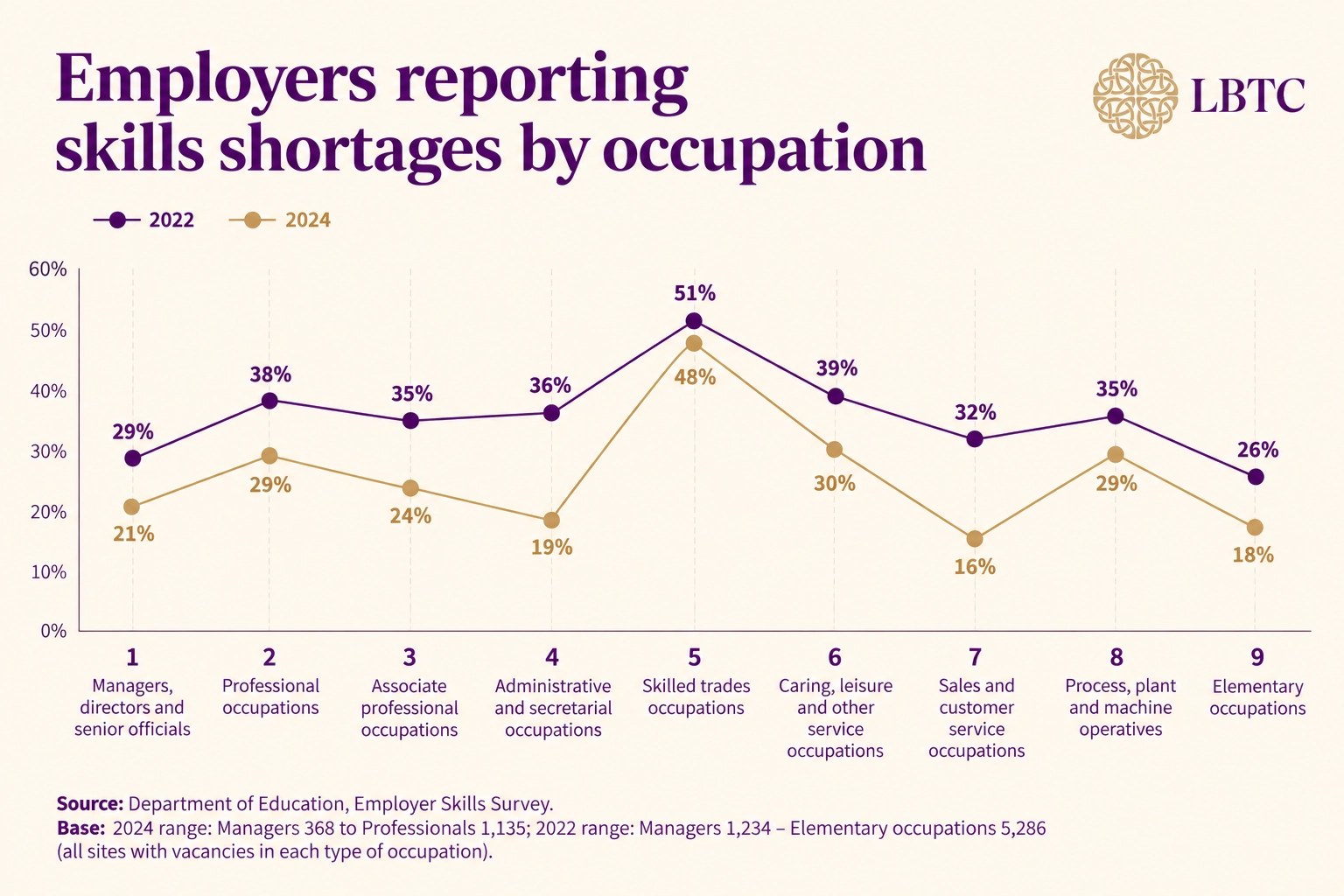
The skilled-trades category is broader than Facilities Management and includes occupations outside building services, so the figure should be treated as a labour-market signal rather than a direct measure of FM recruitment. Even so, it reinforces the need to plan for technical capability rather than assume it will always be available on demand.
Facilities leaders should monitor time to fill technical vacancies, turnover, succession coverage, apprenticeship or trainee pipelines and dependence on a small number of specialist contractors. Outsourced models require the same scrutiny; a contract does not guarantee suitably competent labour will always be available. Relevant Facilities Management courses can also strengthen workforce planning, contractor management and technical leadership capability.
US projections show why shortages persist. The U.S. Bureau of Labor Statistics projects 4% growth in general maintenance and repair jobs to 2035, yet about 148,700 openings each year (BLS, 2026a). LBTC’s charts below show how few are new jobs.
Around nine in ten hires refill a post, not a new job, projected hires needed a year per 100 workers, by reason, US, 2025–35. Each bar shows how many people must be hired each year for every 100 already working in that job. The purple part replaces people who retire, leave work or change occupation; the small gold part is new jobs from growth.
New jobs are a thin slice of each year’s openings, projected job openings a year, by reason, US, 2025–35. This is the same split in real numbers. General maintenance alone expects about 148,700 openings a year, but only 6,860 are new jobs; the rest refill posts that people leave.
For general maintenance and repair workers, HVAC mechanics, electricians and plumbers, LBTC’s calculation from BLS figures shows that more than nine in ten openings (92.5%) replace people who leave. Facilities managers follow the same pattern. The UK job market differs, but a team that never grows still has to hire. If contractors deliver your technical and facility services, keep someone in-house to check their work.
Practical Priorities for Facilities Managers
A useful review of Technical Services can start with six actions:
1. Identify the assets and statutory systems whose failure would create the greatest safety, compliance or operational consequence.
2. Check that Preventive Maintenance tasks and frequencies reflect those risks and current asset
condition.
3. Match technician competence and authorisation to the work being assigned.
4. Audit the quality of CAFM or CMMS job records rather than checking completion percentages alone.
5. Analyse repeat faults and ageing backlog to identify where reactive work is masking deeper asset
Problems.
6. Create a formal route for technician observations to influence Maintenance Planning, Asset
Management and capital replacement decisions.
These actions connect Facility Maintenance with wider business decisions rather than treating technical work as a collection of isolated jobs.
Conclusion: Technicians Are Where Strategy Becomes Reality
Technicians are central to Facilities Management success because they convert plans, budgets and service standards into operational reality. Their decisions affect reliability, safety, compliance, workplace experience and the quality of asset information available to managers.
The strongest organisations do not manage technicians as a reactive labour pool. They create clear competence boundaries, risk-based maintenance plans, disciplined work-order data, effective escalation routes and balanced performance measures. They also treat technician knowledge as an input to lifecycle and investment decisions.
For Facilities Management leaders, the practical question is therefore whether technical capability is being planned and protected as carefully as the assets themselves. LBTC’s Facilities Management courses explore the broader management, operational and asset-management capabilities needed to lead that work effectively.
Frequently asked questions
What does a maintenance technician do in Facilities Management?
A maintenance technician inspects, tests, maintains and repairs building systems within defined competence limits. The role typically includes Preventive Maintenance, fault diagnosis, reactive repairs, record keeping and escalation of defects that require specialist attention.
How is a maintenance technician different from a facilities manager?
Technicians are closer to the physical inspection, diagnosis and repair of assets. Facilities managers coordinate budgets, people, suppliers, priorities, risk and performance. Strong Facilities Management depends on both roles working together and sharing reliable information.
Why is preventive maintenance important in Facility Operations?
Preventive Maintenance can identify deterioration before failure and make work more predictable. However, it is most useful when tasks and frequencies reflect asset condition, criticality and legal requirements rather than being followed mechanically.
Why is CMMS or CAFM data important for Maintenance Management?
Maintenance systems create the history used for planning, budgeting and lifecycle decisions. Accurate job records help managers identify repeat failures, understand asset condition, prioritise backlog and demonstrate that required work has been completed.
How should Facilities Management measure technician performance?
Use a balanced set of measures covering planned maintenance, repeat faults, backlog, statutory actions, work-order quality, asset downtime, safety and capability. Avoid relying on closure speed or job volume alone because those measures can encourage the wrong behaviour.