


All You Need to Know About Management Consulting and How It Helps Businesses
21 min read
Management consultancy is a service offered by consulting firms or businesses that helps their clients improve the effectiveness of an organisation’s strategy, operational processes and structure. As new technologies emerge, customer expectations change, costs rise, and regulations evolve, organisations must continually review how they operate.
Consultants solve complex problems by providing external expertise and practical advice grounded in structured analysis. A management consultancy identifies areas where your company can add value and improve business performance. It can also build essential skills within the organisation. When challenges extend beyond a single department, consultants can help coordinate change across several functions.
Companies may commission consultancies to create a strategic plan to help them achieve a specific goal. Their work may involve running a project to support business growth, recommending cost-saving initiatives or helping introduce new systems. Depending on the engagement, they can also provide implementation support rather than advice alone. The value of this work depends on understanding the underlying problem, developing appropriate recommendations and translating them into workable changes.
This guide explains what management consultancy is, what management consultants do, the main areas of consulting and how organisations can decide whether external support is appropriate.
Key Takeaways
- Management consultancy helps organisations analyse complex business challenges and develop practical responses.
- Consultants can provide an independent perspective, specialist expertise and additional project capability.
- Management consulting may cover strategy, operations, technology, finance, people and organisational change.
- A consultancy engagement can extend from diagnosis and recommendations through to implementation and review.
- Strategy consulting is generally narrower than management consulting, although the two often overlap.
- Consultancy does not guarantee better performance; results depend on the quality of the analysis, solution, implementation and organisational participation.
- Organisations should compare consultancy with alternatives such as internal improvement teams, recruitment, training or process changes.
What Does a Management Consultancy Do?
A management consultant provides impartial advice to help streamline business operations and improve productivity and profitability over time. This support can also help organisations manage change and work towards strategic or operational objectives.
Organisations seek help from a management consultancy for many reasons. Often, they need an independent business professional to assess how the company operates from an external perspective. Consultants work with leaders, employees and other stakeholders to understand the challenges they face and explore practical solutions.
Management consultants can support the following aspects of a business:
- Human resources
- Marketing
- Business strategy
- IT and communications
- Supply chain
- Finance
The different sectors they work in include:
- Charities
- Manufacturing
- Educational services
- Retail
- Healthcare
- Hospitality
- Media
- Public sector
- Financial services
A management consultant’s main responsibility is to review the organisation, analyse areas for improvement, and develop appropriate recommendations. Depending on the challenge, this may involve organisational design, technology implementation, cost management or wider transformation. The work should begin with the organisation’s actual needs, not a predetermined solution.
For example, declining performance may initially appear to be a staffing problem. Further analysis might reveal inefficient processes, unclear responsibilities, unsuitable technology or conflicting performance measures. Addressing only the visible symptoms could leave the underlying issue unresolved.
Consultants can be particularly useful when a challenge crosses departmental boundaries, as they examine how processes, systems, people and decisions interact across the organisation. When the agreed contract includes implementation, they can also help introduce new methods and support teams in putting the recommended changes into practice.
What Does a Management Consultant Do?
As a management consultant, your job role may include the following responsibilities, depending on the client, industry and project:
Understanding how the company operates:
Review the organisation’s objectives, structure, procedures and operating environment. This includes researching competitors, supply chains and other key business areas while understanding the organisation’s resources and constraints.
Gather feedback from staff, senior management, and other stakeholders:
Speak with people involved in or affected by the challenge, including customers and suppliers where relevant. Their perspectives can reveal practical issues that may not be apparent from management reports alone.
Collecting and analysing data from different business areas:
Review business data, documents, systems and controls, and map processes to understand how work is carried out. Consider relevant market or regulatory factors alongside internal evidence to build an informed assessment.
Identifying problems and recommending improvements:
Establish the underlying causes of a problem rather than addressing only its visible symptoms. Develop possible solutions and assess them against cost, risk, available resources, organisational capability and expected benefits to determine whether they are practical.
Developing proposals and presenting plans to the client’s management team:
Explain the findings, recommended improvements and reasons behind them. Outline how the proposed changes could be implemented, including responsibilities, timelines, resources, dependencies, oversight and agreed performance measures.
Applying solutions and supporting the organisation through change:
Where implementation is included in the agreed engagement, help introduce new systems, processes, structures or ways of working. Relevant project management training may also help internal teams strengthen their ability to plan and coordinate implementation.
Reviewing results and transferring knowledge:
Use agreed KPIs or other measures to assess progress, recognising that factors beyond the consultancy project may also influence performance. Help internal teams understand the new methods and responsibilities so they can maintain improvements after external support ends.
Specialised Fields in Management Consulting
Management consultancy covers a wide range of management issues. Individual consultants or firms may specialise by business function, sector or type of organisational challenge. The main areas include:
Strategy Consulting:
Focuses on decisions about an organisation’s future direction, including growth, market entry, competitive positioning and business transformation. Consultants assess the organisation and its external environment to help leaders evaluate priorities and options. Strategic management courses can complement external advice by strengthening internal strategy development.
Operational Consulting:
Examines how an organisation delivers its products or services, covering processes, procurement, supply chains, resource utilisation and service quality. The aim may be to reduce avoidable costs, improve productivity or enhance customer experience. When the main need is internal skills development, operations management courses may complement, or sometimes replace, consultancy.
Marketing Consulting:
Helps organisations understand their markets, customers and competitive position. Projects may involve market research, customer strategy, marketing planning or improvements to sales processes and commercial performance.
Financial Consulting:
Supports financial decision-making through financial strategy, cost analysis, forecasting, business cases and performance analysis. It may also involve improving finance processes or supporting wider finance transformation.
Human Resources Consulting:
Addresses people-related challenges, including workforce planning, organisational design, leadership, performance management and culture. Consultants may also support change management by helping employees understand and adopt new ways of working. Leadership and change management training can strengthen internal capability alongside consultancy support.
Technology Consulting:
Helps organisations evaluate systems, develop digital strategies and manage technology-enabled transformation. Because new technology can affect processes, responsibilities, data, governance and skills, consultants consider how it fits within the wider organisation rather than treating implementation as a purely technical task.
Applications Consulting:
Focuses on selecting, integrating and using business applications to support organisational needs, often as part of a broader technology consulting engagement.
Environmental Consulting:
Examines the environmental impact of an organisation’s activities and identifies opportunities to improve environmental practices and performance.
Quality Management Consulting:
Focuses on the processes, standards and controls used to maintain and improve the quality of products or services.
Outsourcing Consulting:
Helps organisations assess which activities may be suitable for outsourcing and how to manage relationships with external service providers.
Public Sector Consulting:
Alongside these functional specialisms, consultants may focus on sectors. Public sector consulting supports government departments, local authorities, healthcare organisations and other public bodies with strategy, operational improvement, digital transformation, cost management and service redesign.
When selecting external support, organisations should assess relevant expertise alongside cost, accountability, knowledge transfer and measurable outcomes.
Management Consulting and Strategy Consulting: What Is the Difference?
Management consulting and strategy consulting are closely related, and firms use the terminology differently.
In general, management consulting is broader. It may cover strategy alongside operations, people, technology, organisational change and implementation.
Strategy consulting usually concentrates more specifically on high-level direction: where an organisation should compete, what priorities it should pursue and how it intends to achieve longer-term objectives.
For example, a strategy project might recommend entering a new market. A broader management consultancy engagement could then examine the operating model, workforce, technology, processes and implementation required to support that decision.
In practice, strategy and implementation often overlap.
Management Consultant vs Business Consultant: What Is the Difference?
The terms business consultant and management consultant are often used interchangeably, and no universal occupational boundary exists between them.
A business consultant may focus on a particular area such as marketing, finance, HR, operations or business development.
Management consultancy can sometimes take a broader organisational perspective, particularly when a challenge involves several functions, management systems or organisation-wide transformation.
The consultant’s expertise, proposed scope and deliverables are therefore more important than the title alone.
The same principle applies to the distinction between advisory and consultancy. Some advisory engagements focus mainly on analysis and recommendations, while broader consultancy projects may continue into solution design and implementation. Organisations should clarify the actual scope rather than relying on terminology.
What Is the Management Consulting Process?
Every consultancy project is different, but effective engagements commonly follow several stages.
1. Define the Challenge
The consultancy and client establish the organisation’s objectives, current challenges, project scope, stakeholders and desired outcomes.
Getting this stage right is essential. Solving the wrong problem efficiently still produces the wrong outcome.
2. Diagnose the Current Situation
Consultants gather relevant information through interviews, workshops, observations, documents, data analysis and process reviews.
The objective is to establish an evidence-based picture of the organisation’s current position.
3. Identify Root Causes
Visible business problems are often symptoms of deeper issues.
For example, poor customer satisfaction could result from inefficient processes, inadequate systems, unclear responsibilities, skills gaps or a combination of several factors.
Root-cause analysis helps prevent organisations from investing resources in temporary fixes.
4. Develop Recommendations
The consultant develops possible solutions and evaluates them against factors such as feasibility, cost, risk, resources and expected impact.
Recommendations should reflect the organisation’s actual circumstances rather than relying on a generic model.
5. Plan and Implement Change
Once the appropriate solution is agreed, attention shifts to execution.
This can involve project planning, communication, process redesign, training, new systems, governance structures and change management.
6. Embed and Measure Improvement
Successful transformation should continue after the consultancy engagement ends.
Processes, responsibilities and capabilities therefore need to become embedded within the organisation.
Progress can then be assessed using agreed measures and KPIs.
Why Do Organisations Use Management Consultants?
Organisations usually engage consultants because they need expertise, independence or temporary capability that is not readily available internally.
Common reasons include:
- A challenge affects several departments.
- Specialist knowledge is unavailable internally.
- Leadership requires an independent assessment.
- A significant transformation is planned.
- Existing processes or systems are no longer suitable.
- A new strategy requires coordinated implementation.
- Performance problems have proved difficult to resolve.
- A time-limited project requires additional capacity.
An external consultant can also challenge assumptions embedded in established ways of working.
However, consultancy should not automatically be the preferred response. Organisations should compare it with alternatives such as internal improvement teams, recruitment, bespoke training, coaching or changes to existing processes.
The decision should depend on the capability gap, urgency, complexity, cost and outcomes required.
When Should a Business Consider Management Consultancy?
Not every business problem requires external consultancy.
However, organisations may benefit from management consultancy when:
- growth has slowed or performance is declining;
- existing processes are no longer suitable;
- a major organisational transformation is planned;
- multiple departments need to work together on a complex challenge;
- leadership needs an independent assessment;
- a new strategy needs to be developed or implemented;
- technology or systems need significant change;
- costs need to be controlled without damaging performance;
- internal teams lack the specialist expertise required;
- change initiatives repeatedly fail to become embedded; or
- the organisation is expanding into new markets or ways of operating.
The strongest consultancy relationships start with a clearly understood business need, not with bringing consultants in simply because change is expected.
What Makes Management Consultancy Effective?
Effective consultancy combines expertise with disciplined analysis, collaboration and implementation.
Recommendations need to reflect the organisation’s actual strategy, culture, workforce, systems, resources and constraints. A generic solution that worked elsewhere may fail when transferred without considering context.
Several factors are particularly important.
Clear scope: The client and consultant should agree on the problem, objectives, responsibilities, deliverables and boundaries of the engagement.
Evidence-led diagnosis: Recommendations should be based on appropriate data, stakeholder input and analysis rather than assumptions.
Practical recommendations: Proposed changes should reflect available resources, capabilities, dependencies and risks.
Stakeholder involvement: People responsible for operating or implementing a change often hold information that is essential to a workable solution.
Implementation discipline: Responsibilities, timelines and measures should be clear enough to turn recommendations into action.
Knowledge transfer: Where possible, the engagement should strengthen internal capability rather than create unnecessary long-term dependence on external support.
How to Choose a Management Consultancy
Start with the business problem, not the consultancy firm.
A potential provider should demonstrate that it understands the challenge before presenting a predetermined solution. Useful questions include:
Do they understand the problem?
The consultant should be able to explain the organisation’s objectives, stakeholders, constraints and operating environment.
Do they have relevant expertise?
Look for experience related to the business function, transformation requirement or sector involved. Experience should match the problem, not just be generally impressive.
What will they deliver?
Clarify whether the engagement includes diagnosis, recommendations, implementation, capability building or ongoing support.
How will they work with internal teams?
Collaboration is particularly important when organisational knowledge, employee adoption and implementation are central to the project.
How will success be evaluated?
Agree appropriate outcomes and measures before implementation. These might include operational indicators, cost measures, service outcomes, milestones or capability improvements.
How will knowledge be transferred?
Establish what internal teams will need to understand or manage once the engagement ends.
Price is important, but the cheapest proposal is not necessarily the best value. Organisations should consider the quality of the proposed approach, relevant expertise, implementation support and the likelihood that the work will produce sustainable capability.
Salary Expectations and Career Development in Management Consultancy: Planning for 2027
Earnings in management consultancy vary by role responsibilities, employer, location, and the level of expertise a consultant brings. For professionals entering the field, the Prospects management consultant career profile reports graduate starting salaries of around £30,000–£45,000 at some large consulting firms, while smaller consultancies may offer lower starting salaries. Early-career consultants typically support client projects by researching business challenges, analysing information and contributing to recommendations.
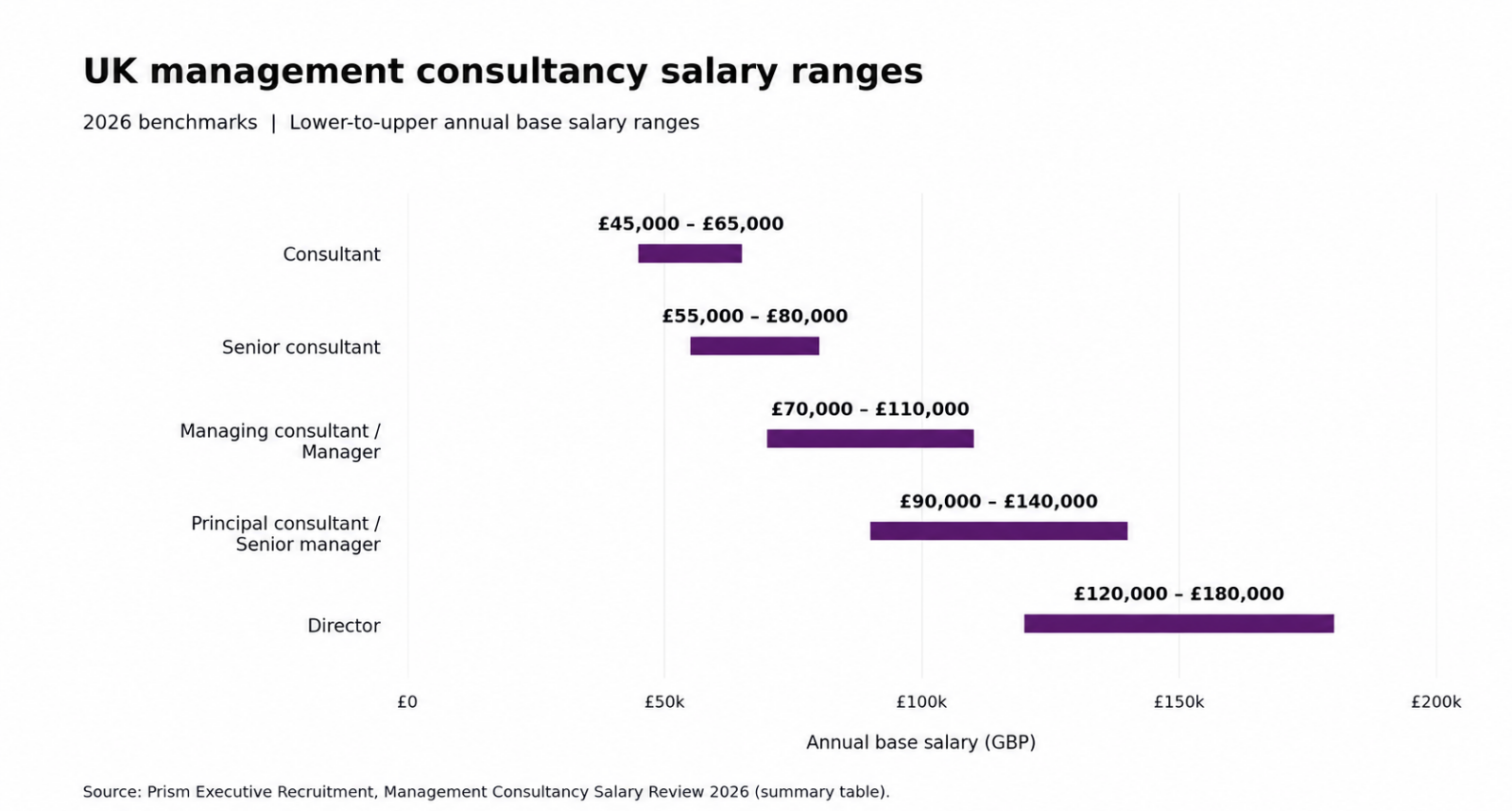
For more experienced professionals, the Management Consultancy Salary Review 2026 from Prism Executive Recruitment provides indicative annual base salary ranges of £45,000–£65,000 for consultants, £55,000–£80,000 for senior consultants and £70,000–£110,000 for managers or managing consultants. The review places principal consultants and senior managers at £90,000–£140,000, while directors may earn £120,000–£180,000 in base salary. Bonuses and additional benefits are separate and vary between employers. These figures are useful for career planning but treat them as 2026 market benchmarks rather than confirmed salaries or forecasts for 2027.
Career development in management consultancy usually involves a gradual shift from supporting individual assignments towards managing projects, supervising colleagues and building stronger client relationships. At more senior levels, responsibilities may also include winning new work, develop client accounts and contribute to the consultancy’s wider commercial growth. As Prospects notes, experienced consultants may also choose to move into independent practice rather than continue through a traditional consultancy promotion structure.
LBTC’s Approach to Management Consultancy
Complex business challenges rarely have one-size-fits-all solutions.
LBTC’s Management Consultancy service is built around each organisation’s specific goals and requirements.
Tailored Solutions for Complex Challenges
Consultancy projects are designed around the organisation, not forced into a standard solution.
LBTC works with relevant stakeholders to understand challenges that may extend across departments and functions before developing appropriate strategies and solutions.
Sustainable, Long-Term Improvement
The objective is not simply to address today’s immediate problem.
Effective consultancy should help organisations develop the systems, processes and capabilities needed to continue improving and respond confidently as their business environment changes.
End-to-End Collaborative Support
LBTC can work alongside organisations from initial diagnosis through planning and implementation.
Projects can also include on-site support in the UK or internationally where required.
This collaborative approach helps move consultancy from recommendations on paper to changes that can become embedded within the organisation.
Expertise in Organisational Change
Organisational transformation can involve strategy, leadership, operations, people and processes simultaneously.
Drawing on expertise across these areas enables consultancy projects to consider how different parts of the organisation interact, helping reduce implementation risks and support coordinated change.
Turning Business Challenges into Sustainable Change
Management consultancy ultimately helps an organisation move from a defined challenge or opportunity to an appropriate course of action.
Strong engagements do more than identify what appears to be wrong. They investigate root causes, involve relevant stakeholders, analyse evidence, develop realistic options and establish how change will be implemented and evaluated.
External consultants can provide valuable expertise, capacity, and independent analysis, but consultancy does not guarantee improved performance.
The value of an engagement depends on the quality of the diagnosis, the suitability of the recommendations, the discipline of implementation and the organisation’s ability to sustain improvements after the consultant leaves.
Frequently Asked Questions About Management Consultancy
What is management consulting?
Management consulting is a professional service through which consultants help organisations analyse business challenges, improve performance, develop strategies or implement organisational change.
What does a management consultant do?
A management consultant investigates organisational problems, analyses information, engages stakeholders and develops practical recommendations. Depending on the engagement, the consultant may also support implementation and evaluate results.
What do consulting companies do?
Consulting companies provide specialist expertise and additional project capability. Their work may include diagnosis, strategy development, process improvement, technology implementation, organisational change and implementation support.
What is the difference between management consulting and strategy consulting?
Strategy consulting generally focuses more specifically on strategic direction and high-level choices. Management consulting is broader and may include strategy alongside operations, technology, people, change and implementation.
Is a business consultant the same as a management consultant?
The terms often overlap. A business consultant may specialise in a particular function, while management consultancy can involve wider organisational or cross-functional challenges. The actual expertise and scope of work matter more than the title.
When should a business consider management consultancy?
Consultancy may be appropriate when a problem is complex, crosses several functions, requires specialist expertise, needs an independent assessment or demands temporary project capability that is not available internally.
Does management consultancy guarantee better business performance?
No. Consultants can provide analysis, expertise and implementation support, but outcomes also depend on organisational participation, execution, external conditions and the suitability of the recommended changes.