

The Triple Bottom Line: Profit, People, and Planet in Corporate Governance
14 min read
Modern businesses face increasing pressure to balance profit with social and environmental responsibility. Today, organisations must think beyond financial performance alone. Customers, investors, employees, regulators, and communities now expect companies to operate with transparency, accountability, and ethical standards.
Because of this shift, the Triple Bottom Line has become an important framework in corporate governance and sustainable business strategy. The Triple Bottom Line, often called TBL, measures organisational success across three areas: profit, people, and planet.
Instead of focusing only on shareholder returns, businesses now consider stakeholder engagement, environmental impact, employee well-being, and long-term business continuity. This wider approach supports better governance, stronger leadership, improved risk management, and more responsible decision-making.
Corporate governance courses are also becoming increasingly relevant, as leaders need practical knowledge of sustainability, ethics, compliance, and governance frameworks. By understanding the Triple Bottom Line, professionals can make better decisions that support both business performance and long-term social value.
Key Takeaways
- The Triple Bottom Line measures business success through profit, people, and planet.
- Corporate governance helps organisations manage sustainability, accountability, ethics, and risk.
- The profit pillar focuses on financial stability, transparency, compliance, and long-term value.
- The people pillar focuses on employees, customers, suppliers, communities, and stakeholder engagement.
- The planet pillar focuses on environmental sustainability, resource efficiency, emissions, and responsible sourcing.
- Corporate governance courses help professionals develop leadership skills, ethical awareness, and practical knowledge of sustainability.
- Businesses that apply TBL principles can improve reputation, risk management, employee engagement, investor confidence, and long-term business continuity.
Understanding the Triple Bottom Line
The Triple Bottom Line is a sustainability framework for measuring organisational performance across three interconnected areas: profit, people, and planet.
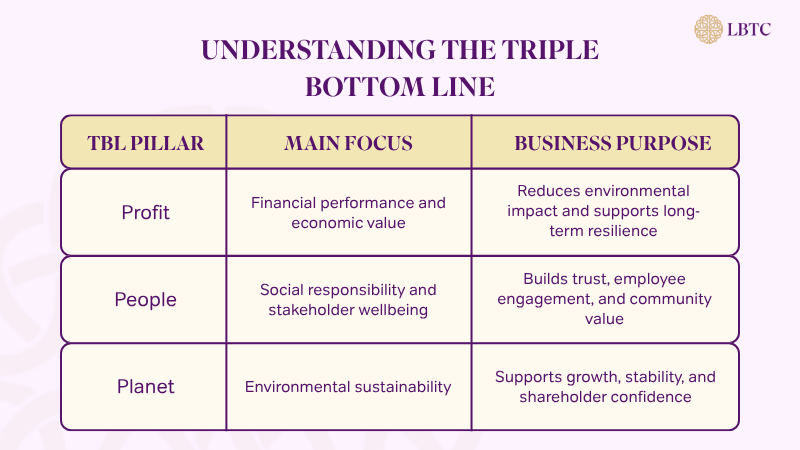
The concept was developed by John Elkington in the mid-1990s. It challenged the traditional business view that success should be measured mainly by profit. Instead, the Triple Bottom Line argues that responsible organisations should also measure their social and environmental performance.
Today, the framework is closely connected to corporate governance, ESG reporting, sustainability strategy, and responsible leadership. It encourages directors, executives, and managers to think carefully about how business activities affect society, the environment, and long-term organisational value.
The Three Pillars of the Triple Bottom Line
1. Profit: The Financial Bottom Line
Profit remains essential for every business. Without financial stability, organisations cannot grow, compete, invest, or deliver long-term value to stakeholders.
However, the Triple Bottom Line promotes sustainable profit rather than short-term financial gain. Businesses should achieve economic success while maintaining ethical standards, regulatory compliance, and responsible governance.
Strong financial governance may include transparent reporting, responsible executive compensation, ethical decision-making, long-term planning, risk management, and regulatory compliance.
In modern business environments, investors increasingly examine governance structures before making investment decisions. Strong governance builds confidence among shareholders, employees, customers, and regulators.
Organisations that focus only on short-term profit may face serious problems later. Poor oversight, weak accountability, and unethical practices can damage reputation, reduce trust, and weaken long-term performance.
2. People: The Social Bottom Line
The people pillar focuses on social responsibility and stakeholder engagement. Businesses must understand how their actions affect employees, customers, suppliers, nonprofit organisations, and communities.
A company may achieve financial success while still creating negative social impacts. Therefore, organisations must examine whether their business practices support fairness, diversity, employee wellbeing, ethical standards, and community value.
Key social considerations include workplace safety, diversity and inclusion, ethical leadership, employee development, fair compensation, communication, and transparency.
Strong business leadership supports healthier workplace cultures and better employee engagement. Employees increasingly prefer organisations that demonstrate strong ethics, fairness, and social responsibility.
Businesses that invest in people often experience higher employee retention, stronger productivity, better collaboration, improved customer loyalty, and stronger long-term business continuity.
3. Planet: The Environmental Bottom Line
The planet pillar focuses on environmental sustainability. Businesses must consider how their operations affect natural resources, climate, ecosystems, and future generations.
Environmental issues now influence regulation, investor decisions, consumer behaviour, supply chains, and corporate strategy. As a result, environmental oversight has become a major responsibility for board members, executives, and managers.
Environmental initiatives may include reducing carbon emissions, improving energy efficiency, supporting sustainable sourcing, reducing waste, protecting natural resources, and improving environmental reporting.
Many organisations now include sustainability goals in governance frameworks because environmental risk can directly affect profitability, compliance, reputation, and long-term business continuity.
Technology, artificial intelligence, and research tools can also support better environmental monitoring, reporting, and decision-making.
Why the Triple Bottom Line Matters
The Triple Bottom Line matters because it provides a more complete view of organisational success.
Traditional business models focused mainly on economics and financial performance. However, companies now operate in a more complex context where stakeholders expect ethical behaviour, sustainability, transparency, and accountability.
The TBL framework helps organisations improve governance, strengthen accountability, reduce risk, support ethical considerations, enhance communication, and deliver long-term value.
Businesses that apply Triple Bottom Line principles can build stronger public trust and investor confidence. They are also better prepared to respond to changing regulations, market expectations, and sustainability challenges.
Corporate Governance and the Triple Bottom Line
Corporate governance plays a central role in sustainability success. Governance refers to the systems, processes, and structures used to direct and control organisations responsibly.
Strong governance helps leaders make effective decisions while balancing financial, social, and environmental priorities. Without proper governance, sustainability strategies may become short-term marketing messages rather than meaningful business commitments.
Good corporate governance supports accountability, transparency, ethical decision-making, regulatory compliance, risk oversight, stakeholder engagement, and strategic management.
Board members and executives must ensure sustainability becomes part of organisational strategy. This includes setting clear goals, measuring progress, assigning responsibility, and communicating results openly.
This is one reason why many professionals pursue corporate governance courses. These courses help managers, directors, and business leaders understand governance responsibilities and apply sustainability principles more effectively.
How Triple Bottom Line Reporting Has Evolved
Triple Bottom Line reporting has changed significantly over time.
In the past, most organisations focused mainly on financial reporting. Today, many corporations publish environmental, social, and governance reports alongside financial statements.
This change reflects growing interest in sustainability, corporate ethics, environmental protection, stakeholder engagement, and regulatory compliance.
Modern sustainability reports may include carbon-reduction targets, employee well-being metrics, diversity statistics, community investment programmes, governance oversight structures, and supply chain standards.
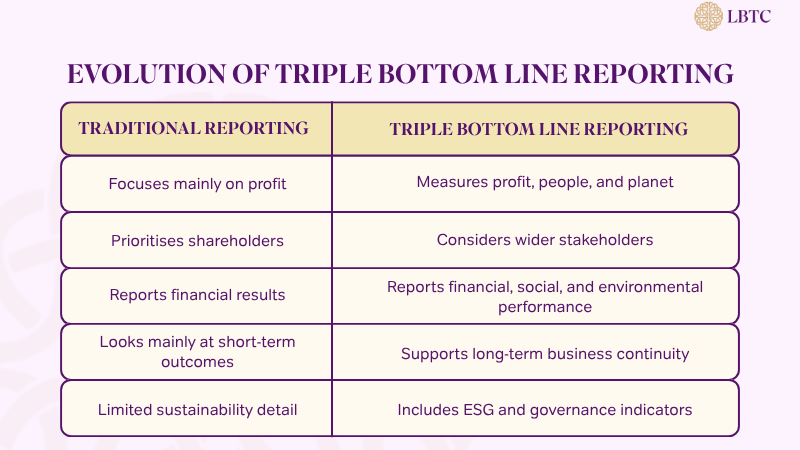
The inclusion of environmental and social indicators shows how sustainability has become a core part of modern management and governance.
Using the Triple Bottom Line as a Decision-Making Framework
The Triple Bottom Line helps organisations make more balanced business decisions.
Instead of asking only whether a decision will increase profit, leaders also consider how it will affect people, communities, the environment, and long-term sustainability.
Organisations using TBL frameworks often ask:
- How will this decision affect stakeholders?
- Does this strategy support long-term sustainability?
- What risks could emerge later?
- Are ethical standards being maintained?
- How will this decision affect environmental performance?
- Does this decision support business continuity?
- This approach encourages responsible leadership, stronger accountability, and better strategic planning.
Benefits of Applying the Triple Bottom Line
1. Stronger Reputation
Consumers increasingly support businesses that demonstrate ethics, sustainability, and social responsibility. A positive reputation strengthens customer trust and improves market position.
2. Better Risk Management
The Triple Bottom Line helps organisations identify operational, environmental, social, and governance risks earlier. Strong risk management supports legal compliance, financial stability, resilience, and business continuity.
3. Improved Stakeholder Relationships
Stakeholder engagement becomes easier when organisations communicate openly and operate responsibly. This improves relationships with investors, employees, customers, communities, suppliers, and regulators.
4. Higher Employee Engagement
Employees often want to work for organisations that align with their values. Strong ethics and responsible leadership can improve morale, retention, productivity, and collaboration.
5. Long-Term Financial Success
Sustainable practices can reduce operational costs and strengthen profitability over time. Examples include energy savings, waste reduction, improved efficiency, lower legal risks, and stronger customer loyalty.
Challenges of Implementing the Triple Bottom Line
Although the benefits are significant, implementation can be difficult.
1. Measuring Social Impact
Financial data is usually easier to measure than social and environmental impact. Organisations may struggle to track community impact, employee wellbeing, and environmental improvements.
2. Balancing Competing Priorities
Executives and board members often face pressure to deliver short-term financial results. Sustainability initiatives may require long-term investment before producing measurable returns.
3. Organisational Resistance
Some leaders and employees may resist operational changes linked to sustainability strategies. Strong communication, leadership development, and executive education can help organisations overcome resistance.
4. Regulatory Complexity
Businesses must comply with evolving regulations related to environmental protection, labour standards, governance, data privacy, and financial reporting. Regulatory compliance continues to become more complex across industries.
How Businesses Can Incorporate the Triple Bottom Line
1. Set Clear Goals
Organisations should establish measurable sustainability targets related to environmental performance, employee wellbeing, governance improvement, and community engagement.
2. Integrate Sustainability Into Strategy
Sustainability should influence operations, supply chains, finance, communication, risk management, business structure, and corporate strategy.
3. Invest in Leadership Development
Strong leadership is essential for sustainability success. Corporate governance courses and executive education programmes can help professionals develop governance knowledge, leadership skills, ethical awareness, strategic thinking, and risk management abilities.
4. Improve Transparency
Open communication builds trust with stakeholders. Organisations should publish clear information about ESG performance, sustainability goals, governance structures, and ethical policies.
5. Use Technology and Research
Modern tools, artificial intelligence, and research platforms can help organisations improve sustainability tracking, reporting, and governance oversight.
Real-World Examples of the Triple Bottom Line
Patagonia
Patagonia is widely recognised for its environmental sustainability, ethical sourcing, and responsible supply chain practices. Its strong commitment to sustainability has helped build customer loyalty, brand trust, and a reputation for responsible business.
Unilever
Unilever has integrated sustainability into its global business strategy, focusing on key areas such as climate, nature, plastics, and livelihoods. Through its global brands and supply chains, the company supports social and environmental initiatives across different markets.
Microsoft
Microsoft continues to invest in renewable energy, carbon reduction programmes, and sustainability governance. These efforts reflect how environmental responsibility and long-term business strategy can work together when supported by strong leadership and accountable governance.
The Growing Importance of Corporate Governance Education
Corporate governance education is becoming more important as the modern business environment grows more complex. Organisations now need leaders who can manage governance, ethics, sustainability, compliance, mergers, risk management, and stakeholder engagement. In this context, a strong business structure helps companies improve transparency, accountability, and long-term business continuity.
Corporate governance courses provide professionals with practical knowledge that can support diverse career paths and goals. These courses are useful for people working in management, finance, law, public policy, nonprofit organisations, university administration, and corporate leadership. They help learners explore how governance frameworks work in real organisations and how responsible leadership can improve decision-making.
Professionals can also leverage corporate governance training to strengthen leadership skills, ethical awareness, strategic thinking, and risk oversight. This knowledge helps them lead teams, support better business structures, and make decisions that balance profit, people, and planet.
For anyone aiming to move into senior management, board advisory roles, compliance, ESG leadership, or executive positions, corporate governance education can provide the tools needed to grow with confidence. It connects professional development with real-world business needs and helps organisations build more responsible, sustainable, and effective leadership.
Conclusion
The Triple Bottom Line has transformed how businesses measure success. Organisations can no longer focus only on profit. They must also consider social responsibility, environmental sustainability, stakeholder engagement, and ethical governance.
The framework encourages better governance, stronger accountability, improved stakeholder relationships, responsible leadership, and long-term business continuity.
Businesses that adopt TBL principles often gain stronger reputations, better risk management, improved employee engagement, greater investor confidence, and more sustainable financial performance.
However, success requires effective leadership, transparent governance structures, ethical standards, clear reporting, and strategic planning.
As sustainability expectations continue rising, professionals increasingly pursue corporate governance courses to strengthen their leadership capabilities and governance knowledge.
The future of business belongs to organisations that successfully balance profit, people, and planet.
Frequently Asked Questions (FAQs)
1. What is the Triple Bottom Line?
The three pillars are profit, people, and planet. Together, they measure financial, social, and environmental performance. The Triple Bottom Line is a sustainability framework that measures organisational success.
2. Why is corporate governance important for sustainability?
Corporate governance helps organisations maintain accountability, transparency, ethical standards, risk management, and regulatory compliance while supporting sustainability goals. Consumers, investors, regulators, and employees increasingly expect organisations to operate responsibly, follow ethical standards, and support long-term environmental and social sustainability.
3. How do corporate governance courses support business leadership?
Corporate governance courses help professionals develop leadership skills, governance knowledge, ethical decision-making abilities, and regulatory compliance expertise.
4. What are the benefits of applying the Triple Bottom Line?
Benefits include improved stakeholder engagement, better risk management, stronger reputation, increased employee satisfaction, greater investor confidence, and long-term business continuity.
5. How can businesses implement the Triple Bottom Line?
Businesses can implement TBL by setting measurable goals, integrating sustainability into strategy, improving transparency, investing in leadership development, and using technology to track performance.
6. Who should take corporate governance courses?
Corporate governance courses are useful for managers, directors, executives, compliance professionals, ESG specialists, university administrators, and anyone interested in exploring governance-related career paths.