

Corporate Governance Courses: 5 Key Elements, Benefits and Best Practices
21 min read
Corporate governance plays a central role in how organisations are directed, controlled and held accountable. It establishes the structures through which boards and senior leaders make decisions, manage risk, oversee performance and maintain accountability to shareholders and wider stakeholders.
As organisations respond to increasing regulatory scrutiny, technological disruption, sustainability expectations and complex business risks, governance responsibilities have become broader and more demanding. Board members and senior executives are expected to understand not only financial oversight and compliance, but also areas such as cybersecurity, artificial intelligence, executive remuneration, succession planning, organisational culture and stakeholder engagement.
For professionals working at, or progressing towards, senior leadership and board level, developing this capability requires more than theoretical knowledge. Corporate governance courses provide structured professional development that helps participants understand governance frameworks, board responsibilities, directors’ duties, risk oversight and ethical decision-making in a practical business context.
This guide examines the key elements of corporate governance, their importance to organisations and the areas professionals should consider when selecting corporate governance training.
Key Takeaways
- Corporate governance defines how organisations are directed, supervised and held accountable.
- Boards play a central role in strategy, risk oversight, leadership accountability and organisational purpose.
- Transparency, accountability, risk management and ethical conduct are fundamental governance principles.
- UK directors have statutory responsibilities under the Companies Act 2006.
- Governance now extends into areas such as artificial intelligence, cybersecurity, sustainability, climate risk and stakeholder expectations.
- Corporate governance courses can strengthen boardroom capability, regulatory awareness and strategic decision-making.
- Effective training should connect governance principles with practical organisational challenges rather than focusing on theory alone.
What Is Corporate Governance?
Corporate governance is the system of structures, responsibilities, processes and relationships through which an organisation is directed and controlled.
It defines the relationship between the board, management, shareholders and other stakeholders and establishes how authority and accountability are distributed across the organisation.
An effective governance framework should provide clarity around important questions such as:
- Who has authority to make significant decisions?
- What responsibilities belong to the board and senior management?
- How should organisational performance be monitored?
- How are strategic, financial and operational risks assessed?
- How are conflicts of interest managed?
- How does the organisation maintain transparency and accountability?
- How are leadership succession and board effectiveness addressed?
- How should emerging risks such as AI and cybersecurity be governed?
Governance frameworks vary according to an organisation’s ownership, size, sector and regulatory environment. However, clear accountability, effective oversight and responsible decision-making remain fundamental across public companies, private companies, financial institutions, multinational organisations, family businesses and public-sector bodies.
Internationally, the G20/OECD Principles of Corporate Governance provide an important benchmark for governance frameworks, covering areas such as shareholder rights, disclosure, board responsibilities and sustainability.
Corporate Governance in the UK
The UK governance environment demonstrates why directors and senior professionals require a strong understanding of both their responsibilities and the frameworks surrounding them.
UK directors have statutory duties under the Companies Act 2006, including acting within their powers, promoting the success of the company, exercising independent judgement, applying reasonable care, skill and diligence, and managing conflicts of interest. The general statutory duties are set out in sections 171 to 177 of the Act.
Listed companies may also be subject to the UK Corporate Governance Code, which addresses areas including board leadership, division of responsibilities, composition and succession, audit and risk, and remuneration. The 2024 Code applies to financial years beginning on or after 1 January 2025, with the revised Provision 29 relating to risk management and internal controls applying from financial years beginning on or after 1 January 2026.
For directors and senior professionals, understanding this environment supports better oversight, stronger risk management and more informed governance decisions. It is also one reason why professional corporate governance training is increasingly relevant to leaders whose responsibilities extend beyond day-to-day operational management.
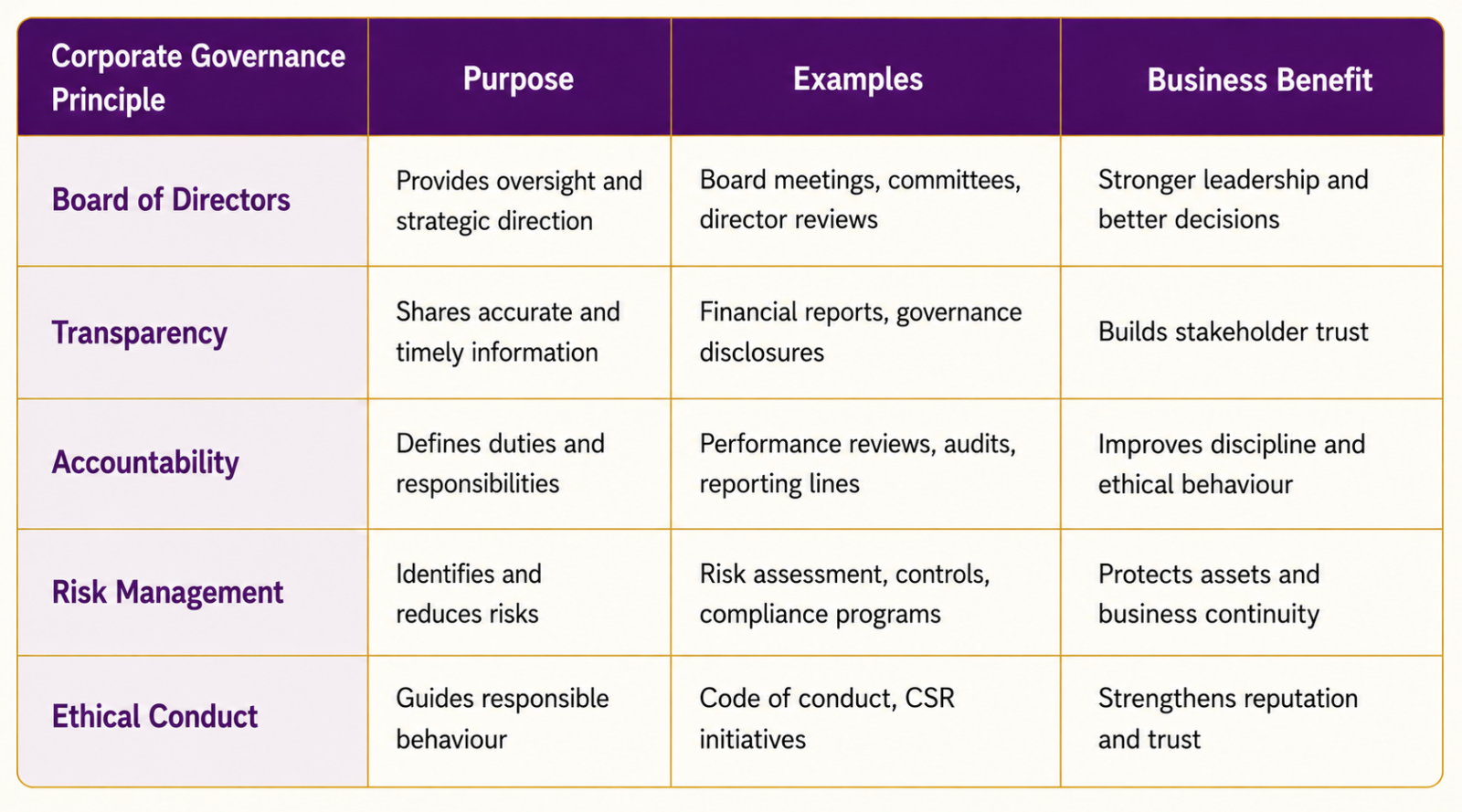
5 Key Elements of Corporate Governance
While governance structures differ between organisations, five elements provide a strong foundation for effective corporate governance.
1. Board of Directors
The board of directors is central to an organisation’s governance structure. Its role extends beyond approving major decisions. An effective board provides strategic oversight, holds executive management accountable, and ensures the organisation remains aligned with its purpose, responsibilities, and long-term objectives.
Board responsibilities commonly involve:
- reviewing organisational strategy;
- overseeing senior management;
- assessing material risks;
- monitoring organisational performance;
- challenging executive decisions where appropriate;
- overseeing succession and leadership continuity;
- monitoring financial and internal controls; and
- maintaining appropriate governance standards.
This distinction between oversight and management is important. Senior executives manage day-to-day operations, while the board provides direction, scrutiny and accountability.
Professionals seeking greater depth in this area can develop their understanding through training focused specifically on board roles and responsibilities, including strategic alignment, fiduciary responsibilities and risk governance. LBTC’s current programme addresses purpose, ESG, culture and systemic risk within the board’s oversight responsibilities.
Board Composition and Effectiveness
An effective board requires an appropriate combination of skills, experience, independence and perspectives.
Depending on the organisation, relevant expertise may include:
- finance and accounting;
- strategy;
- legal and regulatory matters;
- risk management;
- technology and cybersecurity;
- sustainability;
- human resources;
- operations; and
- industry-specific knowledge.
Diversity of experience and perspective can also strengthen constructive challenge and reduce the risk of groupthink.
Board effectiveness is therefore not determined simply by who sits on the board. It depends on how directors interact, challenge assumptions, receive information and reach decisions.
Board Committees
Larger organisations often establish committees to provide greater scrutiny in specialist governance areas.
Common examples include:
- Audit Committee
- Risk Committee
- Nomination Committee
- Remuneration Committee
- Governance Committee
- Sustainability Committee
Committees allow particular issues to receive more detailed attention while remaining accountable to the board as a whole.
2. Transparency
Transparency enables shareholders and other stakeholders to understand how an organisation is performing, how significant decisions are made and how material risks are being managed.
Effective transparency requires information to be accurate, relevant and sufficiently timely to support informed judgement.
Financial Transparency
Reliable financial reporting enables boards, shareholders, investors and other relevant parties to evaluate organisational performance and financial position.
Strong financial governance also depends on appropriate internal controls, audit arrangements and clear reporting responsibilities.
Governance Transparency
Governance transparency extends beyond financial statements.
Organisations may need to communicate information concerning:
- board composition;
- governance structures;
- executive remuneration;
- significant risks;
- shareholder rights;
- sustainability matters;
- succession planning; and
- organisational strategy.
Transparent governance supports credibility because stakeholders can better understand how responsibility is exercised across the organisation.
3. Accountability
Accountability ensures that individuals and governing bodies take responsibility for their decisions, conduct, and performance.
Within an effective governance framework, clear definitions of responsibilities should help directors, executives, managers, and committees understand both their authority and its limits.
Board Accountability
Boards are responsible for providing effective oversight rather than simply accepting information provided by management.
Directors need sufficient information, judgement and independence to question assumptions, challenge proposals and evaluate whether decisions support the organisation’s long-term interests.
Accountability also extends to board effectiveness, performance and succession. Organisations need processes to evaluate directors’ contributions and prepare for leadership changes.
LBTC’s Performance, Reward and Succession training examines board and director performance, incentives, renewal and succession planning-areas that increasingly form part of effective board governance.
Management Accountability
Senior executives are accountable for implementing strategy, managing operations and providing the board with reliable information.
Clear reporting lines, performance measures, internal audits and control systems help organisations monitor whether management responsibilities are being fulfilled effectively.
4. Risk Management and Internal Control
Risk oversight is one of the most significant responsibilities within modern corporate governance.
Organisations face interconnected risks across areas including:
- finance;
- operations;
- regulation;
- supply chains;
- cybersecurity;
- artificial intelligence;
- data protection;
- reputation;
- sustainability; and
- geopolitical disruption.
Corporate governance should therefore establish how material risks are identified, evaluated, monitored and escalated.
Risk Assessment
Risk assessment enables boards and management teams to understand the threats that could prevent the organisation from achieving its objectives.
Effective assessment considers both the likelihood of a risk occurring and its potential impact.
It should also consider emerging risks rather than relying solely on historical information.
Internal Controls
Internal controls are the processes, policies and mechanisms used to manage identified risks and protect organisational resources.
Examples include:
- financial controls;
- internal audit;
- segregation of responsibilities;
- cybersecurity controls;
- approval processes;
- compliance monitoring;
- crisis management plans; and
- data governance procedures.
The increased focus on risk and internal control within the UK Corporate Governance Code makes this an especially important capability for senior leaders and governance professionals.
5. Ethical Conduct and Responsible Leadership
Corporate governance is not simply a compliance framework. It also sets expectations for organisational behaviour, integrity, and decision-making.
Boards influence ethical culture through the standards they establish, the behaviour they demonstrate and the decisions they approve.
Ethical considerations frequently arise in areas such as:
- conflicts of interest;
- executive remuneration;
- employee treatment;
- data privacy;
- artificial intelligence;
- supplier relationships;
- environmental impact;
- whistleblowing; and
- stakeholder engagement.
A code of conduct can set expectations, but policies alone are insufficient. Ethical governance requires leaders to apply those principles consistently when making difficult decisions.
Corporate Governance at a Glance
Why Is Corporate Governance Important?
Strong governance creates more than regulatory compliance. It provides a framework through which organisations can make better decisions, manage uncertainty and maintain accountability.
Better Strategic Decision-Making
Clear governance structures clarify who is responsible for strategic decisions and how those decisions should be reviewed.
Boards with access to reliable financial, operational and risk information are better positioned to challenge assumptions and assess competing priorities.
Stronger Risk Oversight
Governance enables risk to be considered at the appropriate level of seniority.
Rather than addressing threats only after they become operational problems, effective boards can consider emerging risks as part of strategy and investment decisions.
Greater Stakeholder Confidence
Investors, employees, customers, regulators and business partners place greater confidence in organisations that demonstrate responsible leadership, transparency and accountability.
Trust takes time to develop but can be lost quickly when governance failures expose weaknesses in leadership or controls.
Improved Organisational Resilience
Succession planning, internal controls, crisis preparedness, and effective board oversight can better prepare organisations for unexpected disruption.
This is increasingly important in an environment shaped by technological change, regulatory development and geopolitical uncertainty.
More Effective Leadership Accountability
Corporate governance establishes a structured relationship between the board and executive management.
Clear boundaries allow executives to manage the organisation while ensuring that significant decisions remain subject to appropriate challenge and oversight.
How Corporate Governance Is Evolving
Governance responsibilities continue to expand as boards confront risks and expectations that were previously treated primarily as operational matters.
Artificial Intelligence and Technology Governance
Artificial intelligence has introduced questions around data use, accountability, bias, privacy, cybersecurity and regulatory exposure.
Boards do not need to become technical specialists, but they need sufficient governance capability to ask the right questions, understand material risks and determine whether appropriate controls exist.
LBTC’s Tech, AI and Regulatory Oversight course addresses board accountability for AI, data privacy, cyber resilience, digital regulation and internal controls.
Sustainability and Climate Governance
Sustainability has also moved closer to the board agenda.
The 2023 G20/OECD Principles include a dedicated focus on sustainability and resilience, reflecting the growing relevance of climate-related risks and opportunities within corporate governance.
Boards increasingly need to understand how sustainability affects strategy, risk, disclosure and long-term value.
Professionals responsible for these areas can strengthen their capability through focused Sustainability and Climate Governance training covering ESG expectations, climate risk governance and disclosure frameworks.
What Do Corporate Governance Courses Cover?
The content of corporate governance courses varies by level and target audience. High-quality executive training should combine governance principles with practical application.
Important areas can include:
- governance principles and frameworks;
- board roles and responsibilities;
- directors’ duties;
- board composition and effectiveness;
- corporate purpose and strategy;
- fiduciary responsibilities;
- audit and internal control;
- risk governance;
- stakeholder engagement;
- ethical leadership;
- executive remuneration;
- board performance;
- succession planning;
- sustainability and climate governance;
- artificial intelligence;
- cybersecurity; and
- regulatory oversight.
For professionals seeking a grounding in international and UK governance approaches, LBTC’s Governance Principles and Frameworks course examines governance theory, global codes and standards, corporate purpose and ethical leadership.
Training becomes particularly valuable when participants can connect these principles to situations they encounter within their own organisations.
Who Should Attend Corporate Governance Courses?
Corporate governance training can support professionals whose responsibilities involve oversight, strategy, risk, compliance or organisational leadership.
Relevant participants include:
- Board Members
- Non-Executive Directors
- Chairs
- CEOs and Senior Executives
- Company Secretaries
- Governance Professionals
- Risk and Compliance Leaders
- Legal and Regulatory Professionals
- Internal Audit Professionals
- Finance Leaders
- Sustainability and ESG Professionals
- Senior Managers preparing for board-level responsibilities
The appropriate course depends on the participant’s existing responsibilities and development objectives.
An experienced non-executive director, for example, may require specialised development in technology governance or board effectiveness. A senior manager preparing for board-level responsibility may benefit from a broader grounding in governance principles, board duties and strategic oversight.
How to Choose the Right Corporate Governance Course
Selecting corporate governance training should involve more than comparing course titles.
1. Review the Course Content
The curriculum should reflect the governance responsibilities relevant to your role.
A director responsible for technology oversight will have different development priorities from a professional moving into a company-secretarial or governance role.
2. Look for Practical Application
Governance is applied through judgement and decision-making.
Case discussions, governance scenarios, structured exercises and practical frameworks can help professionals translate principles into action.
3. Consider the Expertise of the Consultant
Effective corporate governance training requires more than an academic explanation of governance terminology.
Experienced consultants can connect governance frameworks with boardroom realities, strategic decisions, organisational risk and leadership challenges.
4. Consider Current Governance Challenges
Modern corporate governance courses should reflect contemporary board responsibilities.
Relevant topics increasingly include AI, cyber resilience, climate risk, sustainability, stakeholder pressures, internal control, and organisational culture, alongside established areas such as directors’ duties, audit, and board structure.
5. Match the Training to Your Professional Objectives
The right programme should reflect where you are now and where your responsibilities are developing.
A focused one-day programme may suit a specific capability gap, while a broader multi-day programme can provide more comprehensive development across governance disciplines.
Develop Your Governance Capability with LBTC
Corporate governance requires directors and senior professionals to balance strategic oversight, accountability, risk, ethics and long-term organisational performance.
LBTC’s Corporate Governance Courses are designed for board members, executive directors, senior leaders, company secretaries and professionals whose roles involve governance and organisational oversight. The current portfolio covers areas including governance frameworks, board roles, sustainability, stakeholder engagement, risk management, technology oversight, board effectiveness and succession.
The objective is not simply to understand governance terminology. Effective executive development should enable professionals to apply governance principles confidently within real organisational environments.
Conclusion
Effective corporate governance provides the structure through which organisations establish accountability, oversee strategy, manage risk and maintain responsible leadership.
Its foundations include an effective board, transparent reporting, clear accountability, robust risk management and ethical conduct. At the same time, the governance agenda continues to expand as boards take greater responsibility for technology, artificial intelligence, cybersecurity, sustainability, organisational resilience and stakeholder expectations.
For directors and senior professionals, these developments make governance knowledge an increasingly important leadership capability.
Well-designed corporate governance courses provide a structured way to develop that knowledge, understand relevant governance frameworks and strengthen the judgement required for board and senior leadership responsibilities.
Whether the objective is to prepare for board-level responsibilities, strengthen existing governance capability or address a specific area such as risk, sustainability or technology oversight, professional training can help leaders approach governance decisions with greater clarity and confidence.
Frequently Asked Questions (FAQs)
What are corporate governance courses?
Corporate governance courses are professional development programmes that help participants understand how organisations are directed, controlled and held accountable. Course content can cover governance frameworks, directors’ duties, board responsibilities, risk management, accountability, ethical leadership, stakeholder engagement and regulatory oversight.
Who should take a corporate governance course?
Corporate governance courses are particularly relevant to board members, non-executive directors, CEOs, senior executives, company secretaries, governance professionals, risk and compliance leaders and senior managers preparing for greater governance responsibilities.
What are the five key elements of corporate governance?
Five important elements are board oversight, transparency, accountability, risk management and ethical conduct. Together, they establish how authority is exercised, how decisions are scrutinised and how organisational responsibilities are monitored.
What should I look for in a corporate governance course?
Look for training that combines recognised governance principles with practical application. The programme should cover areas relevant to your responsibilities, be delivered by experienced professionals and address current governance issues as well as established board responsibilities.
Why are corporate governance courses important for directors?
Directors carry significant governance and oversight responsibilities. In the UK, directors also have statutory duties under the Companies Act 2006. Appropriate training helps directors develop a clearer understanding of their responsibilities, governance frameworks, risk oversight and board-level decision-making.
Does corporate governance include risk management?
Yes. Risk oversight and internal controls are important components of corporate governance. Boards need to understand material risks, ensure appropriate controls exist and determine how significant risks are monitored and reported.
How is artificial intelligence affecting corporate governance?
AI introduces governance considerations involving accountability, data privacy, cybersecurity, regulatory compliance, model risk and ethical decision-making. Boards therefore need sufficient understanding to oversee how AI is adopted, controlled and used within their organisations.
Where can I study corporate governance in the UK?
LBTC provides corporate governance courses in London and online for directors, senior executives and governance professionals. Programmes range from focused one-day courses to broader multi-day governance training covering board responsibilities, risk, sustainability, technology and leadership.