

Difference Between a Secretary and an Administrative Assistant
8 min read
Understanding the difference between a secretary and an administrative assistant is essential for anyone building a career in office administration. A secretary usually focuses on clerical and organisational tasks, while an administrative assistant often provides broader business, client, and leadership support.
Many learners start with secretary courses or personal assistant training to develop the essential skills needed in modern business environments. These skills include communication, time management, document handling, diary management, office administration, and professional organisation.
In today’s workplace, secretary courses and personal assistant training programmes help learners build a practical skill set for administrative professionals. These roles support daily business operations, improve office efficiency, and help teams communicate more effectively.
Key Takeaways
- A secretary mainly handles clerical, organisational, and communication tasks that support smooth daily office operations.
- An administrative assistant usually has broader responsibilities, including project coordination, team support, data management, office administration, and operational problem-solving.
- The main difference between a secretary and an administrative assistant is the level of responsibility. Secretaries often focus on routine administrative support, while administrative assistants may support departments, managers, executives, or wider business functions.
- Secretarial courses, online secretarial courses, and personal assistant training help learners build essential office skills, including diary management, document handling, professional communication, time management, and digital administration.
- A secretary role is often a strong entry point into office support, while an administrative assistant position can offer wider career progression, greater responsibility, and stronger links to business operations.
- Both secretaries and administrative assistants play an important role in modern workplaces by improving organisation, communication, productivity, and office efficiency.
What Does a Secretary Do in the Workplace?
A secretary plays a key role in office organisation, communication, and daily business support. This job focuses mainly on routine administrative tasks that help keep office operations smooth, organised, and predictable. Traditionally, the secretary handled practical administrative workflows for a department, manager, or executive.
Common secretary responsibilities include:
- Answering phone calls and routing professional communications to the appropriate people or departments.
- Scheduling meetings, coordinating appointments, and maintaining organised calendars.
- Organising office documents, physical records, and secure digital filing systems.
- Supporting managers with routine administrative tasks such as sorting mail and greeting guests.
- Handling basic office administration duties, including monitoring stationery inventories.
Many employers value candidates who complete secretarial courses because these courses help build essential communication, organisation, and office administration skills from day one. The modern secretary role also requires confidence with word processing software, database entry, digital records, and professional telephone etiquette.
A secretary role is often suitable for individuals with a high school diploma or equivalent who want to start a career in office support and develop professional qualifications over time. It provides a strong entry point into the corporate world, helping learners understand standard operating procedures, organisational structures, workplace communication, and corporate culture.
What Does an Administrative Assistant Do?
An administrative assistant has a broader range of responsibilities than a traditional secretary. This role supports multiple teams, departments, or regional offices and often involves project management, data analysis, and cross-functional business coordination. Rather than focusing solely on routine clerical tasks, an administrative assistant is expected to exercise independent judgment, take initiative, and address operational bottlenecks.
An executive assistant is a more advanced role that acts as a strategic partner to senior leadership, handling high-stakes logistics, confidential information, and project tracking. This position requires strong emotional intelligence and organisational agility, while also offering higher salary potential and greater networking opportunities.
The administrative assistant role requires strong communication skills, excellent time management, and professional confidence. Professionals in this role use advanced technical skills to support business operations and improve organisational performance. They often work with project management systems, spreadsheet functions, and digital collaboration platforms to manage tasks, enhance productivity, and streamline workflows. Many candidates complete personal assistant training or a comprehensive personal assistant course to prepare for the agile, analytical, and practical nature of this role.
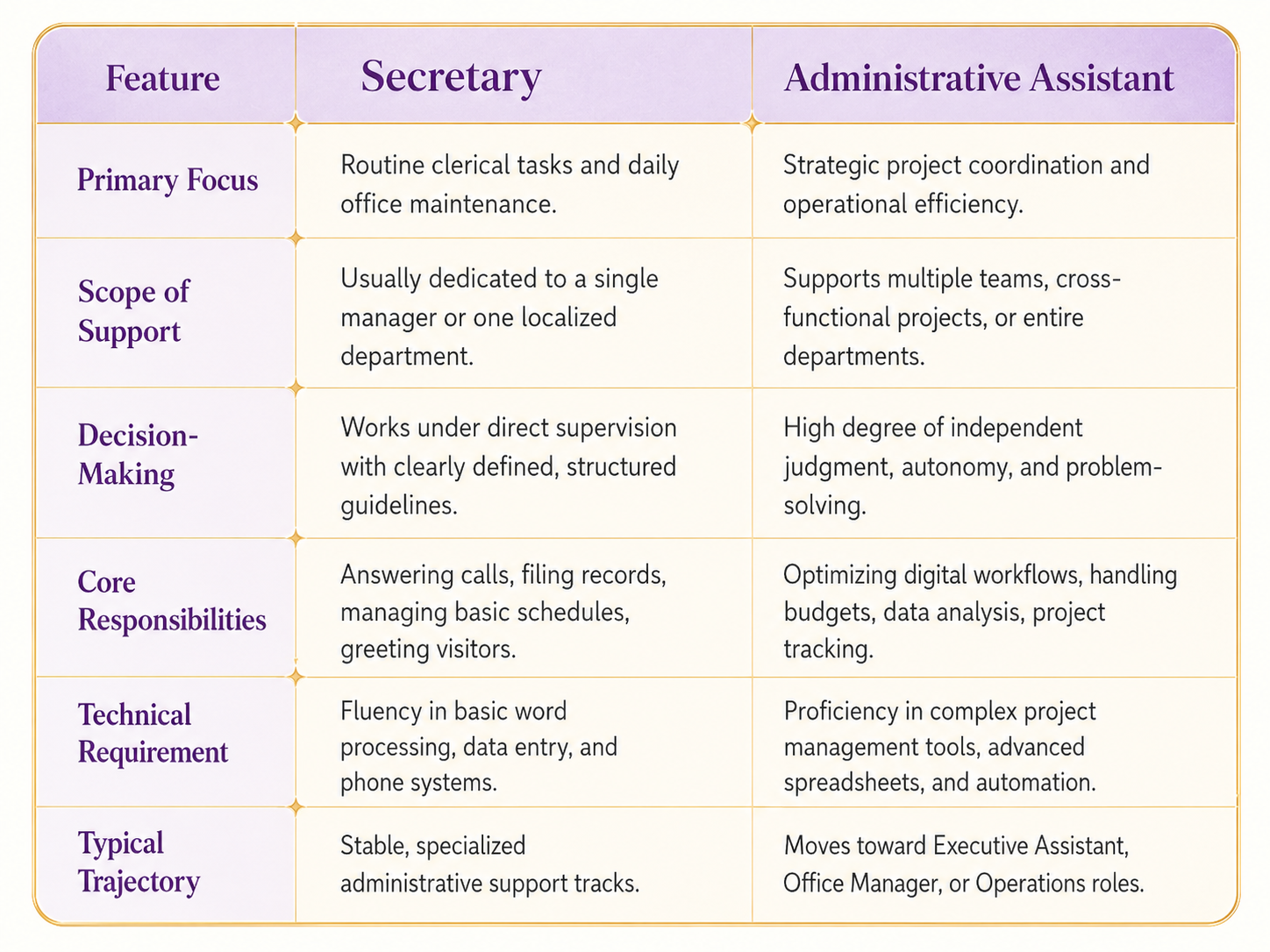
Key Differences Between Secretary and Administrative Assistant Roles
Although both roles support office environments and overlap in fundamental ways, there are clear, industry-recognised differences in their responsibilities and execution styles.
How Personal Assistant Training Builds Career Skills
Personal assistant training helps learners develop the practical skills needed for office administration, business support, and executive support roles. This type of PA training connects basic clerical knowledge with strategic executive support, helping learners enhance their administrative ability and gain a competitive edge in the workplace.
This training helps learners:
- Improve communication skills and professional communication with managers, clients, and executive stakeholders.
- Manage sensitive phone calls, resolve client complaints, and handle public relations interactions professionally.
- Develop strong time-management and organisational skills to handle competing priorities.
- Build confidence in workplace tasks, presentations, meetings, and daily office responsibilities.
- Use modern digital office administration systems, scheduling tools, and collaboration platforms.
- Prepare for specialised executive assistant courses and advanced administrative roles.
A personal assistant course also supports long-term career development by helping learners gain technical skills, complete structured online programs, and build a stronger resume. Many employers value formal training because it shows practical knowledge, emotional intelligence, and readiness for professional office environments. For example, learners who research administrative career paths and pursue relevant training may be better equipped to secure employment in business support roles.
Why Secretary Courses Are Important for Beginners
Secretary courses are often the best starting point for individuals entering office administration for the first time. These programs explain communication, workplace procedures, and administrative tasks in clear, practical modules, helping learners build a strong foundation.
These courses cover:
- Communication skills, active listening, and business communication.
- Office administration, file management, and cloud-storage organisation.
- Scheduling, diary management, and time management.
- Professional behaviour, corporate standards, and workplace etiquette.
- Meeting support, document distribution, and travel arrangements.
Online secretarial courses are flexible and allow learners to study from any location. This makes them useful for people balancing entry-level work, family commitments, or personal responsibilities while developing new career skills. These online courses support professional development, build workplace confidence, and encourage excellence in administrative roles.
Executive Assistant and Career Progression
With experience, reliability, and advanced training, many administrative professionals advance into executive assistant roles and higher-level positions. The move from administrative assistant to executive assistant is a shift from routine administrative work to strategic business support.
An executive assistant directly supports senior leadership, C-suite executives, or board members. Common executive assistant responsibilities include:
- Complex scheduling, crisis calendar management, and international meeting logistics.
- High-level business communication, executive gatekeeping, and public relations correspondence.
- Advanced project management, strategic initiatives, and cross-departmental tracking.
- Confidential office responsibilities involving sensitive HR, financial, legal, or business information.
This advanced role requires strong communication, leadership ability, emotional intelligence, discretion, and organisational agility. Because of the high-stakes nature of the position, executive assistant roles often offer higher salary potential, stronger corporate benefits, and valuable networking opportunities with senior industry leaders.
Online Courses and Flexible Learning
The digital transformation of education has made it easier for learners to build sustainable careers in corporate administration. Modern online courses are no longer passive; they feature immersive simulators, live interactive webinars, and global peer networks.
Key benefits of adopting online learning frameworks include:
- Access to elite professional training programs: Removing geographic barriers to studying cutting-edge methodologies developed by international administration experts.
- Ability to develop new skills from anywhere: Learning advanced management or digital communication tools from anywhere
- Support for rapid career progression: Seamlessly accumulating digital badges, verifiable certifications, and recognised professional qualifications.
Many successful professionals complete personal assistant training or online secretarial courses to prepare for rapid onboarding. These programs help individuals build specialised expertise, cultivate professional confidence, and vastly improve their global employability metrics.
Career Opportunities in Office Administration
Completing structured administrative training opens doors to a diverse network of career pathways. The modern office is no longer defined solely by physical walls, leading to specialised variations in administrative roles across global industries.
Prominent career tracks include:
- Secretary: Perfect for individuals who excel at keeping specific teams structured, organised, and focused on immediate operational targets.
- Personal Assistant (PA): Focused intensely on optimising the daily life, travel, and schedule of a specific individual, requiring high loyalty and adaptability.
- Executive Assistant (EA): Serving as a strategic business partner to C-suite executives, managing high-level corporate goals and confidential communications.
- Virtual Assistant (VA): Providing freelance, flexible administrative, technical, or creative assistance to global clients remotely from an independent workspace.
- Office Administrator: Managing the broad spatial logistics, facilities, procurement, and administrative support staff for an entire corporate building or regional branch.
These positions all require an unshakeable foundation of communication, clear organisation, and robust business knowledge. Global employers frequently fast-track candidates who complete structured, recognised courses because they demonstrate real-world professionalism, verifiable technical ability, and an immediate readiness for workplace responsibility.
Salary, Employment, and Career Growth
Compensation within the administrative sphere scales directly with a professional’s level of specialised training, technical expertise, and independent responsibility. As tasks move from routine execution to strategic management, salary levels adjust accordingly to reflect that corporate value.
In general:
- Secretaries often start in foundational entry-level positions, where salaries are tied to local market standards for clerical support.
- Administrative Assistants earn higher baseline salaries as their experience grows, reflecting their cross-functional responsibilities, project management contributions, and department-wide impact.
- Executive Assistants command premium, higher-level compensation packages that often include performance bonuses, stock options, and executive-tier corporate perks, given their proximity to senior leadership.
Global employers place immense value on candidates who actively develop professional certifications and complete recognised training programs. A modern, optimised resume, combined with advanced communication skills and practical experience, vastly improves career progression velocity and job security in changing economic environments.
Why Training and Professional Development Matter
Continuous professional development is the ultimate catalyst for long-term career sustainability in modern industries. As artificial intelligence automates routine spreadsheet sorting and basic scheduling, the administrative professional must continuously elevate their skill profile to focus on human-centric, high-value tasks.
Targeted training helps individuals:
- Develop profound confidence and verifiable technical competence in front of corporate boards.
- Improve communication, master diplomatic negotiation, and refine advanced organisational design.
- Gain international qualifications and competitive certifications that bypass standard corporate screening algorithms.
- Prepare for immediate employment, navigate career pivots, and accelerate upward career growth.
- Succeed under pressure within fast-paced, high-stakes global business environments.
Many international associations in administration recognise the vital role that structured, lifelong learning plays in career advancement. Continuous learning ensures that employees remain irreplaceable, competitive, and highly effective assets across all modern industries.
Conclusion
The difference between a secretary and an administrative assistant is mainly reflected in the scope of their duties, the level of responsibility, and their contributions to broader business operations. Secretaries typically focus on essential clerical and organisational tasks, while administrative assistants often manage broader responsibilities, including team coordination, digital systems, project support, data management, and operational problem-solving.
Despite these differences, both roles are vital to maintaining efficient communication, organised workflows, and productive workplace environments. Completing secretary courses, online secretarial courses, or personal assistant training can help learners build the practical, technical, and interpersonal skills required for these careers.
Training also strengthens professional confidence and prepares individuals for changing workplace expectations. With experience, continued development, and recognised qualifications, professionals can progress into roles such as personal assistant, executive assistant, office administrator, or office manager. Choosing the right training path can therefore support long-term employability, greater responsibility, and sustained career growth across modern organisations.
Frequently Asked Questions (FAQ’s)
1. What is the difference between a secretary and an administrative assistant?
A secretary supports basic, routine office tasks for a specific manager or department, focusing on reactive clerical duties. An administrative assistant handles broader business responsibilities, manages cross-functional projects, analyses data, and supports multiple teams independently.
2. Are secretary courses useful for beginners?
Yes. They provide an ideal foundation by teaching essential baseline skills like corporate communication, digital document organisation, diary scheduling, and professional workplace etiquette, making entry into the corporate world smooth and manageable.
3. What does personal assistant training typically include?
Personal assistant training includes advanced business communication, executive diary coordination, international travel logistics, crisis management, client relationship-building, and training in modern digital office administration systems.
4. Can these administrative roles lead to better corporate opportunities?
Absolutely. Developing these core operational skills can lead directly to lucrative careers as an executive assistant, office manager, operations coordinator, virtual assistant entrepreneur, or department project manager.
5. Do modern employers value online courses and digital certifications?
Yes, employers highly value recognised online courses and certifications. It demonstrates a candidate’s self-motivation, mastery of modern digital tools, practical industry knowledge, and an immediate readiness to perform without extensive organisational training.