


Accounting for Managers: Financial Statements to Results
22 min read
Modern organisations run on decisions. Pricing, staffing, supplier choices and delivery trade-offs shape results long before month-end reporting arrives. Yet many managers still treat financial statements as documents for the finance team rather than as management tools that guide daily decisions. When leaders cannot interpret financial data, costs drift, cash tightens, and performance issues surface only after they become expensive to fix across companies in every industry.
That is why accounting for managers matters. Instead, it builds practical decision-making capability and stronger leadership skills. Managers learn how to read the income statement, balance sheet and cash flow statement, then translate those signals into operational action. They also learn how management accounting supports control: setting targets, running budgeting cycles, updating forecasts, and using variance analysis to understand what changed and why.
In most organisations, this work sits between the chief financial officer and the accounting manager, but it should not stay inside finance. Business leaders in operations, HR, procurement and project delivery make financial decisions every day. They also rely on business analysts and finance teams to convert financial information into clear options. When leaders share the same knowledge base, discussions move faster, and financial planning becomes more realistic.
However, performance routines on their own are incomplete. Many pressures that damage financial performance begin as unmanaged uncertainty. Therefore, this article explains performance management to risk management, including practical exposure areas such as compliance, contracts, and tax laws. It shows how stronger risk discipline helps managers surface financial risks early, protect cash, and sustain delivery when conditions shift. Across the sections that follow, you will learn how to interpret the three statements, apply practical decision tools, align KPIs with strategy, and adopt modern reporting habits supported by accounting software and AI dashboards in 2026. You will also leave with Monday-morning actions that professionals can apply immediately.
In this article, you’ll discover:
- The role of accounting for managers in improving financial decision-making
- How to interpret income statements, balance sheets, and cash flow statements
- How management accounting supports budgeting, forecasting, and variance analysis
- Why KPIs, performance management, and risk management should be linked
- How tools such as CVP analysis, scorecards, and dashboards support better decisions
- Practical actions managers can take to improve financial control and business performance
Why Accounting for Managers Matters in 2026
Three shifts make financial clarity more critical in 2026:
- More complexity: Cross-functional delivery, supply volatility, and multi-entity reporting increase management burden. Decisions now cascade across departments, geographies, and regulatory regimes. As a result, managers must develop stronger financial judgement to stay in control.
- More transparency: Boards, audit functions, and regulators expect clearer accountability. Managers must explain what happened, why it happened, and what controls reduced exposure. That requires communication and analytical skills, because leaders must both interpret the numbers and tell the story behind them.
- More speed: Modern accounting software and AI dashboards compress reporting cycles. Leaders receive signals faster, so they must respond faster. Yet speed without understanding creates reactive management, not proactive control. Teams that can prepare reports quickly, challenge assumptions, and agree on actions make better business decisions under pressure.
Therefore, strong decision-making requires a shared language between operations and finance. That language is accounting—best developed through structured learning delivered by BAC-accredited (British Accreditation Council) training providers such as LBTC, helping managers build recognised knowledge and practical capability in accounting.
What “Accounting for Managers” Means in Practice
Management accounting is not statutory reporting. It is the discipline of using financial data to plan, control, and evaluate performance. Managers do not need to prepare statutory accounts. They do need to interpret what the numbers signal and act accordingly.
From Reporting to Managerial Control
The real value of management accounting lies in managerial control:
- Planning: Allocating resources to strategic priorities and setting achievable targets.
- Controlling: Monitoring performance, diagnosing variance, and triggering corrective action.
- Evaluating: Assessing outcomes, learning from results, and refining future plans.
This rhythm connects operational decisions to financial outcomes. Without it, organisations drift between reactive firefighting and budget overruns.
The Difference Between Financial Accounting and Management Use
Financial accounting serves external stakeholders such as investors, lenders, and regulators. It follows standardised rules (GAAP, IFRS) and focuses on historical accuracy.
Management accounting serves internal users. It is forward-looking, tailored to decision needs, and unconstrained by statutory formats. Managers need speed, relevance, and actionable insight.
As OpenStax (Managerial Accounting) explains, managerial accounting is more future-oriented, while financial accounting focuses on what has already happened. This distinction matters because managers use accounting information to influence outcomes, not simply record them.
Financial Statements as Management Tools
Managers do not need to prepare statutory accounts. They do need a working command of what the three core statements reveal operationally.
Income Statement: Profit and Margin Drivers
The income statement highlights revenue, cost structure, and profitability. Managers should look beyond totals. Key questions include:
- What costs are fixed versus variable?
- What is driving margin changes: price, mix, volume, or waste?
- Which activities generate contribution, and which destroy it?
This is where Cost-Volume-Profit (CVP) thinking becomes practical. Contribution margin, the difference between sales and variable costs, shows how each sale helps cover fixed costs and generate profit.
Balance Sheet: Resilience and Working Capital
The balance sheet signals financial health and operational resilience. Working capital discipline sits here. So do risk exposures such as receivables concentration, inventory obsolescence, and leverage pressure.
Managers should focus on:
- Receivables ageing and credit exposure: Late collections tighten cash flow and increase the risk of bad debt.
- Inventory turns and slow-moving stock: Excess inventory ties up capital and increases write-off risk.
- Liabilities that will tighten cash: Understanding payment timing reduces liquidity surprises.
Cash Flow Statement: Funding Reality
IAS 7 (Statement of Cash Flows) sets out how organisations present changes in cash and cash equivalents during a period. For managers, this statement is where strategy meets reality. A profitable department can still create cash strain if collections lag or inventory expands.
Managers should track:
- Cash conversion patterns
- Timing of major payments and payroll cycles
- Seasonal peaks that require earlier action
Six Ways Managers Use Financial Statements for Decision Making
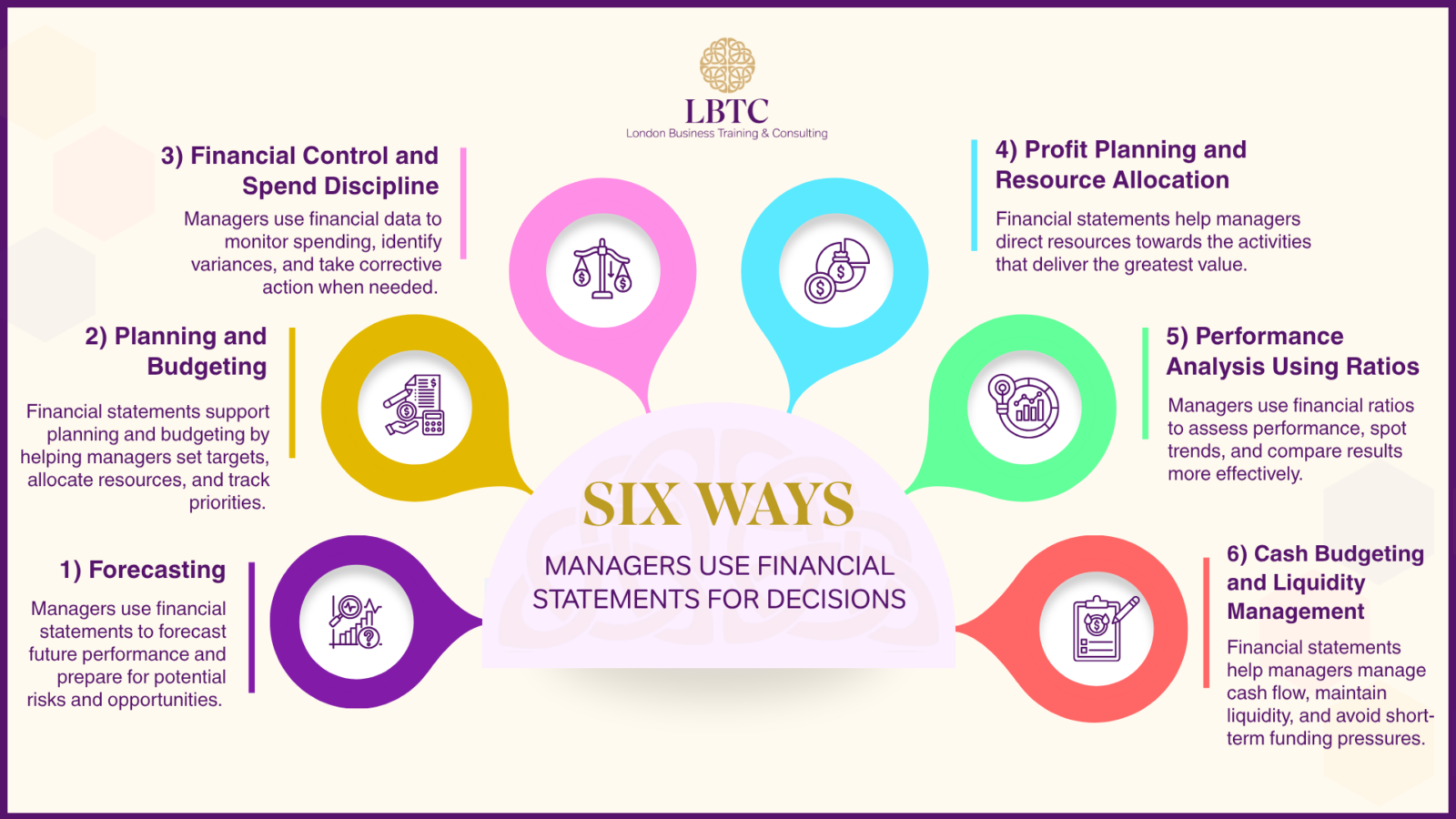
1) Forecasting
Managers project future performance using trends, market signals, and operational plans. Forecasting helps anticipate pressures before they materialise. Forecasting is an integral part of management accounting. Managers use forecasts to estimate business performance, gauge cash flow and decide on what kind of inventory and staffing needs they’ll have in the coming months. Forecasts also help managers with their marketing and sales activities by informing them when they can expect spikes in demand for their products or services. Further, they help predict when new hires may be needed to handle increased workloads. As such, forecasting informs many managerial decisions at all levels of an organisation.
2) Planning and Budgeting
Budgets translate strategy into numbers. They set targets, allocate resources, and create accountability. Managers use budgets to communicate priorities and manage expectations. A manager planning next year’s budget will want to review all relevant finances. An income statement shows precisely how much money came in, what was spent, and whether any profit was made. The balance sheet will show their assets, liabilities, and net worth at that time. A cash flow statement provides a more detailed view of how cash flows into and out of your business. This allows them to decide which assets to acquire or divest to maximise future profitability.
3) Financial Control and Spend Discipline
Budget-versus-actual reporting reveals where performance is drifting. Managers diagnose drivers, assign accountability, and agree on corrective actions. One of your main tasks as a manager is to ensure you manage your finances. There are several ways to check on what’s going on with finances. While there are numerous types of statements, here we will focus on reviewing balance sheets and income statements. These two documents will give you an idea of where your company stands financially, so you can plan accordingly for both short-term and long-term financial goals.
4) Profit Planning and Resource Allocation
Managers assess which activities generate the strongest returns. They shift resources toward value-creating work and away from activities that destroy value. Profit planning, also known as income statement forecasting, is essentially figuring out how much revenue your company will bring in. This helps you decide how much money to allocate to different aspects of your business, how many salespeople you need, or whether you need an expensive new product development team. It also allows you to estimate potential profit margins based on competitor analysis and historical data.
5) Performance Analysis Using Ratios
Ratios such as gross margin, operating margin, return on assets, and working capital cycles provide fast signals. This helps managers better understand their company’s performance. To do so, they use financial ratios to compare numbers from one year to another, across departments, with industry averages and so on. While some ratios can be precise, such as a benchmark for profit margin in a specific industry, others are more general. The six most common categories of financial ratios are profitability, liquidity, activity, leverage, investment and efficiency.
6) Cash Budgeting and Liquidity Management
Cash budgets project inflows and outflows over short timeframes (weekly or monthly). Managers use them to avoid liquidity issues and negotiate payment terms. It’s simply creating budgets by estimating income and expenses for future periods. This allows your company to keep track of its cash flow (and plan ahead to collect receivables, for example). If you’re running a small business, there are also online applications that will help you with cash budgeting; take advantage of these if they’re available to you.
Framework 1: Cost-Volume-Profit for Better Trade-offs
CVP analysis gives managers a disciplined way to link operational levers to outcomes. It supports pricing, capacity, and break-even decisions.
Break-even logic and contribution thinking
OpenStax defines contribution margin as the amount by which a selling price exceeds total variable cost per unit. Break-even is the level at which total contribution covers fixed costs.
Managers use CVP to answer:
- What sales volume is required to cover fixed costs?
- How will the margin change if we discount the price?
- Which product or service mix improves contribution?
Pricing and volume scenarios
CVP models trade-offs. For example, if fixed costs are £100,000 and the contribution margin per unit is £20, the break-even point is 5,000 units. Managers can then test scenarios: volume falls by 10%, variable costs rise, or prices change.
Where CVP supports fast operational decisions
CVP is most helpful when managers face short-term choices: accept a discounted order, adjust service levels, or shift capacity between products. It improves decision quality by making assumptions explicit.
Management Accounting That Actually Helps Managers
Many organisations describe management accounting as reporting. That view is too narrow. The real value is managerial control: planning, monitoring, and corrective action.
Budgeting and forecasting as a management rhythm
Budgets set expectations. Forecasts adjust those expectations as conditions change. Together, they create a rhythm:
- Budget creation: Translate strategy into resource allocation and targets.
- Monitoring: Track performance against budget on a monthly or quarterly basis.
- Variance analysis: Diagnose what changed and why.
- Corrective action: Adjust plans, resources, or execution.
Cost management essentials
Managers must distinguish between fixed and variable costs. Fixed costs (rent, salaries, insurance) do not change with activity levels in the short term. Variable costs (materials, commissions, utilities) scale with output.
This distinction improves decisions:
- Cost control: Identify waste, renegotiate contracts, and eliminate non-value activity.
- Cost-reduction levers: Target variable costs for faster impact; address fixed costs to enable structural change.
Variance analysis that drives action
Variance analysis compares actual results to the budget. Favourable variances signal stronger-than-expected performance. Unfavourable variances signal pressure.
Effective variance analysis assigns accountability, identifies root causes, and triggers action. Reporting variance without follow-through turns management accounting into a compliance exercise.
Common Limitations of Management Accounting and How to Fix Them
The usefulness of management reporting depends on the quality of inputs, the consistency of definitions, and managers’ ability to act on outputs.
Data quality: “garbage in, garbage out”
If cost codes, classifications, or data capture are inconsistent, managers receive misleading signals. The issue is not only accuracy. It is comparable over time.
Fix: Standardise chart-of-accounts logic, cost classifications, and data entry rules. Review exceptions regularly.
Complexity and capability gaps
Reports can be technically correct and still unhelpful. Managers need a shared understanding of terms, drivers, and trade-offs. Otherwise, decision-making becomes guesswork.
Fix: Invest in training and refresh reporting guides. Focus on interpretation, not theory.
Discontinuity and ad hoc reporting
One-off reporting breaks trend visibility. It also encourages reactive management.
Fix: Establish a consistent monthly cycle with stable templates and definitions.
Subjectivity and bias
Bias appears when teams over-weight certain metrics or ignore context. Incentives can worsen this, especially when leaders chase short-term wins.
Fix: Balance metrics across perspectives with a structured approach (e.g., a scorecard).
Resource constraints and system limitations
Smaller organisations may lack specialist analysts or robust systems. Yet even larger organisations can under-invest in data governance and training.
Fix: Start with fewer, higher-quality metrics. Use tools to automate reporting, not replace judgement.
KPI Alignment and Performance Management
A frequent performance issue is KPI overload. Teams track what is easy, not what matters. A Balanced Scorecard approach helps by forcing balance across perspectives.
Framework 2: Balanced Scorecard
Kaplan and Norton’s Balanced Scorecard frames performance through four perspectives:
- Financial
- Customer
- Internal process
- Learning and growth
Harvard Business School Online explains that the Balanced Scorecard combines financial measures with customer, process, and learning perspectives. This helps managers avoid overfocusing on a single dimension of performance.
Choosing KPIs that link to strategy
A strong KPI set usually has these traits:
- Clear ownership and accountability
- A defined target and tolerance range
- A link to strategy and operating priorities
- A visible action when performance drifts
A KPI must trigger a decision, a review, or a corrective action. Otherwise, it is a reporting burden.
Communication and accountability in performance reviews
Performance reviews should integrate KPIs with variance analysis and risk discussions. This creates a single conversation that connects outcomes, drivers, and exposures.
Risk Management as a Financial Discipline
Many organisations treat risk management as a separate track. That often fails. Risks affect costs, cash, delivery confidence, and control integrity. Therefore, risk should sit inside the same management rhythm as performance reviews.
Why risk and performance must be integrated
Operational risks often drive financial outcomes. For example:
- Uncontrolled overtime inflates labour costs.
- Weak supplier terms increase cash strain.
- Project scope drift creates rework and delays.
- Compliance failures trigger remediation costs.
Effective risk management surfaces these early and connects them to action.
Framework 3: COSO ERM
COSO’s Enterprise Risk Management framework links risk to strategy and performance. It supports a clear cycle:
- Identify: What risks could affect objectives?
- Assess: What is the likelihood and impact?
- Respond: What controls or actions will we take?
- Monitor: How will we track effectiveness?
This is not bureaucracy. It is a predictable decision quality.
Financial risk managers should actively track
Managers often miss financial risks that look operational:
- Cash risk: Collections lag, payment terms tighten, or seasonality creates shortfalls.
- Credit risk: Customer concentration or weak credit checks increase exposure to bad debt.
- Cost volatility: Supplier price increases, currency movements, or regulation changes inflate costs.
- Compliance risk: Failures trigger fines, remediation, or reputational damage.
- Delivery risk: Delays, quality failures, or resourcing constraints create financial penalties.
A Unified Operating Model: Linking Risk, KPIs and Financial Results
A practical way to integrate these elements is a single monthly cycle that connects performance, variance, and risk.
Monthly cycle (one meeting rhythm)
- Review performance signals: KPIs and budget versus actual
- Diagnose drivers: What changed, and why?
- Surface risks: What could worsen outcomes next cycle?
- Agree actions: Owners, dates, and thresholds
- Track learning: What will we change in the operating model?
This creates a disciplined link between management reporting and management behaviour.
RACI-style accountability for controls and decisions
RACI (Responsible, Accountable, Consulted, Informed) clarifies roles:
- Who executes the corrective action?
- Who is accountable for the outcome?
- Who must be consulted before deciding?
- Who must be informed after the decision?
Clear accountability prevents drift and improves follow-through.
Real-World Managerial Example
Imagine a service delivery department tracking monthly results. The manager sees an unfavourable labour variance. Revenue is stable, but margin pressure is rising.
Budget variance case (cost control + service quality)
Step 1: Identify the type of variance. Is the variance driven by rate, volume, or mix? Labour variances often involve overtime and staffing patterns.
Step 2: Link to operational drivers. Scheduling data shows an increase in rework and last-minute changes.
Step 3: Assess risk. The root cause increases operational risk: fatigue, quality issues, and customer dissatisfaction.
Step 4: Choose actions. The manager adjusts shift planning, tightens change control for urgent requests, and clarifies service prioritisation.
Step 5: Update KPIs. A quality KPI linked to rework becomes an early warning signal.
This example is simple. It also reflects the core discipline: connect financial outcomes to operational causes, then manage risk and performance together.
Digital Accounting Tools in 2026 (Brief, Practical)
Modern finance teams no longer rely on spreadsheets alone. In many companies, managers now see performance signals through cloud finance platforms, BI dashboards, and AI-assisted reporting layers. Used well, these tools shorten reporting cycles and improve decision speed. Used poorly, they create noise and false confidence.
Examples of tools managers typically work with
- ERP / finance systems: SAP, Oracle NetSuite, Microsoft Dynamics 365 Finance, Sage Intacct
- Budgeting and planning tools: Anaplan, Workday Adaptive Planning, Oracle EPM
- BI dashboards: Microsoft Power BI, Tableau, Looker
- Close and control automation: BlackLine (account reconciliations, close workflows)
- Expense and procurement visibility: Coupa, SAP Ariba, Concur (common in larger organisations)
What these tools help with
- Faster reporting cycles
- Earlier pattern recognition
- Quicker scenario testing
What tools cannot replace
- Governance over data inputs
- Validation of assumptions
- Accountability for decisions
Adoption checklist (avoid “back to spreadsheets”)
If you are selecting or upgrading tools:
- Standardise definitions and chart-of-accounts logic first.
- Design reporting around decisions, not system outputs.
- Train managers to interpret trends, not just totals.
- Set role-based access controls and clear ownership.
Tools support judgement. They do not replace it.
Monday-Morning Actions for Managers
Use this checklist to strengthen managerial control quickly:
- Create a one-page “financial story” for your area: what drove results, what changed, and what you will do next.
- Run a budget-versus-actual review with variance owners. Focus on the two or three drivers that matter most.
- Agree 5–8 KPIs with clear actions. Ensure they align with strategy and operating priorities.
- Integrate risk into performance reviews. Review top exposures alongside results, not separately.
- Validate data quality rules. Confirm cost codes, classification standards, and reporting cadence.
- Strengthen cross-functional communication. Coordinate with finance, operations, and delivery teams.
- Use dashboards to shorten cycles, not to skip thinking.
Conclusion
Managers do not need to become accountants. They do need to lead with financial clarity. The core discipline is to connect performance measures, risk exposure, and operational choices to what the numbers are signalling—and to act early, not after the month-end story is already written.
When organisations treat financial statements as management tools, they gain more than compliance. They gain better priorities, stronger control, and clearer accountability. Over time, disciplined management accounting builds resilience: budgets become more realistic, forecasting becomes more useful, and risk conversations move from paperwork to practical action.
For managers, the goal is straightforward. Build a repeatable rhythm: read the statements, test assumptions, review variance, align KPIs, and address risks while there is still time to influence outcomes. That is what turns financial reporting into better decisions, stronger delivery, and sustained performance.
FAQs
What is accounting for managers?
Accounting for managers is the use of financial data to support planning, control, and decision-making. It helps managers link operational actions to financial outcomes and risks.
Which financial statements matter most for managers?
All three core statements matter: the income statement, balance sheet, and cash flow statement. Together, they show profitability, resilience, and funding reality.
How do I improve KPI alignment without increasing reporting burden?
Start with fewer KPIs. Ensure each KPI has an owner, a target, and a defined action when performance moves. Use a scorecard approach to avoid overfocusing on a single dimension.
How does risk management connect to performance?
Risks often drive variance. For example, process failures increase rework, which increases labour cost. Integrating risk discussions into performance reviews improves control and decision quality.
Do digital tools remove the need for strong financial understanding?
No. Tools speed up insight generation. Yet managers still need judgement, governance discipline, and the ability to translate signals into actions.
What is the cash conversion cycle, and why does it matter?
The cash conversion cycle measures how quickly an organisation turns cash invested in operations into cash collected from customers, after considering payment timing to suppliers. It matters because it connects operational decisions to liquidity. Improving it usually requires actions such as tighter receivables follow-up, lower slow-moving inventory, and better supplier terms.