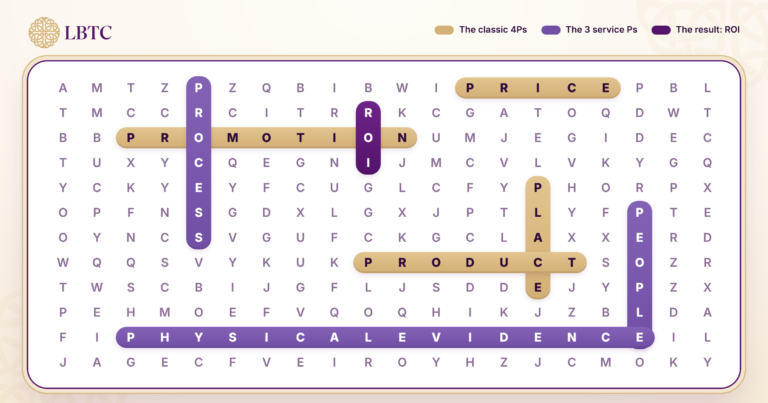
7 Ps of Marketing: A Practical Guide to Better ROI
16 min read
The 7 Ps of marketing help managers examine the whole customer experience, rather than treating promotion as the only route to growth. Product, price, place, promotion, people, process and physical evidence provide a shared structure for reviewing marketing decisions using the 7 Ps of Marketing technique. Their value lies in identifying what needs attention before committing more budget.
Consider a campaign that attracts enquiries but generates few profitable customers. Increasing advertising might amplify the problem rather than solve it. Instead, the organisation may need a clearer offer, more credible evidence or a simpler buying process.
This guide explains how to apply the framework, connect decisions to commercial measures and prioritise improvements. It also shows how relevant marketing training courses can support professionals responsible for strategy, customer experience and communication.
Key takeaways
- Review all 7 Ps of Marketing together: stronger promotion cannot compensate indefinitely for an offer or service that disappoints.
- Start with a defined audience, then identify the buying barriers that matter most to that group.
- Measure incremental contribution, not simply campaign revenue, when assessing marketing return on investment.
- Use the framework to decide what to test; it does not prove that a particular change caused growth.
What are the 7 Ps of marketing?
The 7 Ps of marketing are Product, Price, Place, Promotion, People, Process and Physical Evidence. They extend the original four-part marketing mix by adding staff, service delivery, and visible evidence.
A useful distinction is that the framework organises decisions; it does not choose your strategy. Managers must still decide which customers to serve, what value to offer and where to compete.
For example, a premium advisory service needs more than premium pricing. Its expertise, accessibility, communication and delivery must justify the proposition. Otherwise, the marketing mix contains contradictions that customers may notice before managers do.
Start with the audience, not the channel
Before reviewing the 7 Ps of Marketing, define one priority customer group and one commercial objective. A marketing plan aimed at everyone provides little guidance when budgets or delivery capacity become constrained.
Distinguish the person using the service from the person approving the purchase. In professional training, a participant may value practical application, while their manager needs evidence of relevance to departmental priorities. Procurement may need clear terms and documentation. Therefore, one generic message will not answer every stakeholder’s questions.
Use segmentation, targeting and positioning to establish this foundation. Then test assumptions through customer conversations, enquiry analysis and lost-business reviews.
For organisations operating in the UK, GCC, Indonesia, Nigeria or other markets, investigate local regulations, business practices and cultural expectations rather than making broad assumptions about individual markets. Check language, payment arrangements, time zones and buying authority at segment level. Adapt the execution without making promises that delivery teams cannot support.
Apply the 7 Ps of marketing to commercial decisions
1. Product: make the value proposition specific
Start with the outcome the customer needs, then examine whether the offer delivers it. Features matter, but buyers also need to understand suitability, scope and limitations.
For a training provider, the product includes learning objectives, subject coverage, teaching approach and opportunities to apply knowledge. An extensive syllabus alone does not explain which business problem the course addresses.
Review enquiries that did not convert. Were customers unclear about relevance, level or expected application? Use those objections to improve the offer before rewriting advertisements. However, do not add features simply because individual prospects request them. Consider delivery costs and whether the change serves your priority audience.
Track qualified-enquiry conversion alongside complaints about mismatched expectations. Together, these measures offer a more useful diagnostic than page traffic alone.
2. Price: evaluate margin and customer confidence
Price decisions should connect willingness to pay, positioning and the cost of serving customers. A discount may increase orders while reducing the contribution available to cover marketing and overheads.
Therefore, evaluate the commercial effect before celebrating higher sales volume. Compare contribution per sale, discount use and acquisition costs across relevant customer groups.
Make inclusions and additional charges clear. Where customers hesitate, investigate whether the barrier is affordability, uncertain value or internal approval. These problems require different responses; reducing the headline price will not resolve all three.
For example, clearer documentation may help a business buyer secure approval without a discount. Conversely, a genuinely unsuitable price may require redesigning the offer, not more persuasive messaging. Protecting margin also means recognising when an opportunity costs too much to serve.
3. Place: remove obstacles to access
Place concerns how customers find, buy and receive the offer. Review the entire route, including distribution partners, websites, sales conversations and delivery arrangements.
For services, availability and format belong in this discussion. A suitable programme may remain inaccessible if its timetable, location, or booking arrangements don’t fit the customer’s circumstances.
Test the journey on the devices customers actually use. Can they compare options, understand availability and reach someone who can answer questions? Also check what happens after an enquiry passes to another team.
Keep responsibility visible across handovers. A marketing team may generate interest successfully, yet lose opportunities when sales or delivery information arrives late. Track completion rates and response times by route, rather than assuming every channel performs equally.
4. Promotion: connect the message to the buying decision
Promotion should explain relevant value and guide the next action. Select channels after clarifying the audience and objective, not because a platform is fashionable.
For example, search content can answer a specific question, while an email sequence can address objections after an enquiry. Public relations may support reputation and stakeholder understanding. However, these activities should reinforce the same proposition rather than make conflicting promises.
Agree what counts as a qualified response before launch. Otherwise, teams may optimise clicks or inexpensive leads that sales colleagues cannot use.
Review messaging against actual delivery. Claims about speed, expertise or flexibility need operational support. Where performance disappoints, investigate message quality and audience fit alongside the other six elements. Promotion is one possible cause, not the automatic explanation.
5. People: support the staff who deliver the promise
Ask whether customer-facing colleagues have the knowledge, authority and information required to respond consistently. Training alone cannot resolve unclear responsibilities or systems that hide essential information.
For instance, an account manager handling a delayed service needs an accurate update and a workable escalation route. Without these, even excellent communication skills have limited value.
Agree practical standards for enquiry handling, expectation setting and problem resolution. Then review real interactions across marketing, sales and service teams. Use recurring questions to improve customer information and staff guidance together.
Also examine incentives. A target based solely on new sales may encourage promises that delivery teams struggle to fulfil. Balance commercial goals with suitable measures of customer outcomes and avoid blaming individuals for problems created by the wider process.
6. Process: investigate where the experience breaks down
Map the steps from initial interest through purchase, delivery and follow-up. Include internal handovers, because customers experience their consequences even when they cannot see them.
Evidence helps identify useful questions. In Eurostat’s 2025 online-shopping survey, 35.4% of EU online shoppers reported problems. Slow delivery affected 19.9%, website usability or performance problems affected 11.5%, and incorrect or damaged deliveries affected 10.4%.
These are survey estimates for people aged 16–74 who bought online during the preceding three months. They are not percentages of transactions or estimates of lost revenue.
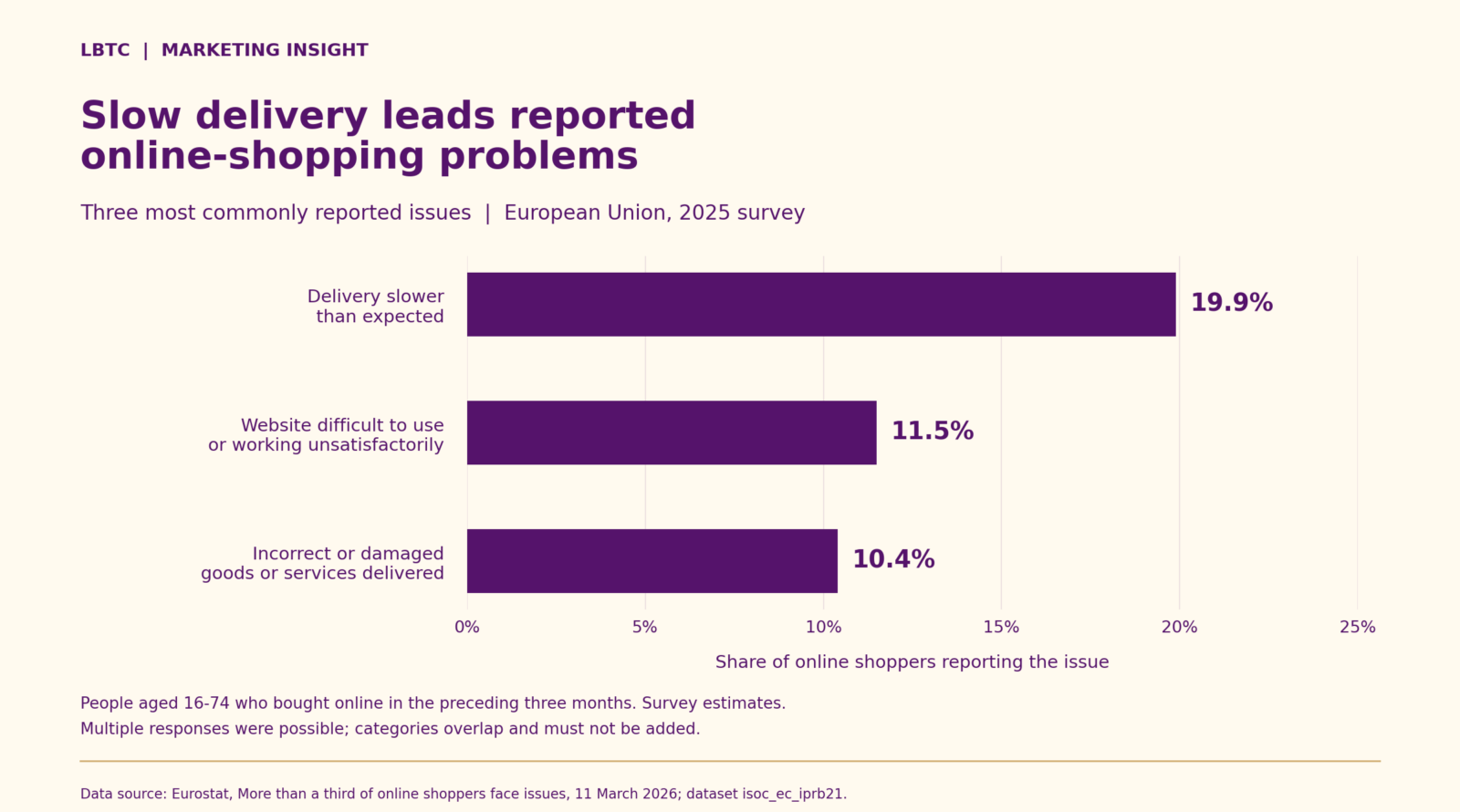
Slow delivery was the most commonly reported issue among the three problems shown, affecting 19.9% of EU online shoppers surveyed in 2025.
For managers, the implication is to test the promise against the experience. Review delivery expectations, usability and error handling before increasing acquisition spending. However, use your own customer evidence to prioritise action; EU consumer findings do not establish your organisation’s failure rates.
7. Physical evidence: provide credible proof
Physical evidence includes the tangible and visible cues through which customers assess a service. Consider premises, documents, demonstration materials and the quality of the digital environment.
Choose evidence that answers a genuine buying concern. A detailed agenda can clarify course relevance; a demonstration can show how a service works. Similarly, a well-scoped case example can explain application without suggesting that every customer achieves identical results.
Keep evidence current, specific and proportionate. Obtain appropriate permission for testimonials and client materials, and explain the scope of any accreditation accurately.
However, polished presentation is not a substitute for delivery quality. Compare what the website implies with what customers actually receive. The strongest evidence matches the experience, rather than distracting from its weaknesses.
Measure ROI without confusing activity with value
For this review, use a contribution-based measure:
Marketing ROI = [(incremental contribution before marketing costs − marketing costs) ÷ marketing costs] × 100.
Incremental contribution means additional revenue attributable to the activity, less the variable costs of fulfilling that additional business. Agree the cost treatment and measurement period with finance before comparing campaigns.
Consider an illustrative scenario, not an LBTC performance result. A campaign generates £40,000 in incremental revenue and £24,000 in associated variable costs. With marketing costs of £8,000, the calculated ROI is 100%: (£16,000 − £8,000) ÷ £8,000 × 100.
However, the difficult part is establishing incrementality. Some customers may have purchased anyway. Where feasible, compare similar groups with and without the change, and consider seasonality, price changes and overlapping campaigns. Otherwise, describe the result as an estimate rather than proven causation.
Use conversion, retention, response times and complaints as diagnostic measures. Do not add their improvements together as though each represents a separate financial return. Likewise, keep longer-term brand indicators visible, but don’t present them as realised profit.
Run a focused marketing-mix review
Choose one offer, one customer segment and one recent performance problem. Bring marketing, sales, operations and finance together around the same evidence.
First, identify where expectations and delivery diverge. Next, record a hypothesis, an owner and a practical change. For example, slow conversion may reflect unclear approval documents rather than weak advertising.
Establish a baseline before testing the change. Agree on the success measure, review period and safeguards, such as protecting margin or avoiding additional service complaints. Also decide what evidence would cause you to stop or revise the intervention.
Change a manageable number of elements at once. Otherwise, attribution becomes harder, and delivery teams may struggle to implement the plan. Review findings at an agreed point, then retain, revise or stop the change. This turns the framework into a learning process rather than a presentation exercise.
Example: diagnose a service business before adding spend
Consider a hypothetical maintenance-service company with strong enquiries but slow purchasing decisions. Customer interviews suggest that buyers cannot compare service coverage or explain the total cost to colleagues.
The initial response should connect several elements. Clarify the service scope under product, explain charges under price and provide a sample service report as physical evidence. Meanwhile, simplify quotation approval under process and give account managers consistent guidance under people.
Next, update the website and sales materials so access and promotion reflect the revised offer. Keep the campaign budget stable during the initial test where practical. Compare qualified-enquiry conversion, contribution per contract and complaints about service scope against the baseline.
This is an illustrative diagnostic, not evidence of a guaranteed improvement. Its purpose is to show why a coordinated change may be more sensible than treating every weak conversion rate as an advertising problem.
Choose marketing training courses around your responsibilities
Our marketing training courses support development across strategic marketing, customer understanding and communication. The portfolio serves newcomers to marketing as well as experienced managers developing specific capabilities. It includes digital marketing topics such as content, social media, email, SEO, Google Ads and Google Analytics. However, individual course outlines differ, so match your required skills to the relevant programme.
For managers responsible for the wider marketing mix, Strategic Marketing (5-days) is the closest fit. It covers marketing performance, customer behaviour, strategy, customer experience, marketing planning and segmentation, targeting and positioning. Its audience includes senior marketing managers, brand and product managers, digital specialists and customer experience leaders. Group exercises, case-based discussion and action planning connect the content to workplace decisions.
If the immediate need is messaging and reputation, Public Relations Management (5-days) offers a more focused route. It covers stakeholder identification, channel and message alignment, media relations and reputation management. The programme suits PR and communication professionals, including executives building their foundations and marketing colleagues with stakeholder-facing responsibilities.
For broader communication leadership, Advanced Strategic Public Relations Management (2-weeks) covers social media strategy, crisis communication, internal alignment, and thought leadership. This is relevant when the review identifies weaknesses across promotion, people and credibility, rather than a narrow campaign-planning gap.
LBTC offers London classroom learning and live online participation across its portfolio. Check the selected delivery option when booking. As a British Accreditation Council-accredited provider, we combine professional development with practical application. Choose the programme around your current responsibilities and intended workplace project, not duration alone.
Conclusion
The 7 Ps of marketing provide a practical structure for connecting customer needs with commercial decisions. Their value comes from examining how the offer, price, access, communication, staff, processes and proof work together. A campaign should not promise an experience that the organisation cannot consistently deliver.
For managers, the next step is to choose one priority audience and one measurable problem. Review customer feedback, identify the most likely barrier and assign responsibility for a focused improvement. Then compare the results against a baseline, checking both customer outcomes and commercial contribution. This approach supports better decisions without assuming that every increase in sales comes from marketing alone.
Relevant marketing training courses can help professionals develop the judgement needed to apply this framework. At LBTC, we encourage readers to connect their development priorities with a practical workplace challenge. Ultimately, the objective is not to complete a 7 Ps of Marketing checklist, but to make clearer choices about customer value, delivery and responsible investment.
FAQs
Are the 7 Ps of marketing only useful for service businesses?
No. Product-based organisations can also review staff, delivery processes and visible evidence alongside the original four elements. However, use only the detail relevant to the buying experience; the framework should clarify decisions rather than create unnecessary documentation.
What is the difference between place and process?
Place concerns the routes through which customers access the offer. Process concerns how activities operate along those routes. An online booking channel is a place decision; its approval steps and confirmation workflow are process decisions.
Which of the 7 Ps of marketing elements should managers improve first?
Start with the element linked to the clearest customer problem and strongest available evidence. Then check its dependencies. Improving an enquiry form may achieve little when the offer remains unsuitable, or the delivery team lacks capacity.
Can the framework guarantee a better marketing ROI?
No. It helps organise diagnosis and testing, but results depend on execution, demand, costs and other conditions. A well-structured review should make assumptions and trade-offs more visible, not promise a particular financial outcome.