

Understanding PESTLE Analysis in Strategic Management
9 min read
Imagine yourself sitting in a global coffeehouse with a fresh cup of coffee. It feels simple, but that cup has travelled through farmers, suppliers, shipping routes, labour rules, customer trends, pricing decisions, and technologies. Climate change may reduce harvests and increase bean prices. A new import duty may raise supplier costs. New labour laws may affect how beans are harvested, packed, and shipped.
This is the invisible world in which every business operates. A strategic management course helps learners look beyond daily tasks and understand the external business environment. Strategic management is the discipline of reading the external environment, comparing it with the internal environment, and using that insight to build a strong business strategy. It brings together strategic thinking, critical thinking, decision-making, leadership, resources and capabilities, and implementation to help managers make better strategic decisions.
PESTLE analysis is one of the most useful key concepts in strategic management. It supports strategic decision-making by helping managers understand political, economic, social, technological, legal, and environmental factors. When used properly, PESTLE becomes more than a checklist. It becomes part of the strategic plan because it shows how the external business environment can influence strategy, corporate strategy, competitive advantage, strategic change, and long-term organisational objectives.
Key Takeaways
- PESTLE analysis helps managers understand the wider external business environment before making strategic decisions. It supports strategic thinking by showing how political, economic, social, technological, legal, and environmental factors can influence business strategy.
- A strong strategic plan should not rely only on internal resources. It should also consider external pressures, competitive forces, stakeholder expectations, and market changes.
- PESTLE works best when used with SWOT analysis, competitive analysis, stakeholder analysis, and other strategic frameworks. Together, these tools help managers connect analysis with action.
- For learners, a strategic management course develops the skills needed to understand strategy, leadership, management, business analysis, problem-solving, and real-world decision-making.
- PESTLE is useful for large companies, small businesses, managers, entrepreneurs, students, and professionals considering a career change because it helps turn complex information into clearer strategic choices.
What is PESTLE Analysis?
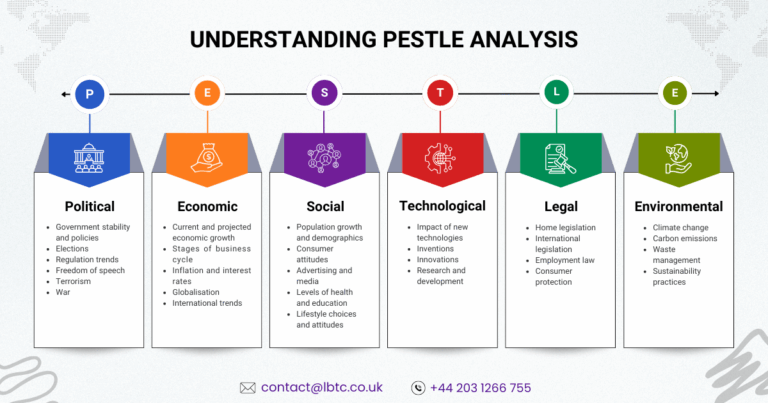
PESTLE (sometimes spelt as PESTEL) stands for:
P – Political
E – Economic
S – Social
T – Technological
L – Legal
E – Environmental
These six areas help a business understand the macro environment and the external business environment before making strategic choices. PESTLE sits alongside SWOT analysis, competitive analysis, stakeholder analysis, and other strategic frameworks in strategic management education. Together, these tools connect theoretical foundations with real-world examples and real-world environments.
A good strategic plan should not rely solely on internal resources. It must also consider external forces that can influence strategy, change demand, reshape markets, or affect resources and capabilities. This is why strategic management understands that activities often begin with environmental scanning. Strategic management understands that work means learners do not simply memorise models; they learn how business strategy responds to competitive forces, customer expectations, law, technology, and social change.
A 1-week in-class training, or an online course in strategic management, often uses PESTLE because it is practical, memorable, and easy to apply. The learning outcomes usually include the ability to understand the external business environment, develop strategic thinking, apply critical thinking, conduct competitive analysis, and make strategic decisions that support competitive advantage.
1. Political Factors
Political factors refer to the way government action affects business. Elections, taxation, trade policy, public spending, labour rules, sanctions, conflict, and regulation can all influence strategy. For example, Brexit created uncertainty for companies operating between the UK and the EU. It changed supply chains, tariffs, labour mobility, paperwork, and planning.
In strategic management, political analysis helps managers understand risks before they become crises. A business strategy that depends on imported materials may need alternative suppliers. A corporate strategy based on international expansion may require review of trade agreements, organisational objectives, resources, and implementation.
2. Economic Factors
Economic factors shape customer spending, business confidence, investment, and pricing. Inflation, interest rates, exchange rates, unemployment, wage growth, economic growth, and stages of the business cycle all influence business strategy. When inflation rises, consumers may reduce discretionary spending. When currency values shift, importers and exporters may see costs and margins change quickly.
For managers, economic analysis is central to strategic decision-making. If a domestic currency depreciates, imported inputs become more expensive. A strategic plan may then include new sourcing arrangements, price changes, cost controls, or vertical integration. Vertical integration can help a business control parts of its supply chain, protect resources and capabilities, and reduce dependence on external suppliers.
3. Social Factors
Social factors examine people, culture, demographics, lifestyle, education, health awareness, media influence, and values. Customers, employees, communities, regulators, and partners all bring expectations that can change over time. For example, health consciousness has changed the food and beverage sector, encouraging organic products, low-sugar alternatives, plant-based options, and recyclable packaging.
In strategic management, social analysis helps managers understand how business culture and organisational culture affect strategy. A business strategy that ignores social change may lose relevance. A strategic plan that considers social trends can identify opportunities earlier, strengthen corporate social responsibility, and support employee well-being.
4. Technological Factors
Technology evolves quickly, and it can transform an industry almost overnight. Streaming services changed television and video rental. Online platforms changed retail. Artificial intelligence, automation, cloud systems, cyber security, data analytics, and mobile technology now affect almost every business.
A strategic plan must consider whether technology will create opportunities, threats, or both. A business may use technology to improve customer service, automate routine work, improve performance measurement, or strengthen competitive analysis. Technology can also create competitive forces by allowing new entrants to challenge established companies.
A strategic management course helps learners understand how technology affects resources and capabilities, internal resources, project management, and implementation.
5. Legal Factors
Legal factors include employment law, consumer protection, contract law, data protection, intellectual property, health and safety, competition rules, and international legislation. These factors can create risks and opportunities. For example, data protection regulations have forced companies to rethink how they collect, store, use, and protect customer data. A business that fails to comply may face fines, reputational damage, and loss of trust.
Legal analysis helps managers make strategic decisions with discipline. A strategic plan must consider what is lawful, ethical, and sustainable. In business and management, legal awareness supports Risk Assessment, stakeholder engagement, and corporate social responsibility.
6. Environmental Factors
Environmental factors have become central to strategic management. Climate change, carbon emissions, energy use, packaging, waste, biodiversity, water scarcity, and sustainability expectations now affect business decisions. Customers, investors, employees, and governments increasingly expect responsible behaviour.
A strategic plan should therefore consider environmental risk and opportunity. A coffee business may need to understand drought, farming practices, transport emissions, recyclable packaging, and supplier resilience. A manufacturing business may need to reduce energy use, improve waste management, or redesign products.
Environmental action can support competitive advantage when it improves efficiency, strengthens reputation, and prepares the business for future regulation.
How PESTLE Supports Business Strategy?
PESTLE supports business strategy by helping managers understand what is happening outside the organisation before deciding what to do within it. It gives structure to decision-making and helps avoid narrow thinking. Without PESTLE, a business may focus only on sales figures, internal resources, or short-term problems. With PESTLE, managers can see the external business environment more clearly.
PESTLE also supports SWOT analysis. The opportunities and threats in SWOT analysis often come directly from PESTLE. A technological trend may become an opportunity, while a legal change may become a threat. Competitive analysis then helps managers understand how competitors are responding. Stakeholder analysis shows who will be affected. Together, these tools support Strategy formulation, implementation, and performance measurement.
A strong strategic plan uses evidence, not guesswork. Managers compare internal resources with external trends, evaluate resources and capabilities, and make strategic choices. They may choose cost leadership, differentiation, focus strategy, vertical integration, partnership, innovation, or market entry. These competitive strategies are not random. They are strategic decisions shaped by the external, internal, and competitive environments.
Connecting PESTLE with Competitive Advantage
Competitive advantage means creating a position that enables a business to outperform competitors. PESTLE helps identify potential sources of competitive advantage. A company may gain a competitive advantage by responding more quickly to technological change, complying more effectively with regulations, building sustainable supply chains, or serving changing customer needs. It may also gain a competitive advantage through internal resources such as skilled people, trusted brands, strong data, financial capacity, or unique resources and capabilities.
For example, vertical integration may create a competitive advantage if it gives a business greater control over quality, costs, delivery, or the customer experience. However, vertical integration can also increase complexity. Managers must assess whether their resources and capabilities are sufficient to manage the additional activities. This is where strategic decision-making becomes essential.
A strategic management course helps learners connect competitive advantage to real-world decision-making. It teaches that competitive advantage is about being cheaper or bigger. It is about fit: the fit between business strategy, external business environment, resources, capabilities, leadership, and implementation.
From Analysis to Strategic Plan
PESTLE is only useful when it leads to action. A strategic plan should translate insight into priorities, actions, responsibilities, and measures. It should explain the organisation’s aims, the strategic choices it will make, the resources required, who is responsible, and how progress will be measured.
A good strategic plan links organisational objectives to the external business environment. It asks: What is changing? What does it mean for our business? What internal resources do we have? What resources and capabilities must we develop? What strategic decisions should we make now? What implementation challenges may appear?
This is where project management becomes useful. Once the strategic plan is agreed upon, project management helps turn it into workstreams, timelines, budgets, milestones, and accountability. Change management helps people understand why change is needed and how to support it. Human resources help develop skills, communication, training, and leadership.
Why Learners Choose a Strategic Management Course
People choose a strategic management course for many reasons. Some are managers who want to improve decision-making. Some are professionals considering a career change. Some are entrepreneurs trying to understand their market. Some are students attending summer school and exploring business and management for the first time. Others are experienced leaders who want to strengthen strategic leadership and develop better strategic thinking.
A strategic management course can help learners understand key topics such as business strategy, corporate strategy, competitive advantage, SWOT analysis, competitive analysis, stakeholder analysis, resources and capabilities, strategic change, and implementation. In many online courses, short course formats, and summer school programmes, the course content is designed around practical exercises and real-world examples rather than theory alone.
A short course is useful because it gives concentrated learning in a focused period. A short course can help busy managers understand strategic management without committing to a long programme. In an in-class setting, learners may explore strategic management, business strategy, leadership, and management.
The learning outcomes may include the ability to understand the external business environment, apply critical thinking, conduct business analysis, evaluate internal resources, analyse competitive forces, build a strategic plan, and communicate strategic decisions.
Conclusion
PESTLE analysis is a practical tool that helps managers, entrepreneurs, students, and leaders understand the external business environment. It supports strategic management by turning complex external forces into clearer categories for decision-making. When combined with SWOT analysis, competitive analysis, stakeholder analysis, and internal analysis, it helps build a stronger strategic plan.
A strategic management course teaches learners to move from observation to action. It helps them develop strategic thinking, critical thinking, problem-solving, leadership, and the confidence to make strategic decisions. It also shows how business strategy, corporate strategy, resources and capabilities, strategic change, change management, and implementation work together in modern organisations.
Whether you are joining online courses, a short course, or a summer school programme, PESTLE can help you understand business in a deeper way. Most importantly, it helps you understand that good management is about reacting to today. Good management is about preparing for tomorrow with a clear strategic plan, strong leadership, informed decision-making, and a business strategy built for the real world.
Frequently Asked Questions (FAQ’s)
1. What is PESTLE analysis in strategic management?
PESTLE analysis is a strategic management tool used to understand political, economic, social, technological, legal, and environmental factors that affect a business. It helps managers study the external business environment before creating a strategic plan or making strategic decisions.
2. Why is PESTLE analysis important for business strategy?
PESTLE analysis is important for business strategy because it helps a business identify risks, opportunities, market changes, and external pressures. It supports better strategic decision-making, competitive analysis, strategic thinking, and long-term management.
3. What is the difference between PESTLE analysis and SWOT analysis?
PESTLE analysis focuses on the external environment, while SWOT analysis looks at strengths, weaknesses, opportunities, and threats. PESTLE often supports SWOT analysis by identifying external opportunities and threats that can influence strategy.
4. When should a business use PESTLE analysis?
A business should use PESTLE analysis when creating a strategic plan, entering a new market, launching a product, reviewing corporate strategy, preparing for strategic change, or conducting a risk assessment. It is also useful when managers need to understand changes in the macro environment.
5. How does a strategic management course help managers use PESTLE analysis?
A strategic management course helps managers understand how PESTLE connects with strategy formulation, business strategy, competitive advantage, resources and capabilities, and implementation. It develops strategic thinking, problem-solving, leadership capabilities, and practical skills for real-world decision-making.