


What Is Operations Management? Roles, Importance & Process Optimisation Explained
22 min read
Operations Management involves planning, organising, monitoring and improving the processes that enable organisations to deliver goods and services efficiently. It connects business strategy with daily operations, ensuring that people, technology, materials and resources work together to achieve organisational objectives.
UK output per hour grew by about 2.1% a year in the decade to 2007. From 2007 to 2025 the average fell to about 0.4% a year, in LBTC analysis of Office for National Statistics (ONS) data. Much of that gap sits inside organisations: in how work is planned, measured, staffed and improved. This is the territory of operations management, the discipline that turns people, materials, information, and money into the goods and services customers pay for.
Whether an organisation operates in manufacturing, logistics, healthcare, retail or professional services, effective Operations Management influences productivity, quality, costs and customer satisfaction. However, managing operations involves more than supervising production or coordinating routine activities. Operations managers must balance customer demand, resource availability, operational risks and performance expectations.
This article explains the meaning of Operations Management, its key functions, managerial responsibilities, importance to business performance and operations management courses if you lead, or are moving into, an operations role. It also examines Process Improvement techniques, career opportunities, salary expectations and the value of professional operations management courses.
Key Takeaways
- Operations management designs, runs and improves the processes that deliver an organisation’s goods and services, linking strategy to daily work.
- Core responsibilities include Supply Chain Management, Inventory Management, Quality Management, capacity planning and performance monitoring.
- Process Improvement, digital technologies and data analysis can help identify inefficiencies and improve decisions.
- UK firms score 0.80 out of 1 on continuous improvement and only 0.42 on key performance indicators (KPIs): measurement is the common weak point.
- Firms with 10 to 19 employees score 0.51 on management practices, compared with 0.68 for firms with 250 or more, pointing to where operational efficiency gains are most available.
- Good process optimisation starts with measurement, not only technology: map the process, define a few KPIs, fix the constraint, and standardise the new method.
- Professional development through operations management courses can strengthen leadership and operational decision-making.
What Is Operations Management?
Operations Management is the process of designing, planning, coordinating, controlling and continuously improving activities involved in producing goods or delivering services. Its primary purpose is to transform organisational inputs into valuable outputs while maintaining appropriate standards of quality, cost, speed and reliability.
Inputs include employees, materials, technology, equipment, financial resources and information. Operational processes combine these resources to produce products, services and customer value. For example, a manufacturer transforms raw materials into finished products through production, inspection, packaging and distribution. A healthcare organisation coordinates staff, equipment, appointments and patient information to deliver services.
These areas overlap in practice. Cutting inventory changes supplier lead-time risk, which in turn changes the capacity buffer you need. An operations manager adds value by treating those trade-offs as one system, not as separate departmental targets.
Why Operations Management matters for UK organisations
The national productivity record shows the scale of the challenge. In ONS data for the whole UK economy, output per hour rose from an index value of 75.3 in 1997 to 93.0 in 2007. By 2025, it had reached only 99.3.
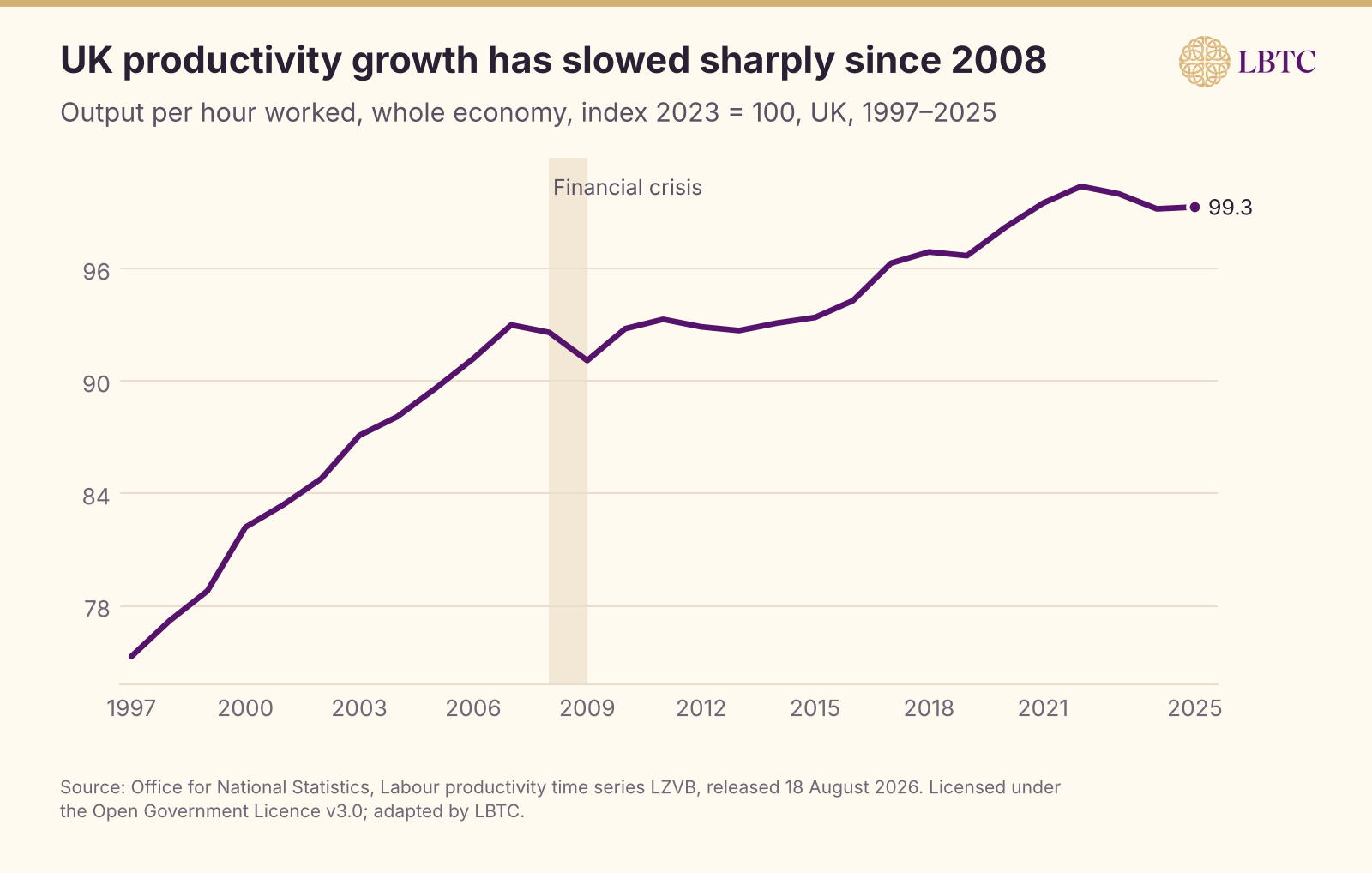
The line flattens after the financial crisis and never recovers its pre-crisis slope. Recent quarters look a little better. The ONS flash estimate puts output per hour 0.7% higher in the year to the second quarter of 2026 (ONS, 2026a), well below the pre-2008 pace. The chart does not explain the slowdown, which economists attribute to several causes, including weak investment.
Management quality is one of the few drivers that leaders control directly. In a seminal study of 732 medium-sized manufacturers in four countries, Bloom and Van Reenen (2007) found that better management practices were strongly associated with higher productivity, profitability, and survival. More recent UK evidence points the same way. The ONS Management and Expectations Survey (MES) reports that a 1% increase in a firm’s labour productivity is correlated with a 0.02 increase in its management practice score (ONS, 2024). This is an association, not proof that better management causes higher output. Yet two independent bodies of evidence point the same way.
What Is the Role of an Operations Manager?
An operations manager oversees the processes, resources and activities required to achieve organisational objectives. The role combines strategic planning, operational coordination, Performance Management and continuous improvement. Although responsibilities vary by industry, several functions are common across organisations.
Planning and Resource Management
Operations managers determine the resources needed to meet demand, including staffing, equipment, production schedules, capacity and budgets. Effective Resource Management balances operational requirements with available capacity. Insufficient staffing can cause delivery delays, while excessive staffing can increase operating costs. Managers should evaluate demand patterns, utilisation and constraints before making allocation decisions.
Managing Supply Chains and Inventory
Operations managers coordinate procurement, supplier relationships, warehousing, transportation and distribution. Supply Chain Management ensures that materials and products move through operational networks according to business needs. Inventory Management seeks appropriate stock levels without excessive storage costs. Managers must consider supplier reliability, replenishment lead times, demand forecasting and product availability.
Monitoring Quality and Performance
Quality Management ensures that products and services meet established requirements. Operations managers establish standards, monitor performance and investigate recurring problems. Indicators might track productivity, delivery reliability, process efficiency or customer satisfaction. Measuring performance alone is not sufficient; managers must interpret results and take corrective action.
Leading Teams and Operational Change
Operations managers coordinate employees, departments, suppliers and stakeholders. They communicate objectives, resolve operational challenges and lead change. Introducing manufacturing technology, for instance, may require redesigned workflows, employee training and updated measures. Strong leadership helps teams understand priorities and participate in improvement initiatives.
Why Is Operations Management Important?
Operations Management affects the ability to deliver reliable products and services while maintaining financial and operational stability. Its importance extends beyond expenditure control to productivity, quality, satisfaction, and resilience.
Improving Operational Efficiency
Operational Efficiency involves meeting business objectives while reducing unnecessary resource consumption and process waste. Managers can remove duplicated activities, shorten waiting times, and address bottlenecks. Yet cheaper processes may produce more errors or customer complaints. Improvement decisions should consider overall outcomes rather than isolated cost savings.
Supporting Productivity Improvement
Productivity Improvement increases valuable output relative to resources consumed. Better scheduling and equipment utilisation may increase production without longer hours. Higher output does not necessarily mean better performance; however, it may indicate deteriorating safety or quality. Managers should assess productivity alongside service reliability and employee wellbeing.
Strengthening Customer Satisfaction
Customers expect consistent quality, timely delivery, and dependable service. Operations managers influence these outcomes through capacity planning, process control, and coordinated resources. Improving inventory accuracy can reduce fulfilment mistakes, while more accurate workforce scheduling can support service demand during busy periods.
Improving Resilience and Sustainability
Operational resilience is the ability to manage disruption and maintain essential activities. Supplier failures, breakdowns, cyber incidents, and demand changes can interrupt delivery. Managers need contingency plans and visibility across dependencies. Sustainability also requires considering energy, materials, waste, and transport, balanced against financial and operational requirements.
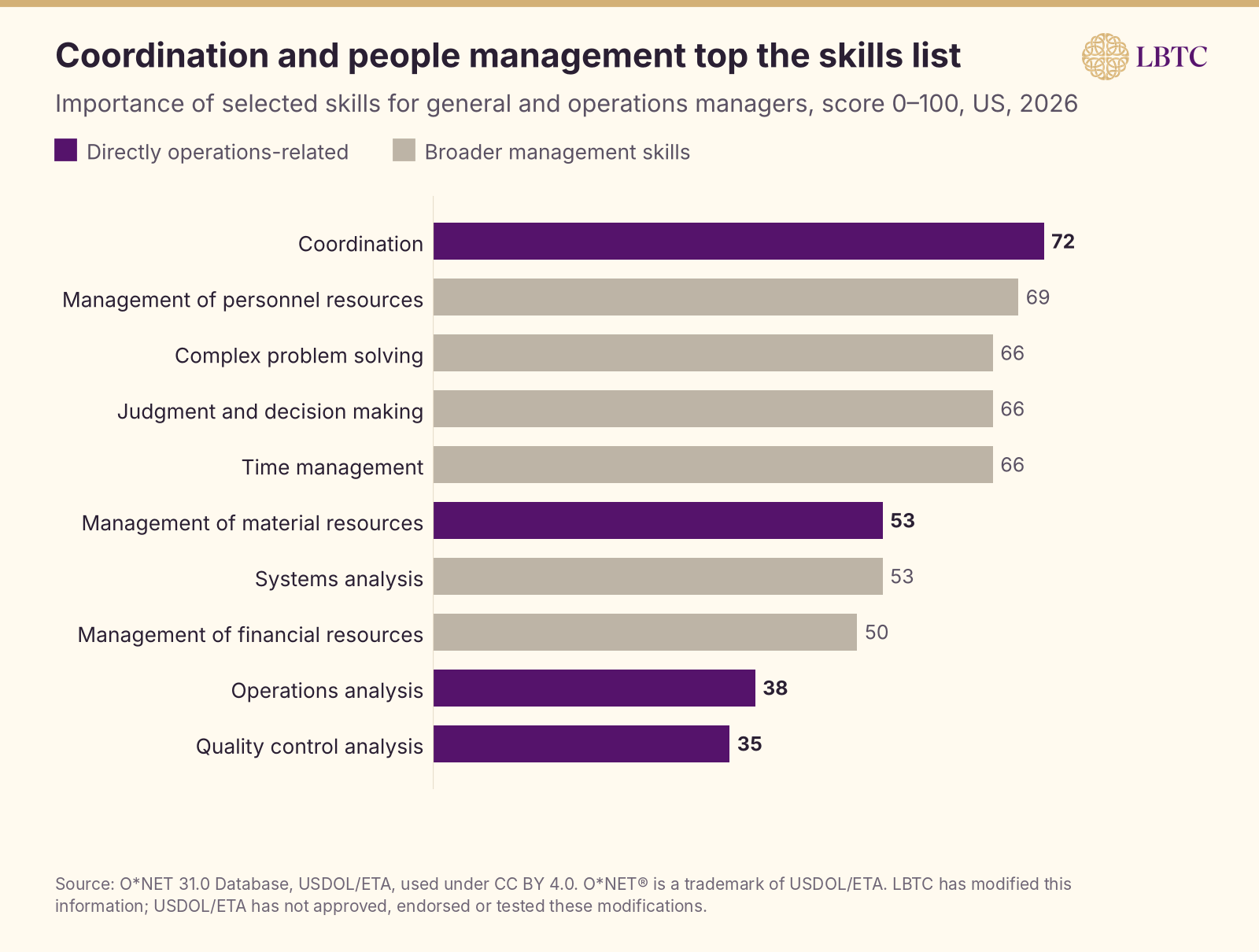
Coordination and people management top the skills list. Importance of selected skills for general and operations managers, score 0–100, US, 2026. Coordination scores 72 and management of personnel resources 69. Operations analysis scores 38 and quality control analysis 35. The profile describes a job built mainly on orchestrating people and resources, with technical analysis in a supporting role. The highest-rated task is reviewing financial statements and performance data to measure productivity or find cost reductions (O*NET, 2026). These are US ratings, and UK roles vary by sector.
Key Functions of Operations Management
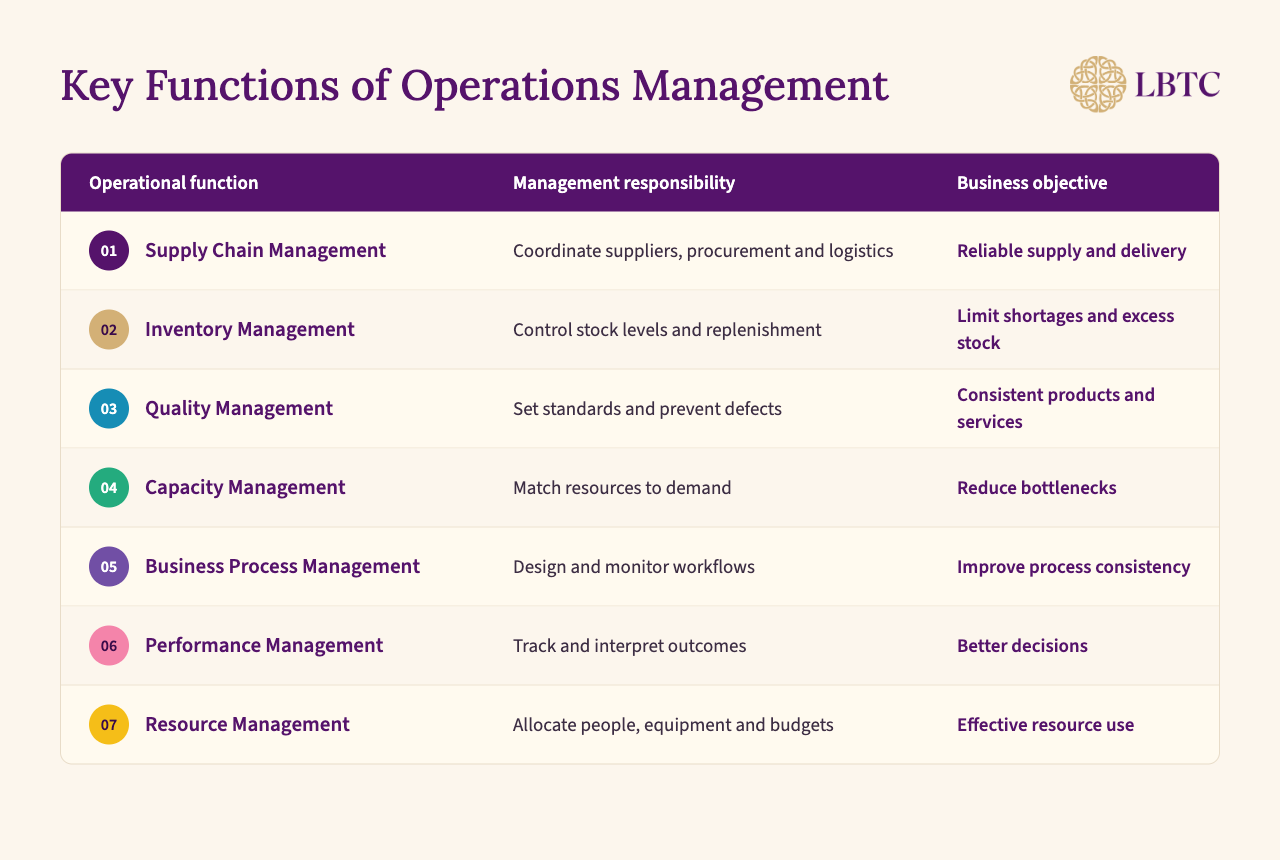
Operational responsibilities are interconnected. For example, lowering stock without considering delivery lead times may increase shortages, while raising production targets without assessing capacity may worsen defects. Managers must therefore understand the consequences of decisions across departments.
Operations Management and Supply Chain Management
Supply Chain Management coordinates sourcing, production, transportation and delivery. It encompasses procurement, suppliers, warehousing, logistics, inventory and distribution. Operations Management has a broader scope: it covers internal activities and their connections with external supply networks.
A manufacturer might run an efficient production line yet miss delivery commitments because a supplier cannot provide materials. Managers should therefore monitor supplier performance alongside production capacity. Relevant indicators include replenishment lead time, stock availability, delivery accuracy and order fulfilment. Resilient supply chains may need alternative suppliers, buffer inventory, or flexible distribution, but each adds costs to evaluate.
Operations Strategy: Connecting Business Goals with Execution
Operations Strategy determines how capabilities support organisational objectives, establishing priorities for cost, quality, flexibility, delivery, technology and resilience. A high-volume manufacturer might prioritise process consistency and equipment utilisation, while a professional service provider may emphasise responsiveness and workforce flexibility.
The right choice depends on customer expectations and organisational capabilities. Operations managers turn strategy into investment decisions, resource plans and performance measures. Conflicting departmental targets can weaken execution: procurement savings may be offset by unreliable delivery. Balanced targets should therefore encourage cross-functional cooperation.
Process Improvement and Business Process Optimisation
Process Improvement identifies operational weaknesses and introduces changes that improve outcomes. Problems can include duplicated work, unnecessary approvals, downtime, communication gaps and inconsistent procedures. Business Process Management provides a structured method for designing and monitoring workflows. Business Process Optimisation applies that method to achieve measurable improvements in cost, quality, speed or customer outcomes.
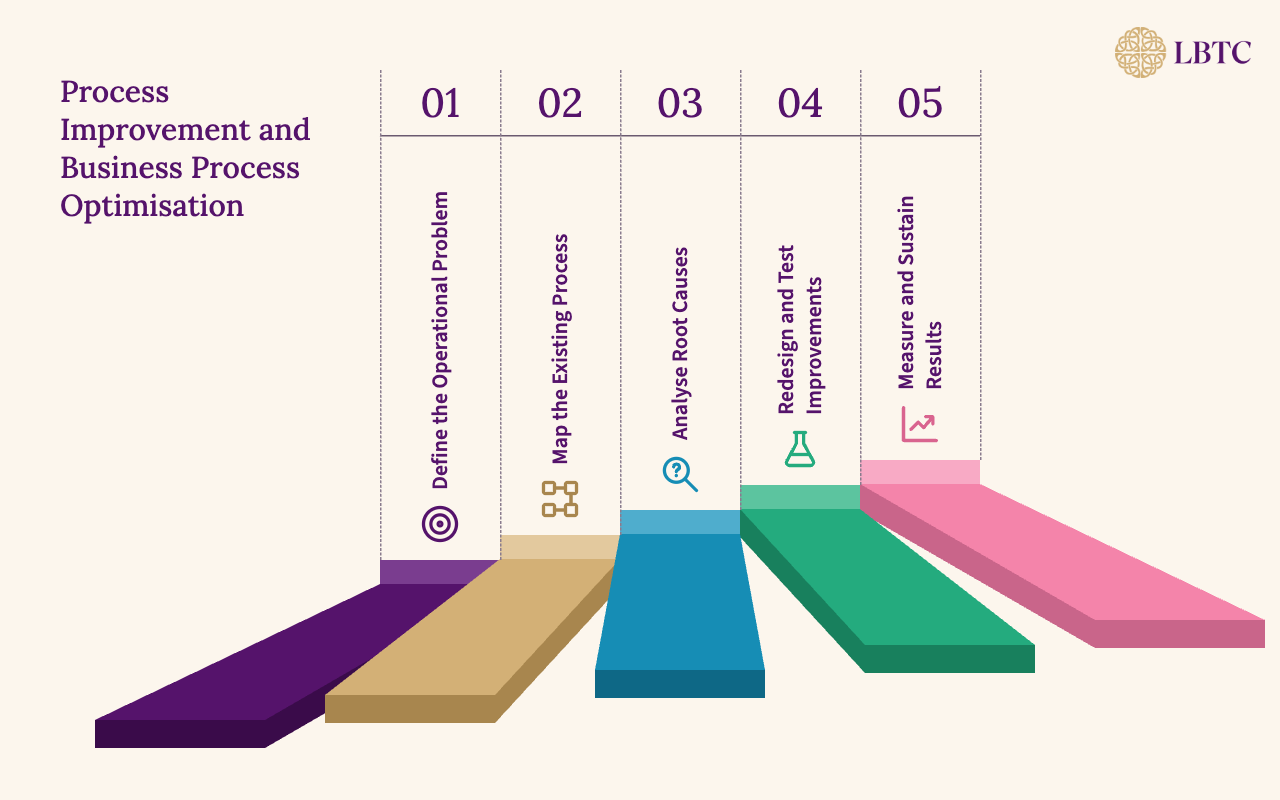
Step 1: Define the Operational Problem
Managers should establish the performance gap and its consequences. Late orders might arise from inaccurate stock records, supplier variation or insufficient warehouse capacity. A clear definition prevents teams from treating symptoms as causes.
Step 2: Map the Existing Process
Process mapping reveals activities, responsibilities, handovers and decision points. Documenting what actually happens, including exceptions, often exposes duplicated checks and departmental delays.
Step 3: Analyse Root Causes
Pareto analysis, root cause analysis, statistical techniques and operational data can identify contributing factors. Lean approaches examine waste, while Six Sigma supports analysis of process variation. Choose methods according to the specific problem and available evidence.
Step 4: Redesign and Test Improvements
Solutions may include simplified approvals, new scheduling methods, revised workflow sequences or automation. Piloting changes in a controlled environment helps managers check whether benefits materialise and whether unintended problems arise.
Step 5: Measure and Sustain Results
Compare actual outcomes with the initial baseline using processing time, error rates, costs or delivery performance. Successful Process Optimisation requires updated procedures, training and accountability so processes do not drift back towards earlier practices.
Measuring Operational Performance
Operations managers need reliable information to distinguish genuine improvement from temporary variation. Common measures include productivity (output per unit of input), cycle time (time to complete a process), first-pass yield (work completed correctly without rework), on-time delivery, inventory turnover, capacity utilisation and customer complaints.
Measures must be interpreted together. Very high utilisation can leave little flexibility for maintenance or demand surges. Faster processing may also increase errors. Effective Performance Management connects results to operational decisions and corrective actions, not dashboards alone.
Digital Transformation in Operations Management
Digital tools can improve operational visibility and coordination. Manufacturers may use sensors to monitor equipment, logistics teams may track shipments, and service organisations may forecast staffing demand. Automation and analytics can support scheduling, exception detection, and process monitoring.
Technology alone does not guarantee better outcomes. Poor data quality, fragmented systems, and unclear process ownership can undermine transformation. Managers should start with a defined problem, assess implementation costs, set success measures, and consider cybersecurity, training, and governance.
Operations Management Career Opportunities and Salary Expectations
Careers connected to Operations Management span manufacturing, logistics, procurement, analytics, project delivery and organisational leadership. Requirements include analytical reasoning, communication, commercial judgement and the ability to manage competing operational objectives. Employment prospects and earnings differ by occupation, sector and geography.
Operations Management Career Growth
According to the US Bureau of Labour Statistics, employment of operations research analysts is projected to grow by 12% between 2025 and 2035, closely followed by aerospace engineering and operations technologists and technicians at 11.9%. Airfield operations specialists are expected to grow 8%, while transportation, storage and distribution managers are projected to grow 6.1%. General and operations managers are projected to grow 5%, compared with 2.6% for industrial production managers.
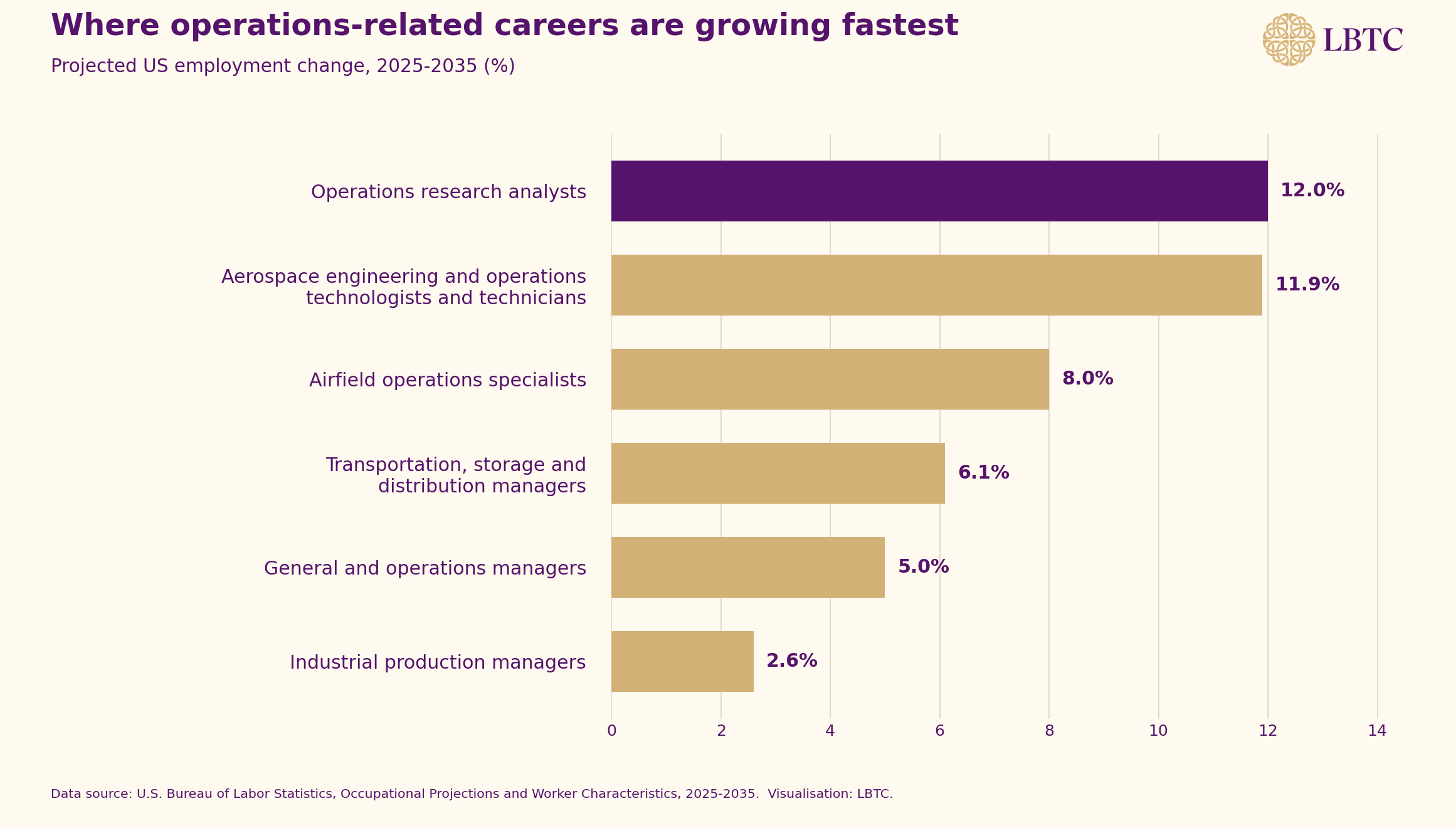
These differences highlight how employment growth varies across operational specialisations. Although analytical and technical occupations show stronger percentage growth, management positions remain important for coordinating business activities and maintaining operational performance. These projections relate to the US labour market and should not be interpreted as equivalent UK employment forecasts.
Operations Management Salaries
Salary expectations across operations-related professions also differ considerably. The US Bureau of Labor Statistics reports that industrial production managers earned a median annual wage of $126,060 in May 2025, followed by transportation, storage and distribution managers at $107,230 and general and operations managers at $105,770.
Operations research analysts earned a median annual wage of $88,940, compared with $82,890 for aerospace engineering and operations technologists and technicians and $56,850 for airfield operations specialists.
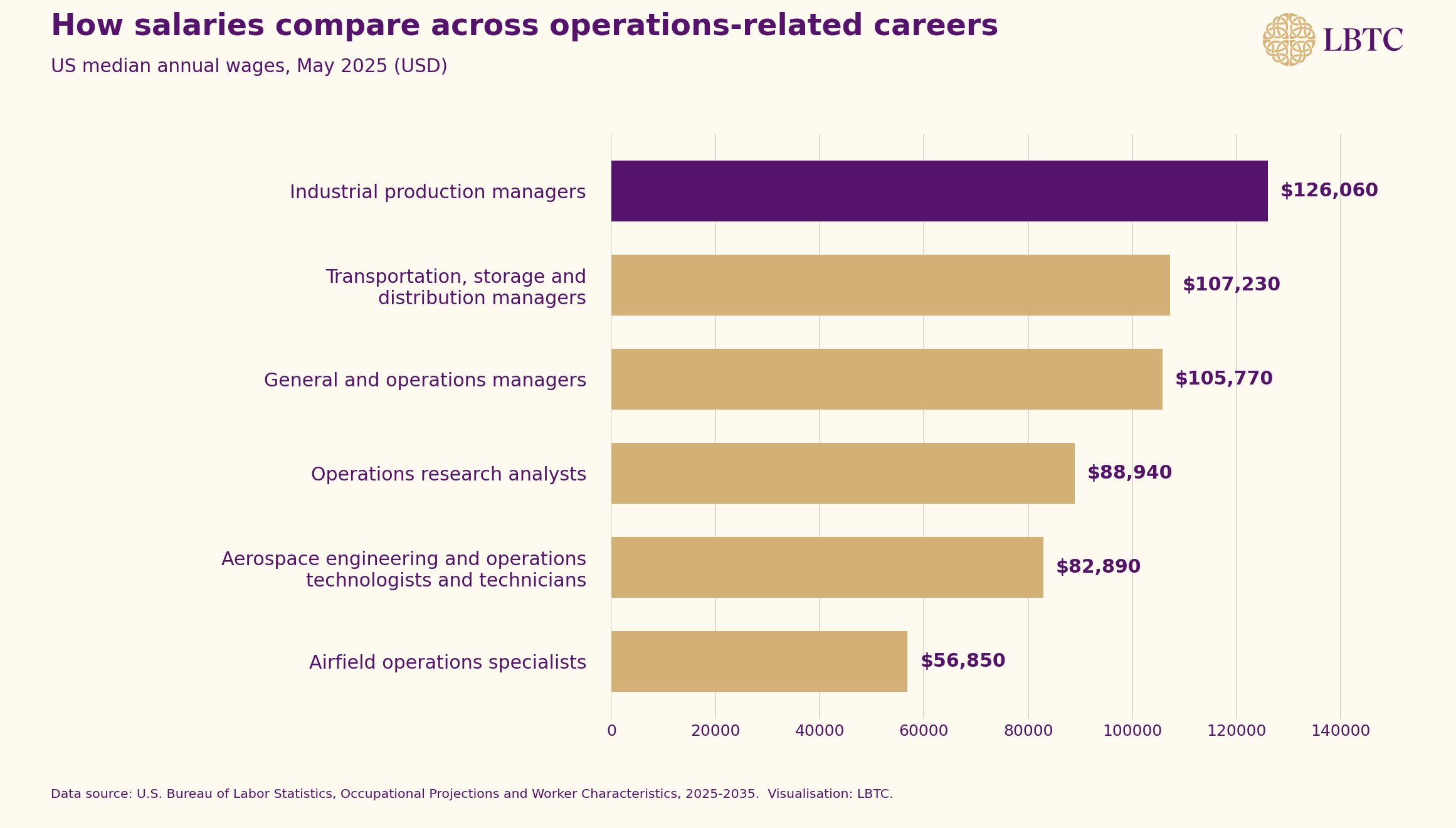
These figures demonstrate that occupations with the highest projected employment growth do not necessarily offer the highest median salaries. Consequently, professionals should consider responsibilities, required qualifications, career opportunities and long-term development when evaluating different operations-related careers.
These figures are US median wages, not mean salaries or UK pay estimates. Professional development may support career capability. Earnings depend on responsibilities, experience, location and employer.
The Value of Operations Management Courses
Professional development can help operations professionals strengthen their skills in operational planning, resource management, process improvement, performance monitoring and risk management. Well-structured operations management courses combine practical business challenges with proven management techniques, enabling professionals to apply what they learn to real operational situations.
Choosing the right operations management course depends on an individual’s responsibilities and career objectives. Supervisors and team leaders may benefit from developing skills in workflow optimisation, team coordination and quality control. Meanwhile, senior operations managers and business leaders may focus on Operations Strategy, operational resilience, strategic decision-making and organisational change.
When evaluating operations management training, professionals should consider whether the programme:
- Offers practical application: Uses real business scenarios, operational data and workplace challenges to support learning.
- Balances strategy and execution: Covers both long-term operational planning and day-to-day performance management.
- Addresses different operational environments: Includes relevant approaches for manufacturing, supply chains and service operations.
- Supports workplace implementation: Provides practical tools and techniques that participants can apply to improve processes and operational performance.
Ultimately, the value lies in helping professionals translate management knowledge into practical improvements that support organisational objectives.
Operations Management Courses at LBTC
London Business Training & Consulting (LBTC) offers specialist training programmes designed to help professionals strengthen operational leadership, improve business processes and support organisational performance. Covering strategic planning, resource management, supply chain sustainability, quality assurance, and operational excellence, these programmes address the challenges operations professionals face across industries.
Strategic Operations Leadership – 5 Days
The Strategic Operations Leadership programme focuses on developing and implementing an effective Operations Strategy aligned with wider business objectives. Participants explore strategy formulation, execution, demand forecasting, capacity planning and long-term resource allocation.
The programme also examines change management, operational dependencies, and risk resilience, helping managers translate strategic priorities into practical operational plans. It is particularly relevant to professionals transitioning from day-to-day operational responsibilities into strategic leadership roles.
Agile and Sustainable Operations – 3 Days
This programme focuses on developing agile, resilient and sustainable supply chains that can respond effectively to changing business requirements.
Participants explore Supply Chain Management, supply chain optimisation, operational risk management and sustainability frameworks. The course examines how organisations can improve adaptability, strengthen supplier relationships and integrate responsible practices into their operational processes.
It is particularly suitable for professionals involved in logistics, procurement, supply chain operations and sustainability initiatives.
Agile & Sustainable Operations and Strategic Quality Management – 8 Days
This comprehensive programme combines sustainable operations, supply chain resilience and Strategic Quality Management to support organisational performance.
Participants examine supply chain optimisation, operational governance, regulatory compliance and sustainability principles. The programme also explores the role of digital transformation, automation, artificial intelligence and data analytics in improving operational processes and decision-making.
By connecting operational agility with quality management and governance, the course broadens understanding of how organisations can maintain consistent standards, manage operational risks, and adapt to changing business environments.
Advanced Operations Management – 5 Days
The Advanced Operations Management programme focuses on improving Operational Efficiency, strengthening performance controls and managing operational risks.
Participants explore process optimisation, resource planning, risk assessment, performance measurement and continuous improvement techniques. The programme also addresses practical approaches to reducing waste, improving workflows and supporting data-driven operational decisions.
Through applied business scenarios and management frameworks, professionals can develop a more structured approach to operational problem-solving, performance improvement and business resilience.
Develop Your Operations Management Expertise with LBTC
Selecting the right professional development programme depends on individual responsibilities, organisational priorities and career objectives. Whether the focus is strategic leadership, sustainable supply chains, quality management or day-to-day operational improvement, LBTC provides training opportunities that support the development of relevant management capabilities.
Explore the full range of LBTC operations management courses to identify a programme aligned with your professional development goals.
Practical Priorities for Operations Leaders
Leaders should first identify the most important performance constraints and confirm customer requirements. Next, establish baselines and analyse resource limitations, process bottlenecks, and supplier dependencies. Prioritise initiatives according to expected value, feasibility and disruption risk. Involve operational teams, assign responsibility, and review outcomes regularly. This connects Business Process Optimisation with wider organisational priorities.
Conclusion
Operations Management connects strategy to the practical processes needed to deliver products and services. Strong operational performance depends on coordinated resources, capable teams, reliable information and careful balancing of efficiency, quality, resilience and customer needs. The UK evidence gives it particular weight. Productivity growth has been slow for almost two decades, and official data link structured management with higher productivity.
Choose one process that matters to customers, map it with the team and agree three to five KPIs. Do this first and change nothing until the measures are in place. Review those measures weekly for a quarter. The results will show where the constraint sits and which improvements are worth scaling. For structured support in building those capabilities across your team, explore LBTC’s operations management courses.
Frequently Asked Questions
What is operations management in simple terms?
Operations management is the planning, control and improvement of the processes an organisation uses to produce goods or deliver services. It combines people, materials, equipment and information to give customers the right output, on time, at an acceptable cost.
What does an operations manager do day to day?
An operations manager schedules people and resources, monitors output, cost and quality against plan, and resolves problems as they arise. Over the longer term, the role redesigns processes, introduces technology and develops the team’s capability.
How is operations management different from project management?
Project management delivers a defined change with a start and an end, for instance, a new warehouse system. Operations management runs and improves the ongoing processes that the change affects. Most operations managers draw on project management skills to lead improvement work.
What skills do operations managers need?
Important skills include analytical thinking, communication, leadership, resource planning, problem-solving, change management and operational risk awareness.
Who should take an operations management course?
An operations management course suits managers who run teams, processes or sites, and professionals moving into wider operational responsibility. It is most useful for participants who can apply the methods to a live process in their own organisation.