


9 Reasons to Become an Accountant: Skills, Careers and Training
13 min read
The profession extends beyond bookkeeping, payroll and tax preparation. It involves recording, analysing, and reporting financial information to help organisations understand performance, manage resources, and make informed decisions.
For someone considering an accounting career, the field offers opportunities to develop technical knowledge, analytical skills and a deeper understanding of how businesses operate.
Accountants work across a range of areas, including financial reporting, management accounting, taxation, auditing and financial control. Although these specialisms have different responsibilities, they share a foundation in core principles and interpreting financial information.
A financial accounting course can introduce these concepts, helping learners understand how transactions are recorded, how financial statements are prepared and how the resulting information is used.
However, training is only one part of professional development. Becoming a qualified accountant may require recognised qualifications, examinations, practical experience and professional requirements, depending on the chosen career route.
This article explores nine reasons to consider becoming an accountant, the skills involved and how structured accounting training can support professional development.
Key Takeaways
- Accounting provides knowledge of how organisations record transactions, manage resources and report financial performance.
- Accountants use financial statements to assess profitability, financial position and cash flow.
- Accounting careers include bookkeeping, financial accounting, management accounting, audit, tax and financial management.
- Technical skills include journal entries, reconciliations, accrual accounting and financial statement analysis.
- Accounting knowledge is useful beyond finance departments, particularly for managers and business owners.
- A financial accounting course can support foundational learning, but professional qualifications and relevant experience may be required for career progression.
Why Become an Accountant?
1. Accounting Builds Valuable Business Knowledge
One reason to consider becoming an accountant is the opportunity to understand how organisations operate financially.
Businesses use reliable records to understand their income, expenditure, assets, liabilities and overall position.
Accountants organise this information into records and reports that managers, investors, lenders, and other stakeholders can use.
For example, a business may generate substantial revenue but still experience cash-flow difficulties if customers take too long to pay or operating costs increase.
Accounting information helps identify these issues and provides a basis for investigating them.
A financial accounting course can introduce learners to essential concepts such as:
- The accounting equation
- Double-entry bookkeeping
- Journal entries
- Accounting periods
- Assets and liabilities
- Income and expenses
- Financial reporting
These concepts show how individual business transactions affect an organisation’s records.
The accounting equation is:
Assets = Liabilities + Equity
It illustrates how an organisation’s resources are financed through obligations to others and the residual interest of its owners.
Understanding this relationship is an important starting point for learning how financial statements are constructed.
2. Accountants Understand Financial Statements
Financial statements provide structured information about an organisation’s financial activities and position.
They help users examine profitability, resources, obligations and cash movements.
Three commonly used financial statements are:
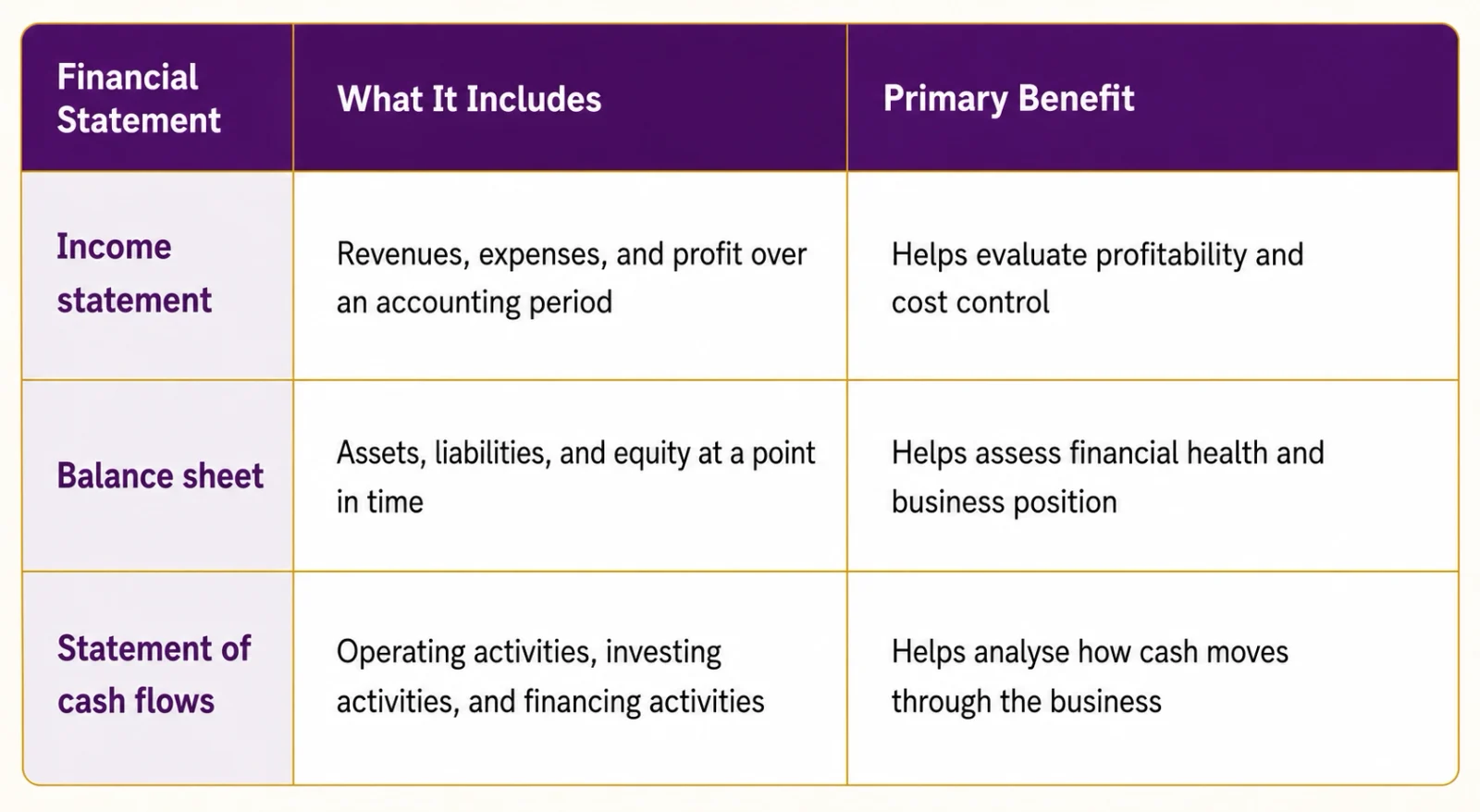
Under IAS 1, a complete set of financial statements also includes a statement of changes in equity and explanatory notes. Profit or loss and other comprehensive income may be presented together or in two separate statements (IFRS Foundation, IAS 1).
IFRS 18 replaces IAS 1 for annual reporting periods beginning on or after 1 January 2027, with earlier application permitted. These statements should be considered together rather than independently.
For example, a profitable business may still experience cash-flow difficulties.
A company might recognise revenue from a sale before receiving payment from its customer. The income statement reflects the revenue, while the balance sheet records the amount receivable.
The cash-flow statement helps show whether cash has entered the business. This distinction matters because profit and available cash are not the same.
Learning to interpret financial statements helps accountants and other professionals identify trends, assess financial performance and understand an organisation’s financial position.
3. Accounting Develops Financial Analysis Skills
Accounting provides the information needed for financial analysis.
Financial analysis involves examining business records, financial statements and other relevant data to understand an organisation’s performance and risks.
An accountant or finance professional may investigate questions such as:
- Is revenue increasing or declining?
- Are operating costs rising faster than income?
- Is the business generating sufficient cash?
- How much money is tied up in inventory?
- Are customers paying within agreed terms?
- Can the organisation meet its short-term obligations?
- How much debt does the business carry?
Financial ratios provide one way to examine these questions.
For example, the current ratio compares current assets with current liabilities, while profitability ratios help explain the relationship between revenue and profit. However, no single ratio fully assesses business health.
Interpret results alongside the organisation’s industry, previous performance, relevant policies, and wider circumstances.
Developing these analytical skills can help professionals move beyond preparing financial information to understanding what it means.
4. Accounting Offers Different Career Pathways
The profession has no single career route.
Professionals may begin in bookkeeping or finance-support positions before developing expertise in financial reporting, management accounting, taxation, auditing or other specialist areas.
Accounting offers opportunities across bookkeeping, financial reporting, audit, taxation and financial management. A financial accounting course can help learners build foundational accounting knowledge, strengthen their understanding of financial statements, and develop practical skills relevant to accounting and finance-related responsibilities.
Examples of accounting career pathways include:
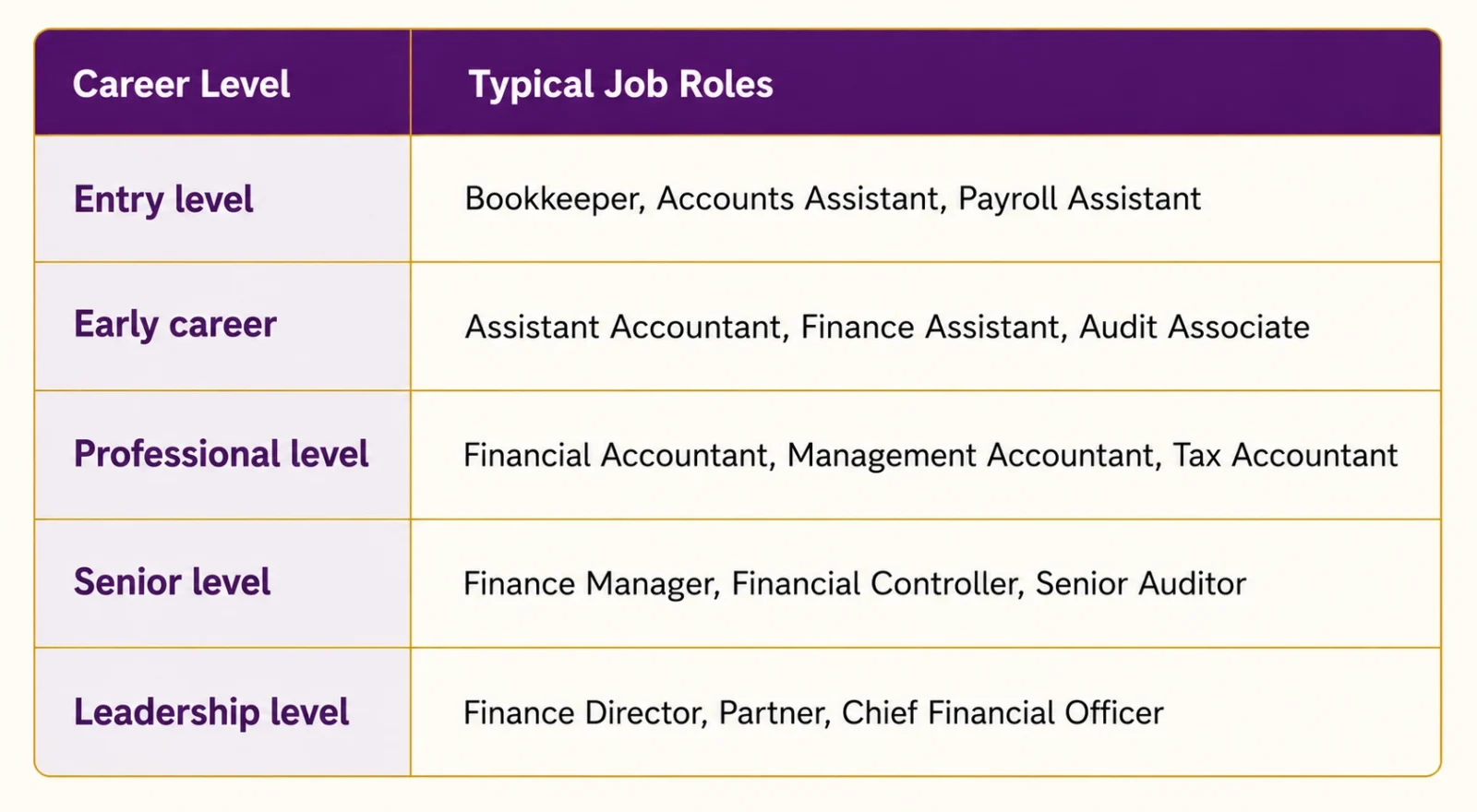
These roles are examples, not a fixed progression sequence. Entry requirements, responsibilities and seniority vary by employer.
For individuals beginning their careers or professionals looking to strengthen their financial knowledge, a financial accounting course can introduce core accounting principles, financial statements, and reporting practices. Structured training can help learners develop practical, job-relevant skills and build a foundation for continued professional development in accounting and finance.
5. Accounting Develops Practical Technical Skills
Accountants need technical knowledge to record transactions accurately, prepare financial information and understand the reporting process.
Important accounting skills include:
- Double-entry bookkeeping
- Journal entries
- T-accounts
- Ledger management
- Bank reconciliations
- Trial balance preparation
- Accrual accounting
- Adjusting entries
- Accounts receivable and payable
- Financial statement preparation
These activities are connected.
For example, recording transactions through double-entry bookkeeping affects ledger balances. You can then check those balances through a trial balance and adjust them where necessary before preparing financial statements.
A trial balance lists ledger account balances and helps check whether total debits equal total credits.
However, a balanced trial balance does not guarantee that every entry is correct. Certain errors, such as recording a transaction in the wrong account, may not affect the equality of debits and credits.
This is why accountants also use reconciliations, supporting documentation, reviews and other control procedures.
A financial accounting course can introduce these concepts and provide a foundation for further practical experience.
6. Accounting Supports Better Business Decisions
Accounting knowledge is useful beyond traditional accounting roles.
Managers, business owners and professionals responsible for budgets can benefit from understanding financial information.
For example, a department manager may need to assess whether spending is within budget, whether a project is viable or whether additional resources are affordable.
Financial accounting provides information about an organisation’s financial position and performance.
Management accounting has a related but different purpose: it focuses on information used internally for planning, budgeting, controlling costs and making management decisions.
Understanding both areas can help professionals assess the implications of their choices.
Consider a business deciding whether to purchase additional equipment.
The decision may involve:
- The initial purchase cost
- Expected operating expenses
- Available cash
- Financing requirements
- Expected benefits
- The useful life of the equipment
- Risks and uncertainty
Reliable records provide relevant evidence for this assessment.
However, financial information should be considered alongside operational, strategic and other non-financial factors.
This knowledge supports informed decision-making rather than replacing professional judgement.
7. Accounting Encourages Continuous Professional Development
The profession requires ongoing learning because reporting requirements, technology, tax rules and professional practices evolve.
Professionals may need to update their knowledge as new standards are introduced or existing requirements change.
Continuous development may involve:
- Financial reporting standards
- Management accounting
- Audit and assurance
- Taxation
- Financial analysis
- Accounting software
- Data analysis
- Professional ethics
- Business finance
The level and type of learning required depend on the individual’s responsibilities and professional status.
London Business Training & Consulting (LBTC) is accredited by the British Accreditation Council (BAC), providing independent quality assurance of its training provision.
Through its financial accounting courses, LBTC helps professionals develop practical knowledge of accounting principles, financial statements, financial reporting and business finance.
For individuals entering finance-related roles or professionals seeking to strengthen their existing expertise, structured accounting training can support continued professional development and help them apply financial knowledge more effectively in the workplace.
8. Accounting Provides Skills That Can Be Applied Across Industries
Accounting principles are relevant to many types of organisations.
Businesses, charities, public-sector bodies and other institutions all need appropriate financial information to manage resources and meet their reporting responsibilities.
Although the applicable accounting rules and organisational objectives may differ, skills such as record-keeping, reconciliation, financial analysis and reporting have wider professional applications.
For example:
In a commercial business, records may help assess profitability, cash flow and operating costs.
In a public-sector organisation, financial information may support budget management, accountability and the use of public resources.
In a charity or non-profit organisation, accounting helps track income, expenditure and financial responsibilities.
This variety gives accounting professionals opportunities to apply their knowledge in different organisational environments.
However, moving between sectors may require additional knowledge of the applicable accounting standards, regulatory requirements and reporting practices.
9. Accountants Work with Financial Technology and Digital Tools
Modern practice increasingly involves digital systems that support transaction recording, reconciliation, reporting and analysis.
Depending on the organisation and role, professionals may use:
- Accounting software
- Spreadsheets
- Financial reporting systems
- Enterprise resource planning systems
- Data-analysis tools
- Reporting dashboards
- Automated reconciliation tools
These systems can reduce some manual processing and make financial information easier to organise and analyse.
However, technology does not eliminate the need for technical knowledge.
Professionals still need to understand whether transactions have been classified correctly, whether reports reconcile and whether the resulting information is reasonable.
For example, an automated system may generate a financial report, but an accountant must still understand the underlying data, assumptions and any material discrepancies.
Digital competence is therefore increasingly relevant alongside traditional technical skills.
A financial accounting course can provide the conceptual foundation for understanding the information these systems generate.
Accounting Ratios Every Beginner Should Understand
Ratios are useful tools for examining profitability, liquidity and capital structure.
They are calculated using figures from financial statements and other relevant records.
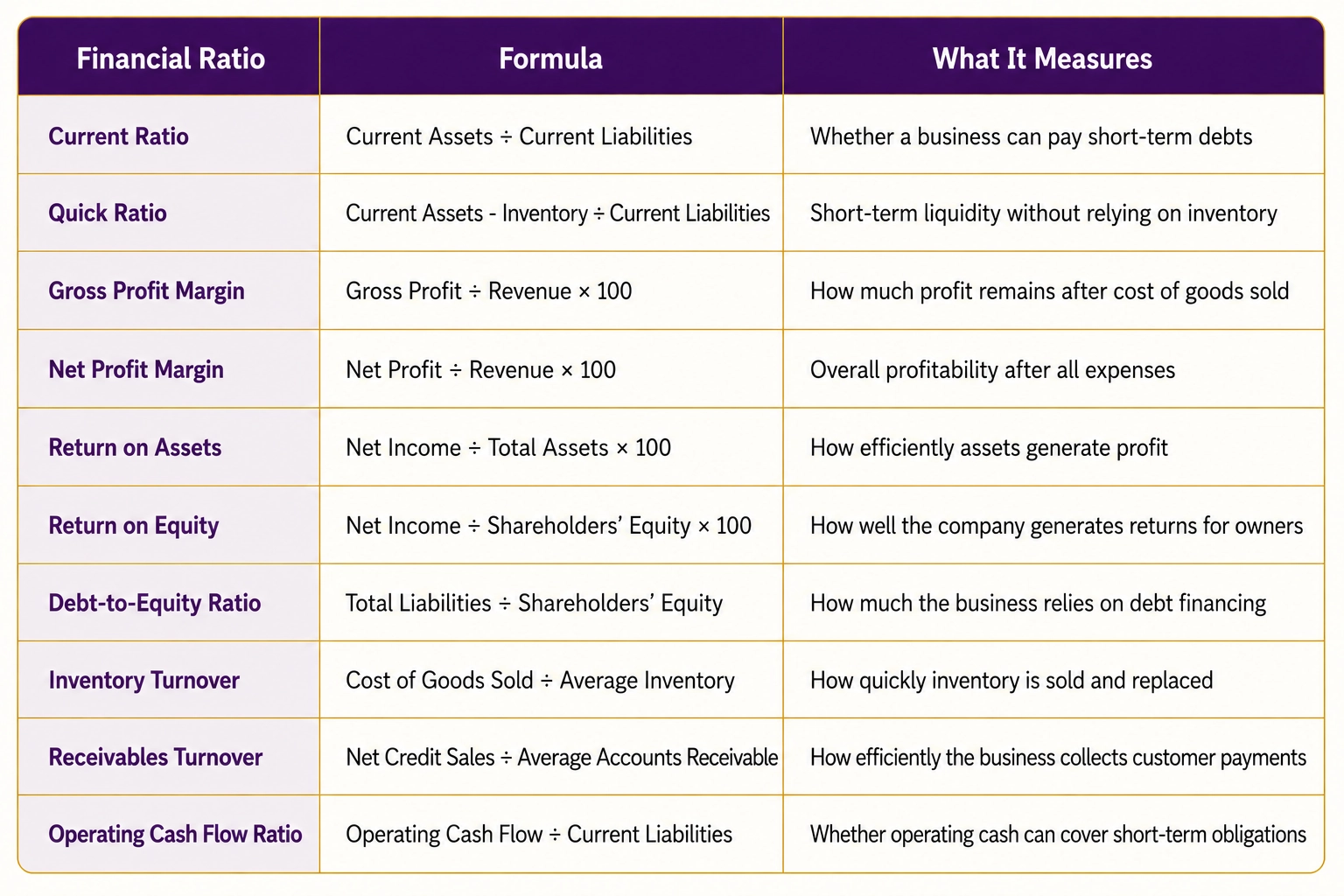
The quick-ratio formula above uses the common simplified approach. Some calculations also exclude other less-liquid current assets, and debt-to-equity definitions may differ according to the analytical context. Therefore, state the chosen definition consistently.
Example: Current ratio
Suppose a business has:
- Current assets: £120,000
- Current liabilities: £80,000
Its current ratio is:
£120,000 ÷ £80,000 = 1.5
This means the business has £1.50 of current assets for every £1 of current liabilities.
It does not necessarily mean the company has £1.50 in immediately available cash. Some current assets may consist of inventory or amounts owed by customers.
That is why you should interpret financial ratios alongside the underlying financial statements and business circumstances.
What Should You Learn in a Financial Accounting Course?
A well-structured introductory financial accounting course should build understanding progressively.
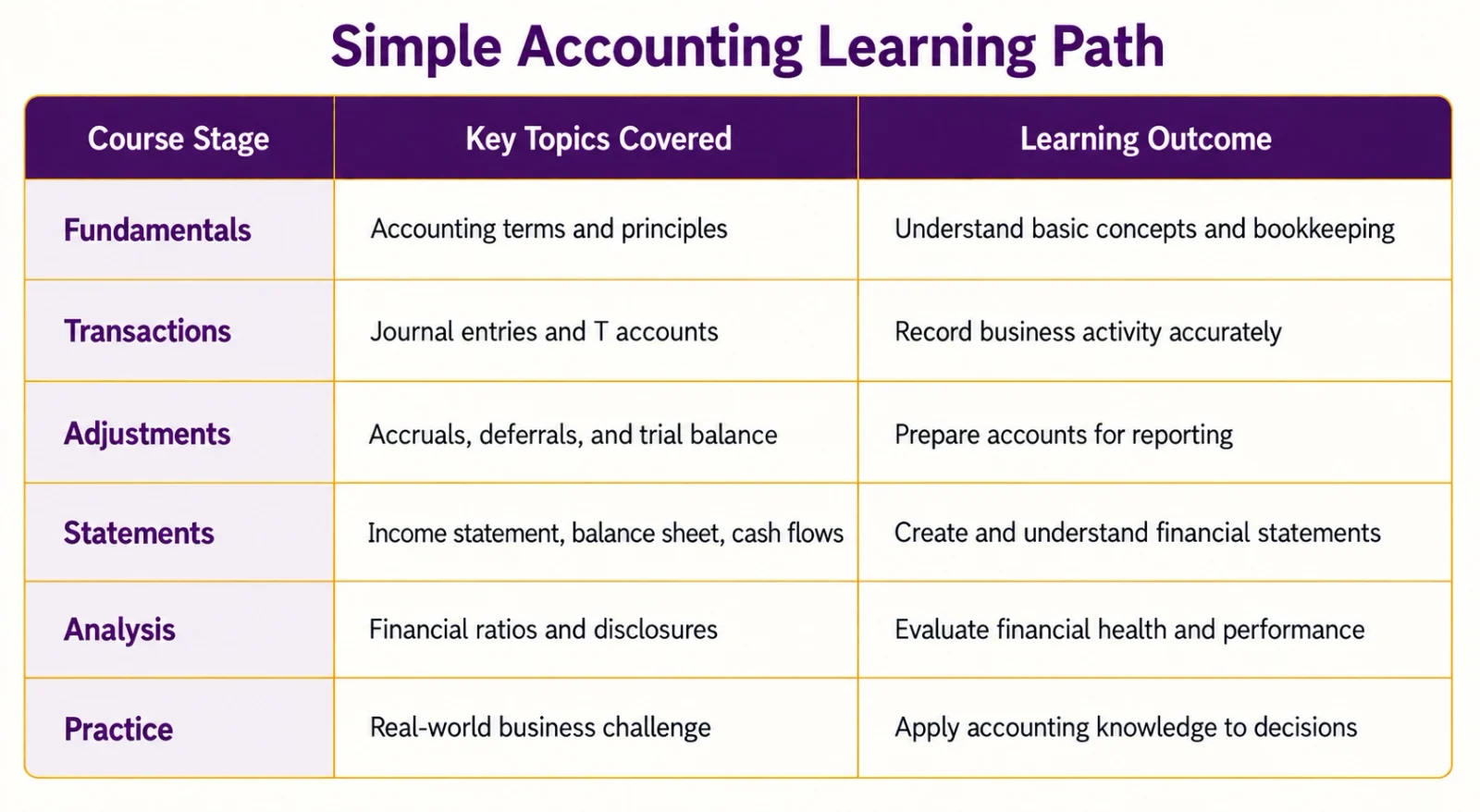
Course content and depth vary between providers, so learners should review the published syllabus before enrolling.
For example, LBTC’s Core Principles of Accounting and Financial Reporting programme covers accounting records, financial reporting standards, profit and loss statements, balance sheets and working capital.
Professionals seeking broader training can also review LBTC’s accounting, finance and banking courses.
The right course depends on experience, learning objectives, and whether the individual wants practical workplace knowledge or a formal qualification.
Is Accounting the Right Career for You?
This career may be worth considering if you enjoy working with information, analysing problems and understanding how organisations operate.
Useful attributes include:
- Attention to detail
- Analytical thinking
- Organisation
- Professional judgement
- Communication
- Problem-solving
- Willingness to learn
- Professional integrity
The role also involves responsibilities that are not always visible from the outside.
Professionals may need to meet reporting deadlines, investigate discrepancies, explain technical information and work within regulatory or organisational requirements.
A career decision should therefore consider both the opportunities and the day-to-day responsibilities of the role.
Learning the fundamentals through introductory training can help individuals make a more informed decision about whether further study is appropriate.
Conclusion
Becoming an accountant can provide opportunities to develop financial knowledge, analytical ability and practical business skills.
This work helps organisations record transactions, prepare financial information, understand performance and make informed decisions.
It also offers different career pathways, from bookkeeping and financial reporting to management accounting, audit, taxation and financial leadership.
However, career progression is not automatic. Relevant experience, professional development, qualifications and employer requirements all influence the opportunities available.
A financial accounting course can provide a foundation in accounting principles, financial statements, journal entries, accrual accounting, and financial analysis.
For individuals considering a career in accounting, the best starting point is to understand the profession, identify the required skills, and choose a learning path that matches their experience and goals.
Frequently Asked Questions
1. What is a financial accounting course?
A financial accounting course introduces learners to how transactions are recorded, classified and reported.
Depending on the programme, it may cover accounting principles, double-entry bookkeeping, journal entries, financial statements, accrual accounting and basic financial analysis.
2. What are the main financial statements?
Three commonly discussed statements are the income statement, balance sheet and statement of cash flows.
A complete set of financial statements under IFRS also includes a statement of changes in equity, presentation of other comprehensive income and explanatory notes, together with any other applicable requirements.
3. Can I become an accountant without an accounting degree?
Yes, there are routes into the profession that do not require an accounting degree.
These may involve short courses, workplace training and professional-body qualifications.
The requirements depend on the role, employer and professional qualification being pursued.
4. What is the accounting equation?
The accounting equation is:
Assets = Liabilities + Equity
It expresses the relationship between an organisation’s assets, obligations and owners’ residual interest.
5. What is accrual accounting?
Accrual accounting recognises the effects of transactions and other events in the periods to which they relate, even when the associated cash receipts or payments occur in different periods.
For example, revenue may be recognised when the relevant performance obligation is satisfied rather than when the customer pays.
6. What is the difference between financial accounting and management accounting?
Financial accounting focuses on recording and reporting financial information, including preparing financial statements for external users.
Management accounting focuses on information used internally for planning, budgeting, controlling costs and supporting management decisions.
7. What technical skills do accountants need?
Relevant skills may include double-entry bookkeeping, journal entries, reconciliations, trial balance preparation, accrual accounting, financial reporting, spreadsheet use and financial analysis.
Requirements vary by role and specialism.
8. Can accounting training support career development?
Yes. Relevant training can help learners improve their financial knowledge and develop skills used in accounting and business roles.