


Project Life Cycle: Five Key Phases of Project Management
17 min read
Project management sits at the centre of organisational performance. When executed well, it transforms strategic intent into measurable outcomes, aligns resources with priorities, and creates sustainable value. By integrating proven project management tools, structured techniques, leadership capability, and comprehensive training resources that support project management skill development, organisations deliver successful projects across construction, IT, business transformation, and professional services. Whether delivering digital transformation, infrastructure programmes, or software development initiatives, leaders must manage projects effectively while balancing cost, time, and quality.
Understanding the five stages of project management alongside the core success factors of a project is essential, whether you are a senior manager responsible for complex projects, preparing for a project management certification or qualification, starting with a foundation as the entry point for beginners in project management, transitioning into a new role, or aspiring to build a project management career. Gaining real-world experience is also invaluable in project management training. This article consolidates the five stages of the project life cycle with the critical factors of cost, performance, and time. It also explains how a structured Project Planning and Management course strengthens capability across every phase, nurturing talented project managers.
In this article, you’ll discover:
- The five key phases of the project life cycle, from initiation to closure
- How project management training supports effective planning, delivery, and control
- The importance of managing cost, quality, and time in successful project delivery
- How project management tools and techniques improve team performance and decision-making
- Why structured project management courses support career development and professional growth
- How organisations can achieve more consistent project outcomes through strong governance and continuous learning
Understanding the Project Life Cycle
The project life cycle provides a structured framework for turning strategy into execution. Most methodologies, including those aligned with the Project Management Institute (PMI), recognise five key phases: initiation, planning, execution, monitoring and control, and closure. A clearly defined life cycle establishes consistency across teams and departments. It ensures that every project follows a structured approach, regardless of size or industry. This consistency strengthens stakeholder management, improves communication, and enhances project performance. Importantly, the life cycle also creates natural control points. At each stage, decision-makers can review progress, assess risk management exposure, and confirm continued strategic alignment. As a result, organisations avoid unnecessary expenditure and maintain stronger control over time, cost, and quality objectives.
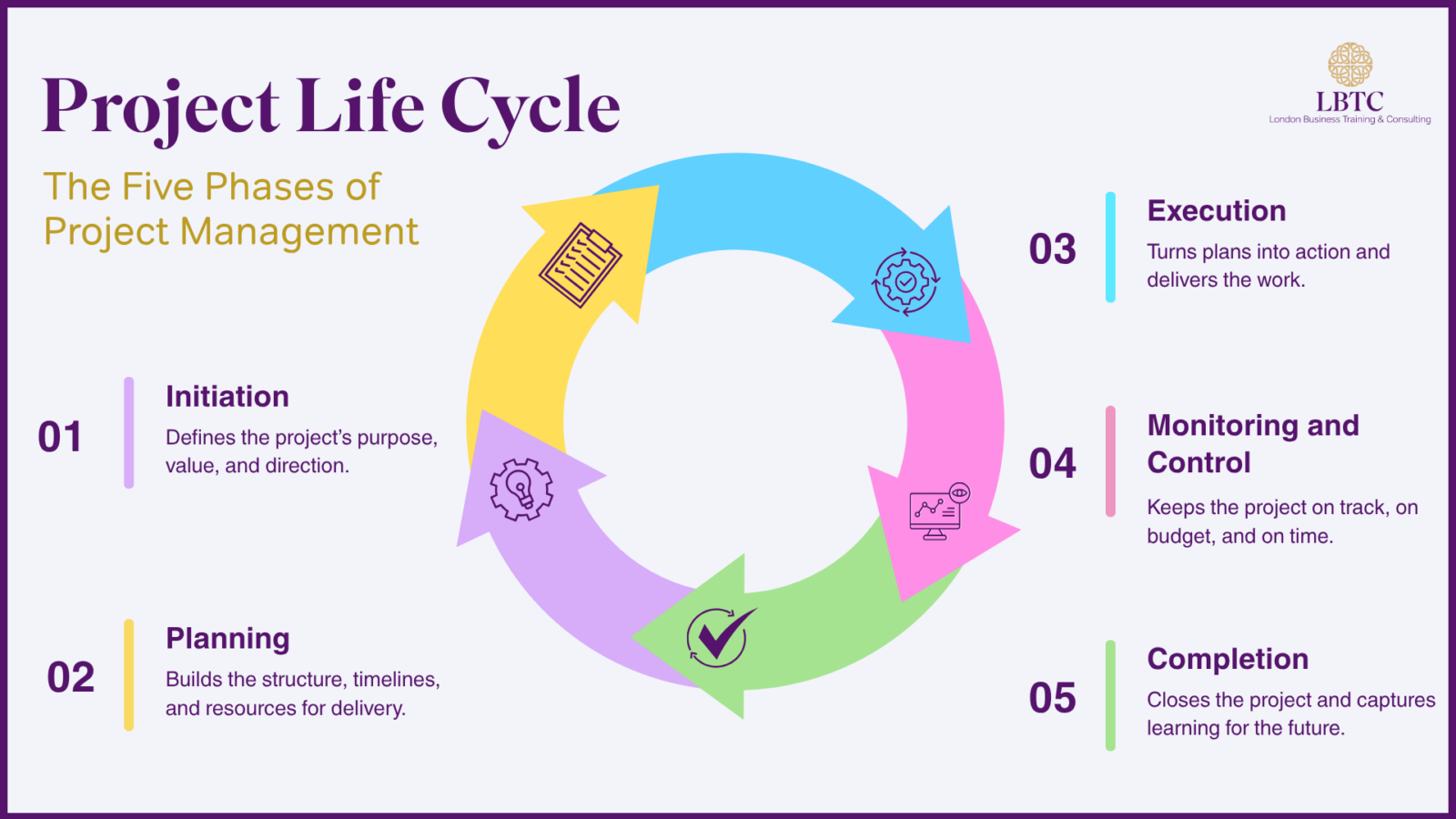
Phase 1: Initiation – Establishing Direction
Every successful project begins with a strong project initiation phase. This phase determines whether the project is viable, strategically aligned, and capable of delivering measurable value within the broader business management environment. Before execution begins, the project manager must assess feasibility, clarify stakeholder expectations, and confirm alignment with organisational objectives. Strong project initiation prevents ambiguity later and establishes governance foundations from the outset.
Through project management training, essential skills are developed in:
- Stakeholder Identification: Identifying, analysing, and engaging project stakeholders early to manage expectations, define responsibilities, and establish effective communication channels.
- Project Charter Development: Creating a clear and robust project charter that defines objectives, project scope, constraints, required resources, and measurable success criteria.
- Feasibility Analysis: Applying structured methods to evaluate financial viability, technical feasibility, and overall business value.
This stage reduces early risks such as scope creep, unclear objectives, and resource misalignment. As a result, organisations strengthen control, improve stakeholder confidence, and increase the likelihood of project success from the outset.
Phase 2: Planning – Building the Framework
Project planning is one of the most critical stages of project management. It transforms strategic intent into a structured roadmap and establishes the control mechanisms that guide the entire project lifecycle. Without disciplined planning, even well-resourced projects struggle to maintain direction.
A robust project management plan defines scope, timelines, budgets, governance structures, and performance expectations. It provides clarity for the project manager, aligns stakeholders, and creates measurable benchmarks for progress.
Key competencies required at this stage include:
- Structured Planning Techniques: Using Work Breakdown Structures (WBS), Gantt charts, scheduling software, and other project management tools to manage complex projects.
- Risk Management Planning: Identifying risks early and applying mitigation strategies to protect project performance. Planning proactively strengthens resilience and reduces costly disruption.
- Resource Allocation Skills: Optimising time, budget, people, and tools to achieve objectives efficiently. Effective allocation ensures that resources are deployed where they generate the greatest value.
Effective planning supports better decision-making, continuous learning, improves confidence among project professionals, and reduces delays and cost overruns.
Phase 3: Execution – Delivering Results
After the project charter is approved and the project manager is assigned, the project moves into its execution phase. In this phase, the project team is assembled, and work begins on delivering the project’s outputs. The project manager coordinates the team, resources, and tools to deliver agreed-upon outcomes while maintaining quality control.
Project management training enhances execution through:
- Leadership Skills Development: Supporting talented and experienced project managers in motivating teams and managing performance.
- Communication Strategies: Ensuring effective communication across stakeholders, senior managers, and project professionals.
- Project Management Tools: Using software and digital tools(Trello, Asana, Jira, Monday.com, and Microsoft Project) to track tasks, manage workflows, and improve productivity.
Strong execution is essential for delivering a successful project that meets performance, time, and cost expectations. The project manager works with the team to create a schedule, assign tasks, and track progress. Risks are identified, and mitigation plans are put in place. The execution phase ends when the project’s objectives are met and the customer accepts the deliverables.
Phase 4: Monitoring and Control – Safeguarding Performance
Monitoring and control are the processes of measuring whether a project is on track and making adjustments when necessary. It is highly important because it ensures that progress remains aligned with objectives, budgets, timelines, and quality standards. This stage runs alongside execution and is central to risk management and informed decision-making.
Key competencies developed through popular project management courses include:
- Performance Measurement: Establishing clear KPIs, milestones, and structured reporting systems to monitor progress, assess the project, and maintain control over cost, time, and quality objectives.
- Problem-Solving Skills: Applying analytical thinking and practical management approaches to address delays, resource constraints, scope changes, and other operational challenges without disrupting overall project delivery.
- Change Management: Managing approved changes through structured governance processes to ensure adjustments are implemented efficiently while protecting project success and stakeholder confidence.
It is important to monitor performance throughout the project lifecycle in order to identify issues early, take corrective action promptly, and prevent minor deviations from escalating into significant risks that could derail the project.
Phase 5: Completion – Securing Organisational Learning
Project completion formally closes the project management process and confirms that objectives have been achieved. However, effective closure goes beyond administrative sign-off. It strengthens accountability, secures knowledge transfer, reinforces continuous improvement across the organisation, and captures the knowledge gained throughout the project lifecycle.
This phase typically includes releasing resources, finalising financial reconciliation, completing performance reports, and confirming that all deliverables meet agreed standards. A structured review at this stage ensures transparency and protects organisational credibility.
Additions from project management training increase value in the following ways:
- Evaluation Techniques: Assessing outcomes against original objectives, analysing project performance, and identifying opportunities for improvement in future initiatives.
- Documentation Best Practices: Recording and archiving key project data, reports, decisions, insights, and knowledge gained to support future project planning and informed decision-making.
- Feedback Collection: Engaging project stakeholders to gather structured feedback, strengthen stakeholder management practices, and improve future collaboration.
More importantly, completion creates an opportunity for evaluation and learning. Organisations that systematically review outcomes build maturity within the project profession and enhance long-term capability. Effective closure transforms individual project experience into organisational intelligence. As a result, organisations not only complete projects successfully but also strengthen their ability to deliver sustained success over time.
The Three Critical Factors in Project Management
The five stages of project management define how work moves from initiation to closure.
However, outcomes depend on how well cost, quality, and time are controlled in practice.
Together, lifecycle structure and disciplined control form the backbone of project management courses.
This framework underpins recognised certification pathways and structured project management training delivered by BAC-accredited (British Accreditation Council) training providers such as LBTC.
In every sector — construction, IT, transformation, or internal change, accountability shifts to the project manager once a project is authorised. From that point, delivery depends on disciplined planning, clear governance, and measurable outcomes. Across industries, performance is evaluated against three core objectives: cost, quality, and time. These remain central pillars within modern project management courses.
1. Cost and Value Management
Effective cost management is one of the most critical success factors in project management and a key competency taught in professional project management courses. Projects must be controlled against clearly defined cost baselines and detailed budgets to prevent overspending, reduce financial risk, and ensure long-term organisational sustainability.
Key cost-related priorities include:
- Accurate cost estimation and budgeting, based on realistic assumptions, prior experience, and best practice techniques.
- Ongoing financial monitoring and reporting, enabling project managers to track expenditure and manage variances proactively
- Alignment with authorised expenditure, ensuring spending remains consistent with the approved project management plan
Failure to manage costs can lead to scope expansion, delayed completion, and loss of organisational confidence. Therefore, strong financial governance is central to effective project management and to every project manager’s responsibilities.
2. Quality and Performance Standards
Quality defines whether deliverables meet agreed specifications and stakeholder expectations. It reflects how effectively planning has been translated into tangible outcomes. High-performing organisations increasingly adopt Total Quality Management (TQM) principles, embedding quality into every stage of the project lifecycle. Organisations avoid treating quality as a final inspection activity. Instead, they integrate standards into design, execution, and oversight.
Core quality factors include:
- Meeting agreed specifications and performance standards, ensuring deliverables align with project scope and objectives
- Reliability, safety, and sustainability, particularly in complex projects across regulated industries.
- Long-term value creation and low operating costs, enhancing return on investment and organisational benefit
- Alignment with ISO 9000 quality management standards, supporting consistent and auditable quality processes
Modern project management recognises that quality is not the responsibility of a single department. Instead, it is a shared responsibility across the entire project team, reinforced through strong leadership, communication, and continuous improvement practices taught in advanced project management training programmes.
3. Time and Schedule Integrity
Delivering projects on time is essential for maintaining organisational credibility, protecting customer relationships, and supporting overall business performance. Effective time management is therefore a core focus within project management certification and training courses, especially for project professionals managing multiple or complex projects.
Time-related priorities include:
- Adhering to agreed schedules, milestones, and defined start and finish dates to ensure predictable delivery.
- Preventing delays arising from resource constraints, weak planning, or slow decision-making.
- Managing dependencies across concurrent projects to minimise disruption within portfolios and programmes.
Consistent failure to meet project timelines damages reputation, increases costs, and disrupts other initiatives waiting to begin. Therefore, disciplined scheduling, continuous monitoring, and structured control are essential capabilities developed through project management training and practical experience.
Why Project Management Training Matters
Structured project management courses strengthen both organisational capability and individual development. They reinforce accountability across the five phases discussed earlier and clarify how cost, quality, and time interact.
For organisations, project management training:
- Enhances stakeholder engagement
- Strengthens risk management capability
- Improves team management effectiveness
- Supports structured project delivery
- Reinforces governance and control
Project management courses also provide access to more resources, structured learning pathways, and applied frameworks that support informed decision-making. As complexity increases across industries, disciplined project management becomes a strategic advantage rather than a technical function. For leaders seeking further guidance, more resources are available through LBTC’s project management programmes and advanced development pathways.
Building a Project Management Career
A project management career offers progression across construction, finance, energy, and software development. Demand for capable project managers continues to grow across industries. However, advancement requires continuous learning and structured development. Career progression depends on building recognised project management qualifications and applied capability. Employers increasingly seek individuals who combine leadership, financial awareness, and disciplined project planning expertise.
To develop new skills and strengthen credibility, professionals should consider:
- Accredited project management qualifications aligned with industry standards.
- Continuous development programmes that reinforce applied knowledge.
- Alignment with recognised professional bodies.
- Exposure to real-world projects across diverse sectors.
A reputable training provider such as London Business Training & Consulting (LBTC) offers flexible options to accommodate different entry requirements. Investment in structured learning through LBTC’s project management courses strengthens capability, expands career pathways, and enhances long-term development within the project management field.
Practical Skills for Modern Project Managers
Today’s project manager must combine technical knowledge with leadership capability. Beyond project planning, they must demonstrate the following capabilities:
- Stakeholder management expertise
- Risk management competence
- Quality management understanding
- Team productivity optimisation
- Performance measurement capability
Importantly, project management training should enable participants to apply what they learn directly in real-world projects. Practical application strengthens knowledge, reinforces management discipline, and builds enduring professional skills.
Delivering Consistent Project Outcomes
Organisations that embed a structured approach across their project management practices strengthen predictability, governance, and operational resilience. They deliver projects with greater efficiency, allocate resources responsibly, and respond to complexity with clarity and confidence.
Consistent results do not occur by chance. They emerge from disciplined project planning, clear accountability, and strong leadership oversight throughout the project lifecycle.
A comprehensive project management course equips teams with the frameworks and applied capability required to manage projects effectively while aligning with recognised standards. As organisational complexity increases globally, investment in structured project management training becomes a strategic priority rather than an operational choice.
Conclusion
Project management remains central to organisational strategy and operational performance. To deliver projects consistently, organisations must integrate disciplined project planning, structured governance, strong stakeholder engagement, and continuous performance measurement.
Equally, individuals seeking a sustainable project management career must build recognised project management qualifications and applied expertise.
Through structured project management training and professionally designed project management courses, organisations and individuals strengthen capability across the full project life cycle. For further information, explore LBTC’s training programmes and access full details on how our courses support professional development and long-term capability.
Frequently Asked Questions(FAQ’s):
1. What is project management training?
Project management training helps professionals build the knowledge, skills, and confidence needed to plan, manage, and deliver projects successfully. It usually covers project planning, stakeholder management, risk management, quality management, leadership, communication, governance, and performance measurement.
2. Who should take project management courses?
Project management courses are useful for project managers, aspiring project managers, team leaders, functional managers, department heads, and professionals who manage tasks, people, budgets, or deadlines. They are also suitable for career changers who want to move into project coordinator, junior project manager, or project leadership roles.
3. What are the main benefits of project management training?
Project management training improves planning, communication, risk management, decision-making, and leadership skills. It helps professionals deliver projects more consistently, use resources more effectively, improve customer satisfaction, and support better business results across different industries.
4. Can I learn project management through online courses?
Yes. Online project management courses allow professionals to develop project management skills while balancing work and other responsibilities. London Business Training & Consulting also offers classroom learning options for participants who prefer face-to-face discussion, trainer interaction, and structured group learning.
5. How can a Project Planning and Management course support career development?
A Project Planning and Management course can strengthen leadership capability, improve confidence, and build practical skills for managing real projects. It can also enhance professional credibility, support career progression, and prepare learners for wider project management responsibilities in their organisation.