


New to Project Management Training? Key Career Benefits
17 min read
Project management can appear complex at the outset, particularly for individuals new to managing timelines, deliverables, stakeholders, and project team coordination. Yet with the right mindset, a structured approach, and access to project management training, project management becomes a practical, learnable discipline rather than an overwhelming one. Regardless of prior experience or industry background, professionals can build confidence through structured project planning, a disciplined learning style, and progressive skills development. For those at the start of a project management career, high-quality training and courses provide the foundation needed to move forward with clarity and purpose.
The following sections outline practical, beginner-friendly steps commonly taught in project management courses and professional training programmes, including specialist pathways such as Earned Value Management Certification. These approaches focus on the knowledge gained through structured learning, applied techniques, and access to relevant training resources, enabling aspiring project managers to transition effectively from theory to real-world project delivery.
In this article, you’ll discover:
- The fundamentals of project management training and how it helps beginners build confidence
- The core project management process, from initiation and planning to execution, monitoring, and closure
- Why structured project management courses and certifications support career progression
- How project management tools improve planning, collaboration, and project control
- The career opportunities available to trained project management professionals
- How continuous learning and practical experience support long-term project management success
1. Understanding What Project Management Training Builds
Project management is not simply about checklists or directing tasks. It is a structured discipline for planning and delivery. It helps organisations complete projects with clarity, control, and purpose. This applies to many types of work. Examples include launching a product, organising an event, or implementing new software. It also supports complex projects with many stakeholders.
Effective project management keeps work within scope. It also supports better use of time, cost, quality, and resources. Teams can collaborate more clearly and deliver more consistent business outcomes. Project management training builds this foundation. It helps learners understand risk, planning, quality, and decision-making. It also introduces recognised project frameworks.
This knowledge is important for people entering the project profession. It supports better judgment, structured delivery, and long-term career progression.
2. Learning the Core Project Management Process and Planning Basics
Before exploring advanced methodologies such as Agile or pursuing project management certification, it is essential to understand the core project management process. Most project management courses begin by introducing the five fundamental phases of project management, which apply across industries and project types. This structured approach helps organisations align projects with specific needs, ensures employees understand their roles, and supports effective decision-making throughout the project lifecycle.
- Initiation – defining the project management plan, objectives, stakeholders, feasibility, and access to required resources.
- Planning – developing timelines, project planning documentation, resource allocation, risk management strategies, and assessment criteria.
- Execution – leading the project team, coordinating employees, and delivering outputs in line with agreed plans.
- Monitoring – tracking progress, managing scope creep, using project management tools to control performance, and making informed adjustments.
- Closure – completing deliverables, securing stakeholder approval, capturing lessons learned, and reviewing outcomes.
These core stages form the foundation of project management qualifications delivered by BAC-accredited (British Accreditation Council) training providers such as LBTC, supporting learners in building recognised knowledge and practical capability within the project profession.
3. Why Project Management Training and PM Courses Matter for Beginners
One of the most effective ways to develop new skills and build confidence is through professional project management training. Well-structured PM training programmes provide essential theoretical knowledge, introduce best-practice techniques, and support real-world application, enabling learners to build capability that supports long-term career development and progression toward management certification.
As an accredited training provider, LBTC delivers project management courses for beginners and aspiring project managers, with flexible learning options including online, classroom-based, and blended formats. Our programmes are structured at foundation level to create a practical and engaging learning experience, allowing students and professionals to learn at their own pace, gain applied knowledge, and work towards recognised certification aligned with industry needs.
Beyond technical skills, project management training at LBTC places strong emphasis on professional development. Through structured courses and applied learning, project professionals strengthen their communication, leadership, and stakeholder management capabilities, which are critical to project management success in modern organisations.
4. Using Project Management Tools to Manage Projects Effectively
Technology plays a central role in modern project management. Project management tools enable project managers to plan, manage, and control projects more effectively by supporting task allocation, scheduling, real-time progress tracking, and collaboration across the project team. Platforms such as Trello, Asana, Jira, Monday.com, Microsoft Project, and other project management software help companies standardise the delivery process and ensure greater visibility and control throughout the project lifecycle.
Most project management training courses introduce learners to industry-standard tools and practical techniques, creating a structured learning experience that allows project professionals to understand how technology supports each stage of the project management process.
By developing familiarity with these tools, talented project managers gain access to valuable resources that support consistent decision-making and best-practice delivery. Beginners are encouraged to start with a single platform, build confidence, and gradually expand their toolkit as projects become more complex and organisational demands increase.
5. Building Real-World Experience Through Learning by Doing
While frameworks, tools, and training provide a strong foundation, real capability in project management is developed through practical application. A learning-by-doing approach allows aspiring project managers to translate theoretical knowledge into action by managing tasks, coordinating teams, and responding to real project challenges. This hands-on experience strengthens understanding of project processes and builds confidence in decision-making.
Project management training at LBTC is designed to bridge the gap between theory and practice by embedding real-world scenarios into the learning experience. Through case studies, applied exercises, and project-based activities, learners gain practical experience managing scope, timelines, and stakeholders in real-world business contexts. This emphasis on real-world experience equips professionals with the skills needed to lead projects effectively and adapt to the demands of complex organisational environments.
6. Continuous Learning for Long-Term Project Management Success
Finally, staying open to learning is essential for long-term success in project management. Each new project introduces fresh challenges, but with experience, professionals become more confident and capable in navigating complex business environments. As a dynamic discipline, project management continues to evolve in response to changing business needs, new tools, and emerging best practices.
Successful project managers commit to continuous learning by updating their skills through professional training, structured courses, and online courses delivered by recognised training providers. By investing in ongoing development, project professionals strengthen their ability to lead projects, manage risk, and adapt effectively to changing organisational and business requirements.
In summary, starting a project management career does not need to feel overwhelming. By understanding the fundamentals, engaging in targeted training, and enrolling in structured project management courses, aspiring professionals can build the confidence and capability required for long-term success. A clear development pathway, supported by recognised project management certification and a relevant project management qualification, enables learners to apply knowledge progressively and effectively.
Every experienced project manager once started at the same point. With the right training, ongoing learning, and practical application, the transition into project management becomes both achievable and professionally rewarding.
Career Opportunities in Project Management and the Role of Training
As professionals progress beyond the basics, many discover that project management offers extensive career opportunities across industries. Project management has become one of the most in-demand career paths in today’s business environment, with organisations increasingly relying on skilled project managers to lead projects, manage stakeholders, and deliver results.
Whether working in IT, construction, healthcare, finance, or other sectors, project management skills are highly transferable. With the right project management qualification and certification, professionals can progress into senior and strategic roles.
Why Project Management is a Strategic Career Choice
Project management involves planning, executing, and closing projects efficiently while managing resources, budgets, timelines, and risks. It is a discipline that requires a unique blend of leadership skills, communication, critical thinking, and technical knowledge. As projects become more complex, companies across various industries are on the lookout for talented and experienced project managers who can lead them effectively, ensuring they are completed on time, within budget, and to the desired quality standards.
This demand makes project management an attractive career choice for professionals seeking growth, responsibility, and long-term career development.
Core Responsibilities and Skills of Successful Project Managers
Project managers are responsible for guiding projects through a structured approach, ensuring alignment with organisational objectives. Core responsibilities include:
- Defining project goals, objectives, and scope
- Creating detailed project management plans
- Leading and supporting the project team throughout the project lifecycle
- Managing budgets, schedules, and risk management processes
- Communicating effectively with stakeholders and senior management
- Ensuring quality standards and project performance targets are met
Project management training helps professionals develop these competencies through case studies, real-world examples, and practical assessment. With such a critical role to play, it’s no wonder that project management is a rewarding career with numerous opportunities for growth.
Rising Demand for Project Managers Across Industries
According to industry reports, the demand for skilled project professionals is expected to continue rising over the next decade. As organisations undertake increasingly unique challenges and larger project portfolios, the need for skilled project managers who can navigate them grows. This growing demand has created a wealth of opportunities for those with the right skills and qualifications. Leading accreditation bodies and training providers emphasise structured learning, accredited qualifications, and continuous professional development.
Project management is not limited to any single industry. Whether you’re interested in working in IT, construction, healthcare, or marketing, project management skills are transferable and highly valued. This versatility allows professionals to explore a variety of industries and find the niche that best suits their interests and expertise.
How Project Management Training Supports Career Progression
While some project management skills can be learned on the job, formal project management training can significantly help with your career advancement. Training programmes provide a structured framework, deepen theoretical knowledge, and prepare learners for practitioner exams. From understanding project management methodologies like Agile and Waterfall to mastering tools like Gantt charts and risk management frameworks, training provides a comprehensive foundation.
Benefits of Project Management Training and Certification:
1. Building Knowledge, Skills, and Best-Practice Capability:
Project management training covers essential concepts, Tools, Frameworks, and Techniques crucial to managing projects effectively. This knowledge can help you stand out in a competitive job market.
2. Gaining Industry-Recognised Certifications and Qualifications:
Obtaining a project management certification through BAC-accredited (British Accreditation Council) training programmes can support career progression and open access to more advanced project management roles across industries.
3. Improving Project Delivery and Performance Outcomes:
Project management training equips professionals to lead projects effectively, manage scope creep, and deliver consistent results while maintaining control over time, cost, and quality.
4. Enhancing Career Growth and Earning Potential:
Project managers with formal training and certifications often command higher salaries, have greater access to senior roles, and carry greater responsibility.
5. Accessing Training Resources, Experts, and Professional Networks:
Training programmes provide access to valuable resources, project management experts, and professional networks that support continuous learning and long-term career development.
Project Management Career Paths and Advanced Roles
Here are some of the key roles you can pursue with project management training and certification:
- Project Administrator / Project Support Officer
- Project Coordinator
- Assistant Project Manager
- Project Manager
- Senior Project Manager
- Program Manager
- Portfolio Manager
- PMO Manager / Head of PMO
- PMO Director
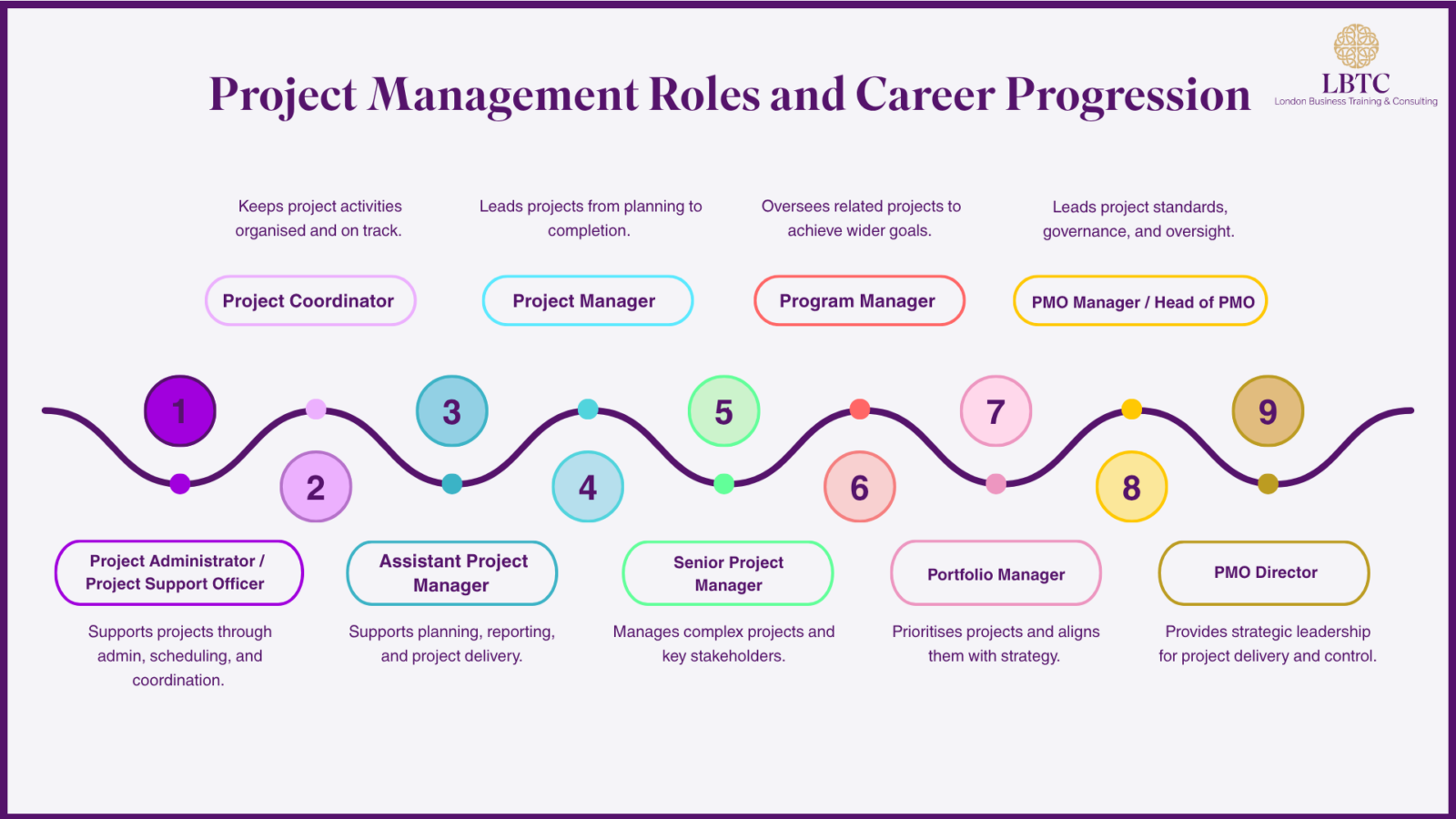
1. Project Coordinator:
An entry-level role that supports project managers by coordinating activities, maintaining documentation, and assisting with scheduling. This position helps build foundational project management experience.
2. Project Manager:
Responsible for leading projects end-to-end, managing teams, stakeholders, budgets, and delivery in line with agreed objectives. The role focuses on ensuring projects are completed on time, within scope, and to quality standards.
3. Program Manager:
Oversees multiple related projects to ensure they align with business strategy and deliver collective value. This role focuses on coordination, risk management, and strategic outcomes.
4. Portfolio Manager:
Manages a portfolio of projects by prioritising organisational investment and balancing risk, resources, and strategic objectives. The role ensures that projects support long-term business goals.
5. PMO Director:
Leads the Project Management Office (PMO), setting governance frameworks, standards, and best practices across the organisation. This senior role ensures consistency, control, and performance across all projects.
6. Project Consultant:
Provides expert guidance to organisations on a project-by-project basis, advising on frameworks, tools, and implementation. This role supports organisations in improving project delivery and capability.
Each role builds on prior experience, advanced qualifications, and continuous learning, allowing professionals to gradually take on greater responsibility, manage more complex projects, and progress into senior and strategic positions within the project profession.
Conclusion
Career opportunities in project management are broad and diverse, enabling professionals to work across industries while taking on challenging roles that contribute directly to organisational success. Investing in project management training is a strategic career decision, as it strengthens practical skills, supports progression towards a recognised project management qualification, and builds the confidence needed to succeed in increasingly complex project environments. Structured project management courses provide a clear pathway for both entry-level professionals and those seeking career advancement.
Whether you are starting your journey or looking to progress into more senior roles, project management offers a rewarding career path with long-term growth potential. By choosing the right training and development opportunities, professionals can unlock new career possibilities and build sustainable success within the project profession.
For further information and access to additional resources, visit our website to explore our online learning options, bespoke programmes, and professional training solutions designed to support every stage of your project management career.
Frequently Asked Questions(FAQ’s):
1. What is project management training?
Project management training teaches professionals how to plan, manage, and deliver projects in a structured way. It covers key areas such as project planning, risk management, stakeholder communication, project controls, budgeting, scheduling, and team coordination. For beginners, it provides a clear foundation for building confidence and starting a project management career.
2. Is project management training useful for beginners?
Yes. Project management training is highly useful for beginners because it explains the core project management process in a simple, structured way. It helps learners understand how projects move from initiation and planning to execution, monitoring, and closure. This makes it easier to manage tasks, support project teams, and progress into project coordinator or project manager roles.
3. What are the career benefits of project management training?
Project management training can improve employability, confidence, leadership skills, and career progression. It helps professionals develop practical skills in communication, risk management, planning, budgeting, and stakeholder management. These skills are valuable across industries such as IT, construction, healthcare, finance, marketing, and business consulting.
4. What qualifications can support a project management career?
Project management qualifications can support career growth by proving a learner’s knowledge and commitment to professional development. Beginner-friendly qualifications often focus on project terminology, planning techniques, risk management, and the basics of project delivery. More advanced qualifications may support progression into roles such as project manager, programme manager, portfolio manager, or PMO leader.
5. How does project management training improve business performance?
Project management training improves business performance by helping organisations deliver projects more consistently and efficiently. Trained project professionals are better able to manage time, cost, quality, scope, and risk. This can lead to stronger team coordination, fewer delays, more efficient resource use, improved stakeholder satisfaction, and higher customer satisfaction.