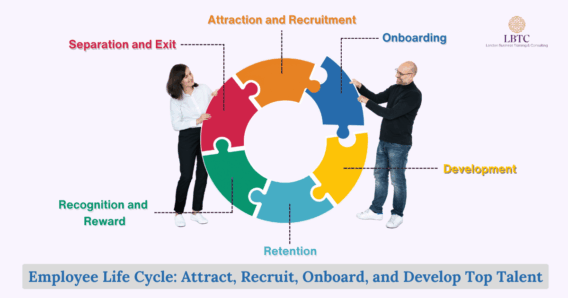


Human Resource Management (HRM)? Meaning, Process, & Trends
13 min read
Human capital has never been more strategically important. As organisations navigate complex workforce dynamics, economic pressure, and rapid technological change, the ability to manage people effectively has become a defining factor in long-term business success. Yet many organisations still treat the HR department or human resources department as a primarily administrative function focused on payroll, regulatory compliance, and record-keeping, rather than as the strategic engine it has the potential to be.
Human Resource Management (HRM) has evolved far beyond its administrative origins. Today, it encompasses workforce planning, talent acquisition, talent management, performance management, employee development, employee relations, and organisational culture, all of which directly influence an organisation’s capacity to grow, innovate, and retain its best people. In the modern human resource management field, HR is no longer limited to administrative tasks. It plays an increasingly central role in improving employee productivity, strengthening positive workplace culture, and supporting long-term business objectives.
This article provides a comprehensive overview of HRM: what it means, why it matters, how it works in practice, and where it is heading. For HR professionals strengthening their strategic approach, line managers improving their people management skills, and organisational development consultants advising on workforce transformation, this guide offers practical insights grounded in evidence and established frameworks. It also helps answer a common question for aspiring professionals: what is HRM course content, and how does it build the knowledge and skills needed for effective people management?
Key Takeaways
- Human Resource Management (HRM) is a strategic discipline focused on managing an organisation’s workforce to support both people and business objectives.
- Effective HRM directly influences workforce productivity, employee engagement, employee retention, and organisational performance.
- Core HRM activities cover the entire employee lifecycle, from hiring and onboarding through to development, performance management, and succession planning.
- Modern HR practices, including digital HR systems, data analysis, and flexible work models, are reshaping how organisations manage their people.
- HR analytics enables data-driven decision-making, supporting more accurate forecasting, improved retention strategies, and stronger business outcomes.
- The future of HRM will be shaped by artificial intelligence, predictive analytics, continuous learning models, and a heightened focus on employee well-being.
The Evolution of HR: From Administration to Strategy
Twenty years ago, HR departments were largely transactional. Their primary responsibilities included processing payroll, maintaining employee records, supporting benefits administration, managing compliance, and administering contracts. Strategic input into the business was limited, and HR was often viewed as a support function rather than a source of competitive advantage.
That perception has changed substantially. Several converging forces have driven the transition from traditional personnel management to strategic Human Resource Management.
Globalisation created more diverse, geographically dispersed workforces, requiring organisations to develop inclusive policies, cross-cultural communication frameworks, and scalable HR systems. The growth of digital technology introduced cloud-based HR platforms, applicant tracking systems, and analytics tools that transformed how organisations recruit, develop, and retain talent.
More recently, the COVID-19 pandemic accelerated the adoption of remote and hybrid work models, forcing HR teams to rethink how they support employee well-being, maintain engagement, and manage performance across distributed teams. These changes have firmly established HRM as a strategic discipline, sitting at the intersection of people, data, leadership, and business operations.
What is Human Resource Management (HRM)?
Human Resource Management (HRM) is the strategic and systematic approach to managing an organisation’s workforce. It encompasses all policies, processes, and practices used to recruit, develop, manage, and retain employees in alignment with organisational goals.
The HRM full form is Human Resource Management, and it reflects its core purpose: treating human capital as a resource to be developed and managed with the same rigour applied to financial or operational assets.
The distinction between HRM and traditional personnel management is significant. Personnel management tends to be reactive and administrative, focused on compliance and employee welfare in a narrow sense. HRM, by contrast, is proactive and strategic. It connects workforce planning to business objectives, uses data to inform decisions, and positions HR as an active contributor to organisational performance. Within the modern human resource management field, this means HR professionals manage not only employment administration, but also workforce capability, engagement, and the systems that shape long-term performance.
Why HRM Matters: The Importance of Human Resource Management
Organisations that invest in robust HRM practices consistently outperform those that do not. The reasons are structural.
1. Budget Control
Workforce costs typically represent the largest single expenditure for any organisation. Effective HRM helps leaders design fair, competitive compensation strategies and employee benefits packages that attract talent without overextending budgets. Strategic workforce planning also reduces costly overhiring or reactive redundancy.
2. Employee Satisfaction and Retention
High employee turnover is expensive. Recruitment, onboarding, and productivity losses associated with replacing an experienced employee can amount to a significant proportion of that employee’s annual salary. HRM supports employee retention through structured engagement strategies, conflict management, employee support, and a culture of recognition and development.
3. Performance Improvement
Performance management systems, when designed and implemented effectively, provide clear expectations, regular feedback, and structured development pathways supported by professional employee training programmes. The result is a workforce that understands how its contribution connects to broader organisational goals, and a leadership team with the data it needs to identify high performers and address underperformance early.
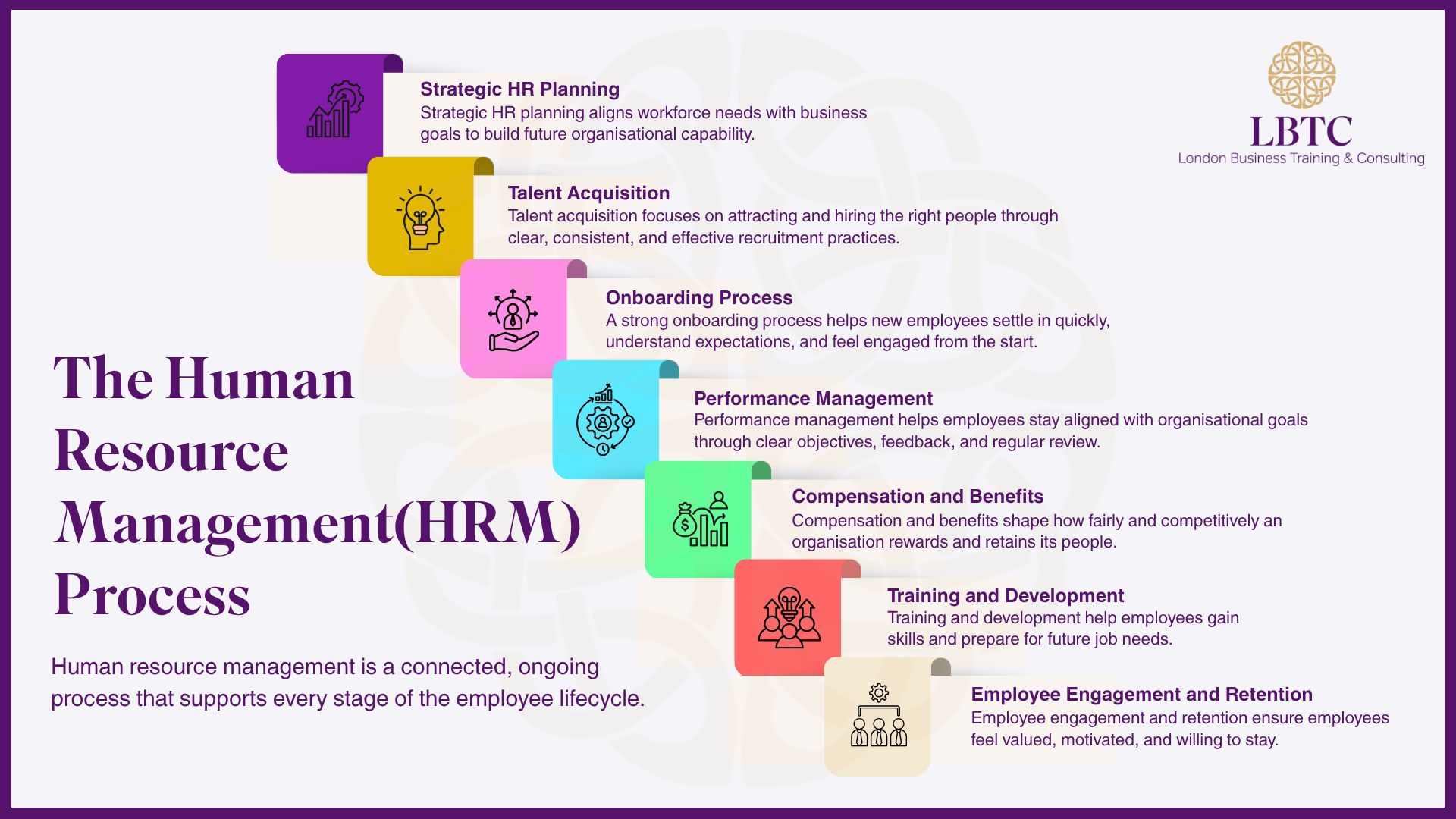
The Human Resource Management Process
Human resource management is not a single activity but a continuous, interconnected process that spans the full employee lifecycle. From workforce planning and recruitment to development, performance, and retention, each stage plays a direct role in shaping organisational capability. Effective human resource management ensures that people practices are not handled in isolation but aligned with wider business priorities, the company’s culture, and long-term workforce needs. In practice, strong human resource management creates the structure through which organisations attract talent, build capability, support performance, and sustain growth.
Strategic HR Planning
Effective HRM begins with alignment. HR leaders work alongside senior management to understand the organisation’s strategic direction and translate that into workforce requirements. This involves assessing current capability gaps, forecasting future talent needs, and building succession pipelines for critical roles.
Dave Ulrich’s HR Business Partner Model is a widely recognised framework here. It positions HR professionals not as administrators but as strategic partners, change agents, and employee champions, each role contributing directly to business outcomes. In this context, HR professionals manage workforce priorities by helping align HR strategies with commercial direction, talent needs, and long-term organisational capability.
Talent Acquisition
Recruitment is one of the highest-impact activities within HRM. Attracting and selecting the right people requires a clear employer value proposition, structured interview processes, and increasingly, data-informed sourcing strategies. Competency-based recruitment frameworks remain a reliable tool for ensuring hiring decisions are objective, consistent, and aligned with the skills the organisation actually needs.
Strong recruitment also depends on effective job analysis, clear job descriptions, and careful writing job descriptions that reflect both role requirements and organisational expectations. In many organisations, HR managers and the human resources manager also rely on digital recruitment tools (such as job posting platforms, CV screening software, and video interview systems) and applicant tracking systems to improve efficiency and consistency in talent acquisition.
Onboarding Process
The onboarding process is often underestimated as a lever for retention. Employees who experience a structured, well-supported onboarding programme are significantly more likely to remain with the organisation beyond their first year. Effective onboarding integrates new employees into the culture, clarifies expectations, and provides early development support.
A strong onboarding process also helps HR professionals manage early engagement, reinforce company policies, and introduce the standards, behaviours, and working practices that support a positive workplace culture.
Performance Management
Performance management sits at the centre of effective human resource management. Regular and meaningful performance reviews, supported by clear objectives and ongoing feedback, help align individual contributions with organisational goals. The SMART goal-setting framework—Specific, Measurable, Achievable, Relevant, and Time-bound continues to offer a practical structure for setting expectations and measuring progress.
Increasingly, organisations are moving away from annual reviews towards more continuous performance conversations, supported by performance management systems and dedicated performance management software such as BambooHR, Lattice, 15Five, or Workday. Organisations looking to explore the leading performance management tools in 2026, or compare platforms through detailed ratings, features, and reviews, can assess a range of options before selecting the most suitable solution. These tools help HR professionals manage goals, monitor progress, and provide more timely constructive feedback.
Compensation and Benefits
Managing salary structures and benefits packages requires both market awareness and internal equity. HR teams must regularly benchmark compensation against sector norms while ensuring pay structures are fair, transparent, and compliant with relevant legislation.
A sound compensation strategy also shapes how organisations position themselves in the labour market. Well-designed compensation and benefits frameworks strengthen attraction, support employee retention, and improve trust in the overall employment relationship. For many HR managers, balancing pay, fairness, and sustainability is one of the most visible parts of the HR function.
Training and Development
The 70:20:10 learning model suggests that 70% of effective learning occurs through on-the-job training, 20% through peer interaction and feedback, and 10% through formal training. This framework is widely used when designing employee development initiatives and well-designed employee training programmes.
In human resources management, training is not only about closing current skill gaps. It is also about helping employees build future capability, strengthen their skills, and prepare them to adapt to changing workplace demands. Strong employee training, supported by structured learning and practical experience, remains central to effective talent management and long-term workforce resilience.
Employee Engagement and Retention
Employee engagement is a measurable indicator of how committed and motivated employees feel in their roles. High engagement correlates strongly with productivity, employee retention, and customer satisfaction. HR teams support engagement through regular pulse surveys, recognition programmes, transparent communication, and a genuine commitment to employee well-being.
The World Economic Forum highlights employee engagement as a key driver of organisational productivity and workforce resilience in the modern workplace. For HR professionals, the challenge is not simply to measure engagement, but to translate insights into actions that improve employee engagement, strengthen trust, and sustain a positive workplace culture.
Core Functions of HRM
The scope of human resource management encompasses several distinct but interconnected functions:
- Recruitment and Talent Acquisition
- Personnel Management and Employee Records
- Employee Relations and Conflict Resolution
- Performance Reviews and Evaluations
- Compensation and Benefits Administration
- Employee Health, Safety, and Well-Being
- Organisational Development and Change Management
Each of these functions requires specialist knowledge, but they are most effective when managed as part of an integrated HR strategy rather than in isolation. In practice, HR professionals manage these responsibilities through structured HR processes that support consistency, capability, and performance across the organisation.
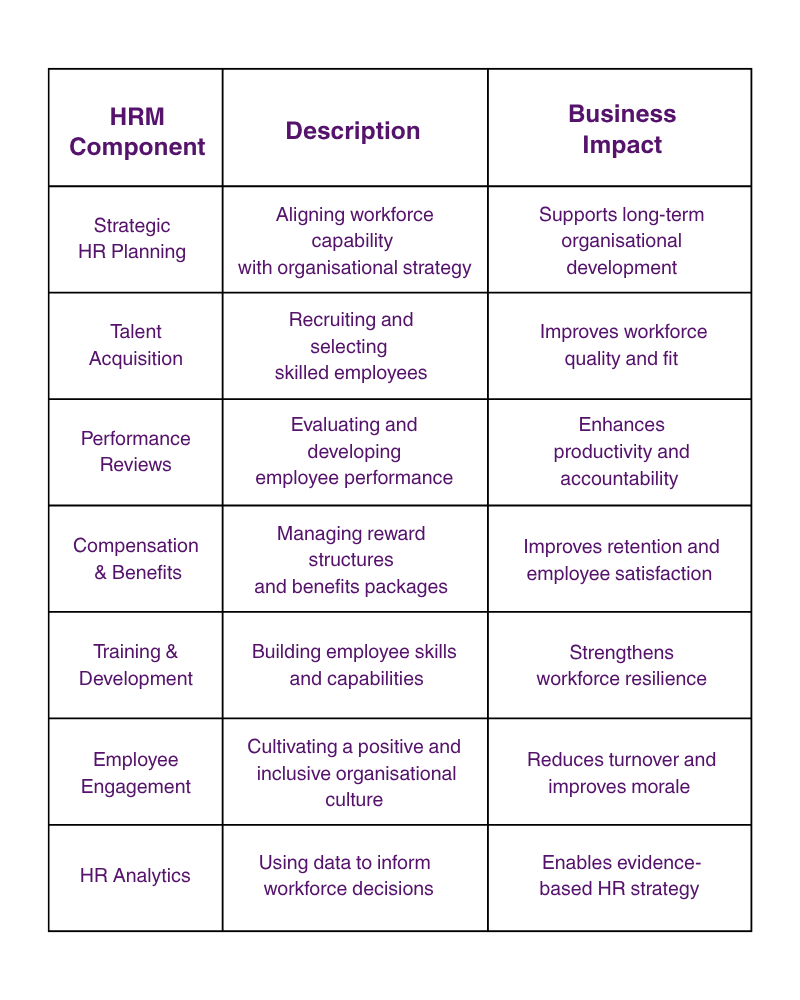
Key Components of HRM: A Summary
Modern HR Practices
The HR function has been reshaped by technology and changing workforce expectations. Four developments, in particular, are defining modern HR practice.
Remote and Hybrid Work
Flexible work models are now a standard expectation for many employees, particularly in knowledge-based industries. HR teams must build policies and management frameworks that support productivity and engagement regardless of physical location.
These models also require HR professionals and HR staff to rethink communication, collaboration, employee support, and the systems needed to sustain a healthy and connected company’s culture.
Online Learning and Upskilling
Digital learning platforms have democratised access to professional development. Organisations that invest in continuous learning cultures and structured employee training programmes are better positioned to adapt to change, address internal skills gaps, and retain employees who value growth.
Modern learning strategies often combine formal learning, peer support, on-the-job training, and wider professional development opportunities, helping employees develop both technical and behavioural capabilities.
Data-Driven HR Decision-Making
The shift from intuition-based to evidence-informed HR decisions is one of the most significant changes in the profession. HR analytics tools enable teams to track engagement trends, predict turnover risk, and assess the effectiveness of recruitment and development programmes.
This stronger use of data analysis allows HR professionals to manage workforce priorities with greater confidence, while also helping leaders connect HR outcomes more directly to performance, retention, and business operations.
Digital HR Systems
Cloud-based HR information systems (HRIS) have transformed workforce management. From automated payroll and compliance tracking to digital performance management and employee self-service portals, these platforms reduce administrative burden and improve data accuracy.
They also streamline day-to-day HR processes, reduce repetitive HR tasks, and enable the HR department to focus more time on strategic priorities such as employee development, talent management, and culture.
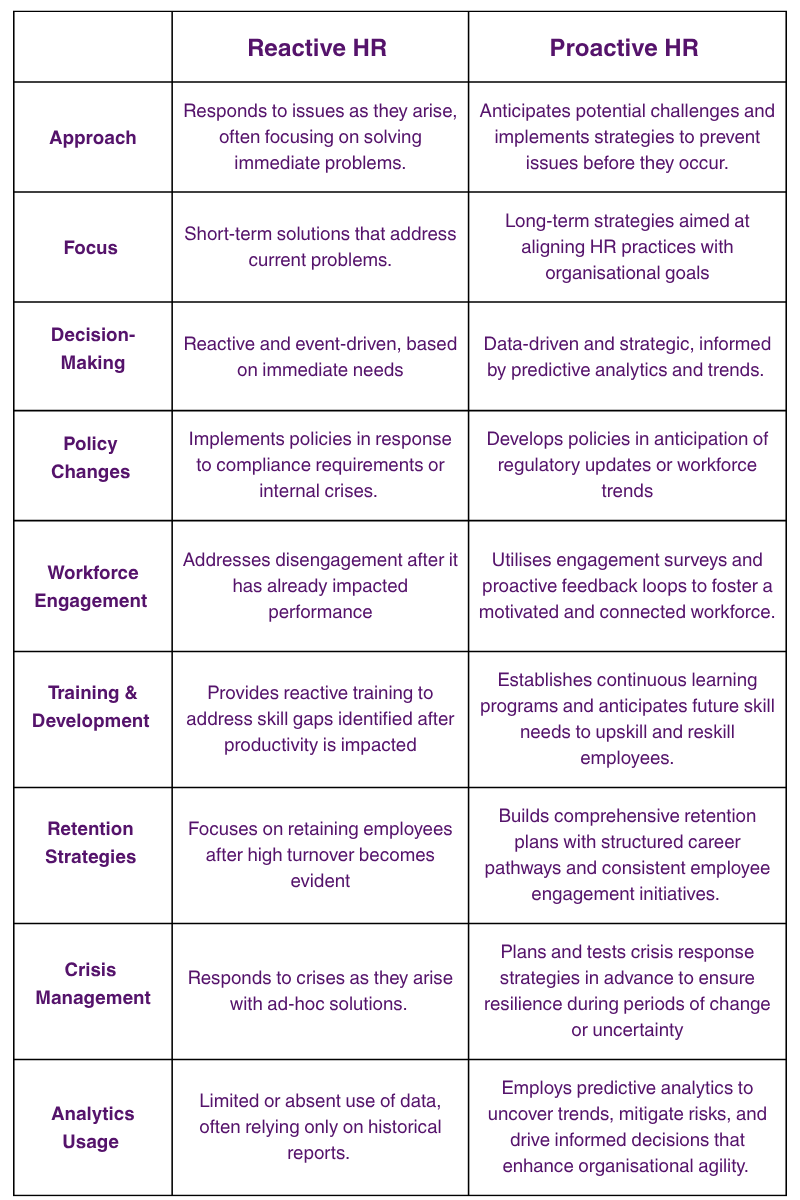
Proactive vs Reactive HR: Why the Difference Matters
To understand the differences between proactive and reactive HR strategies, the table below compares their key characteristics and impact on workforce management and organisational performance.
Shifting from reactive to proactive HR requires investment in analytics capability, leadership buy-in, and a clear framework for translating data insights into action. It also requires HR managers to move beyond short-term fixes and use HR processes that support foresight, resilience, and better outcomes across the organisation.
The Impact of HR Analytics on Business Performance
HR analytics represents one of the most significant advances in modern HRM. By systematically collecting and analysing workforce data, HR leaders can move beyond anecdotal observation to evidence-based strategy.
Practical applications include:
- Predicting employee turnover by identifying patterns in engagement, performance, and absence data
- Identifying high-potential employees for succession planning and accelerated development
- Improving recruitment outcomes by analysing which sourcing channels and selection criteria correlate with long-term performance
- Supporting strategic planning by providing senior leadership with accurate workforce insights
Organisations that embed HR analytics into their decision-making processes consistently demonstrate stronger performance across key workforce metrics. Used effectively, analytics also helps HR professionals manage risk, improve workforce planning, and strengthen organisational effectiveness.
Top Skills to become an HR Professional
The foremost skills that can make you a futurian in this field are-
- Strong Communication
- Ability of Multitasking
- Problem-Solving Personality
- Dual Focus
- Power of Negotiation
- Conflict Management
In practice, successful HR professionals also need strong judgement in employee relations, a sound understanding of employment laws and labour laws, and the ability to balance operational detail with strategic influence. Across the modern human resource management field, these capabilities help HR professionals manage both people issues and organisational priorities more effectively.
Future Trends in Human Resource Management
The HR function will continue to evolve as technology advances and workforce expectations shift. Several trends are likely to define the next phase of HRM.
Artificial Intelligence in HR
AI is already automating elements of recruitment—screening CVs, scheduling interviews, and analysing candidate responses. As these tools become more sophisticated, they will also support performance analysis, learning recommendations, and workforce planning at scale.
For HR professionals, the opportunity is not simply automation, but better decision-making. AI can reduce routine HR tasks, improve consistency, and enable the human resources manager and the wider HR team to focus more on strategy, judgment, and employee support.
Big Data and Predictive Analytics
The volume of available workforce data will continue to grow. Organisations that develop the analytical capability to interpret this data will be better positioned to forecast talent needs, identify emerging skills gaps, and design targeted interventions.
This will strengthen human resource strategy, support better talent management, and help HR professionals manage more complex workforce decisions with greater precision.
Virtual Recruitment
Video-based interviews and digital assessment platforms have become standard practice. As virtual hiring tools improve, organisations will increasingly recruit talent across geographies without the constraints of physical proximity.
This shift is also changing how HR managers approach candidate experience, selection quality, and early engagement during recruitment and onboarding.
Employee Wellbeing
Mental health, psychological safety, and physical well-being are now recognised as core components of an effective HR strategy. Organisations that invest in employee wellbeing programmes demonstrate measurable improvements in engagement, productivity, and retention. This includes supporting employee health and safety, and the broader conditions that enable people to perform well, feel supported, and contribute within a strong, positive workplace culture.
Continuous Learning
The pace of change in most industries means that skills become outdated more quickly than before. Lifelong professional development, supported by accessible learning platforms and targeted employee training programmes, is becoming a defining feature of high-performing organisations.
For the modern workforce, continuous learning supports employee development, helps employees adapt, and ensures organisations have the skills they need to remain competitive.
How to Choose the Best Human Resource Management Course
If you are looking for the best Human Resource Management Course, here are some factors to consider.
- The course must provide practical knowledge along with the foremost skillset.
- Choose a course that covers real HR practices such as Recruitment, Payroll, Employee engagement, and Employee relations.
- The course must include modern modules such as HR tools, labour laws, employment laws, and soft skills used in today’s workplaces.
- Pick a course that not only gives you a certificate but also prepares you for job interviews, internships, or promotions in HR roles.
- Choose a course that makes you confident not just as an HR professional, but as a people leader.
The best HRM course is the one that prepares you for real people, real workplaces, and real challenges. It should also equip learners to understand HR processes, compensation and benefits, conflict management, employee training, and the practical responsibilities that HR professionals manage in modern organisations.
Conclusion
Human Resource Management has never been more central to organisational success. As the demands on the workforce grow more complex and the tools available to HR professionals become more powerful, the gap between organisations that manage people strategically and those that manage them reactively will widen considerably.
The practical implications are clear. HR leaders should prioritise building analytical capability within their teams, investing in digital HR platforms that support data-driven decision-making, and positioning the HR function as a genuine strategic partner to senior leadership. Line managers, in turn, play a critical role in translating HR strategy into day-to-day practice through consistent feedback, structured development conversations, and a commitment to psychological safety within their teams.
The organisations that will lead in the coming decade are those that treat their people as their most strategically important asset. That starts with getting HRM right.
Looking to develop your HR expertise and lead with greater impact? LBTC offers a range of programmes designed for HR professionals, line managers, and organisational development practitioners. Explore our HR and people management courses to find the right development pathway for you.
Frequently Asked Questions
1. What is HRM?
Human Resource Management (HRM) is the strategic management of an organisation’s workforce. It encompasses recruitment, performance management, employee training and development, compensation and benefits, employee relations, and organisational development, all aligned to support business objectives.
2. What is the HRM full form?
HRM stands for Human Resource Management.
3. What is the human resource management process?
The HRM process covers the full employee lifecycle: strategic HR planning, talent acquisition, onboarding, performance management, compensation and benefits, training and development, and employee engagement and retention.
4. Why is HRM important for organisations?
Effective HRM directly influences workforce productivity, employee engagement, employee retention, and organisational performance. It ensures that organisations have the right people, in the right roles, with the right capabilities to meet their strategic goals.
5. What are the future trends in HR management?
Key future trends include the adoption of artificial intelligence in recruitment and performance management, the growth of predictive HR analytics, a continued focus on employee well-being, the expansion of virtual recruitment tools, and the integration of continuous learning into workforce development strategies.